Have you ever been to a concert?
Most of us probably have. Maybe it was inside a packed arena where the lights went down and thousands of people rose to their feet. Maybe it was a summer concert in a city park, where lawn chairs replaced theater seats and the smell of somebody’s popcorn drifted through the crowd.
But have you ever attended a concert where the walls were already standing long before anyone thought about building a stage?
That is Red Rocks.
Just outside Morrison, Colorado, the landscape begins doing something that photographs never quite prepare you for. Massive slabs of red sandstone rise from the foothills at angles that make you wonder how they are still standing. The road curves between them, and somewhere in the middle of all that stone is one of the most remarkable concert venues in America.
We had seen pictures.
Pictures didn’t do it.

Colorado’s Natural Amphitheatre
There are places where you arrive, look around, take a few photographs and move along.
Red Rocks Amphitheatre isn’t one of them.
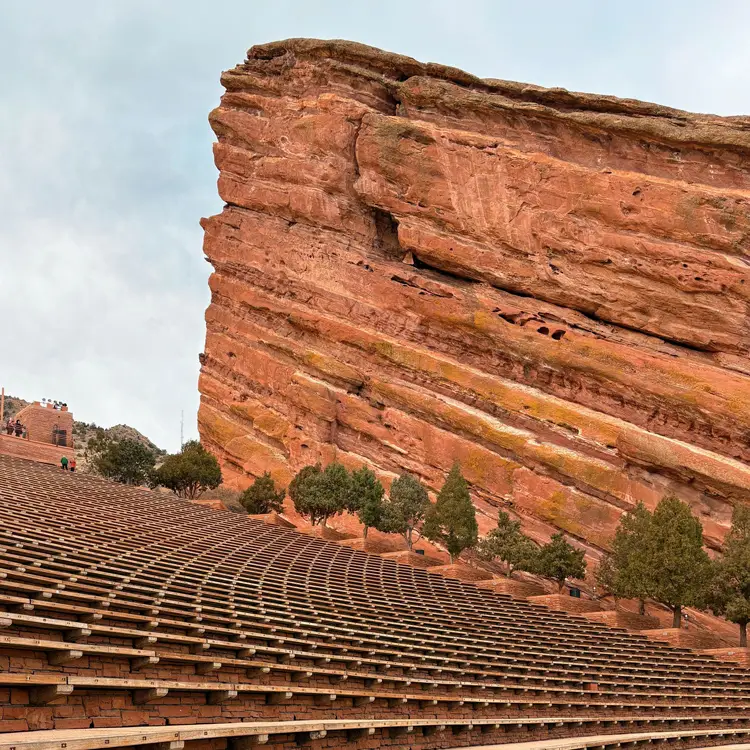
Walking into the amphitheatre for the first time, our attention wasn’t immediately drawn to the stage. It was everything surrounding the stage that stopped us.
Ship Rock rises along one side. Creation Rock towers along the other. Between them, rows of wooden benches descend toward a stage tucked naturally into the landscape.

Then you turn around.
Beyond the seats, Colorado seems to go on forever.
That was the moment we understood why Red Rocks isn’t merely somewhere people go to hear music. The setting is part of the performance.
Long before anyone gathered here for a concert, forces beneath the earth lifted and tilted the sandstone formations along Colorado’s Front Range. Water, wind and weather continued shaping what had been exposed, eventually leaving the enormous formations we see today.
The red and rust colors come partly from iron within the rock. As the iron oxidized, it helped create those unmistakable shades that seem to change as sunlight moves across the stone.
Standing there, however, geology becomes much simpler.
You look up.
And then you keep looking up.
Before Red Rocks Had a Stage
People recognized something special about this place long before there was an amphitheatre.
The land is part of the traditional territory of the Ute, Cheyenne and Arapaho peoples, and its human history reaches far beyond the concerts and performers we associate with Red Rocks today.
By the early 1900s, entrepreneur John Brisben Walker had begun purchasing property around the formations. He developed the area as the Garden of the Titans, recognizing that the natural setting had possibilities few man-made theaters could duplicate.
In 1906, Pietro Satriano and a 25-piece brass band performed on a temporary platform here.
Imagine that for a moment.
No giant video screens.
No elaborate lighting.
No stacks of speakers.
Just musicians, an audience and those enormous walls of stone.
Then came opera singer Mary Garden in 1911.
After performing there, Garden praised the extraordinary acoustics, saying she had never found better acoustic properties in an opera house anywhere in the world.
That was three decades before Red Rocks Amphitheatre officially opened.
Nature had already taken care of the sound system.
When Denver Saw What Was Already There
The City of Denver purchased the Red Rocks property in 1927.
What happened afterward is one of my favorite parts of this story because the people responsible for building the amphitheatre understood something important.
They didn’t need to conquer the landscape.
They needed to work with it.
During the Great Depression, the Civilian Conservation Corps became part of the enormous undertaking of transforming the natural setting into a permanent amphitheatre. Architect Burnham Hoyt designed a venue that fit between the formations rather than competing with them.
That sounds almost obvious today.
It wasn’t an easy project.
Workers removed roughly 50,000 cubic feet of dirt and rock while grading the seating area. They used about 800 tons of quarried stone and 30,000 pounds of reinforced steel. Much of the work was done with picks, shovels, wheelbarrows and plenty of human muscle.
A project expected to take two years took five.
When Red Rocks Amphitheatre officially opened on June 15, 1941, the seats, walkways and stage were new.
The stars of the show were not.
Those were the rocks.
Then Came the Music
Once performers discovered Red Rocks, its reputation grew.
Classical music filled the amphitheatre. So did country, folk, rock, blues and just about everything that followed.
The Beatles performed here in 1964.
Johnny Cash stood on the Red Rocks stage. So did John Denver, whose music seemed particularly at home beneath a Colorado sky. U2’s famous 1983 performance helped introduce an entirely new generation around the world to the sight of musicians performing among the mist, rain and towering red formations.
The list of performers eventually became almost secondary.

Because whoever stands on that stage has to share it with Colorado.
That may be the real secret of Red Rocks.
At most concerts, the venue disappears once the performance begins.
Here, it never does.
There Is Something About the Sound
Red Rocks describes itself as the world’s only naturally occurring, acoustically perfect amphitheatre.
After standing inside it, the claim doesn’t seem particularly difficult to believe.
Ship Rock and Creation Rock help contain and reflect sound through the amphitheatre. Add thousands of people between those enormous formations, and the audience itself becomes part of what happens acoustically.

A performer isn’t simply playing to the crowd.
For a few hours, the crowd, the rocks, the open sky and the music all occupy the same space.
That is probably why musicians talk about performing at Red Rocks differently than they talk about another stop on a tour.
It isn’t just another stop.
Rain or Shine Means Something Different Here
Of course, there is another participant in every Red Rocks concert.
Colorado weather.
Red Rocks sits at approximately 6,450 feet above sea level, and mountain weather doesn’t pay much attention to what was printed on your concert ticket.
A beautiful afternoon can become a cool evening. Wind can arrive unexpectedly. Rain is hardly unusual, and depending on the season, neither is snow.
Most performances continue through ordinary weather conditions.
That means anyone attending a concert should come prepared for more than the music. Layers make sense. So does sunscreen earlier in the day and rain protection when the forecast looks questionable.
And comfortable shoes aren’t optional in our book.
Red Rocks has 9,525 seats, but getting to yours may involve a fair amount of walking, climbing and breathing a little harder than you expected.
There are 193 steps from the stage to the Top Plaza, with about 100 feet of elevation difference between the stage and the highest row.
At 6,450 feet, those steps have a way of reminding visitors that they aren’t in Michigan anymore.
Take your time.
Drink water.
Nobody gives out a prize for reaching Row 70 first.
Visiting Without Seeing a Concert
Here is something we didn’t fully appreciate until learning more about Red Rocks:
You don’t need a concert ticket to experience the place.
On non-event days, Red Rocks Park, the amphitheatre, Visitor Center and Trading Post can be visited without an admission or parking fee. The park and trails generally open one hour before sunrise and close one hour after sunset.
That makes Red Rocks worth considering even when your Colorado travels don’t line up with a performer you want to see.
In some ways, visiting when the amphitheatre is empty gives you an entirely different appreciation for it.
Walk down several rows.
Sit for a while.
Look toward the stage.
Then turn around and look toward the plains.
Without thousands of concertgoers around you, it becomes easier to see just how little of Red Rocks’ grandeur came from human hands.
There is also a Visitor Center at the top of the amphitheatre with exhibits about the venue, its history and performers. Trails run through Red Rocks Park as well, including shorter options for visitors who want to see more of the surrounding landscape.
There is one catch worth knowing before making the drive.
On event days, the amphitheatre usually closes to daytime visitors sometime around early afternoon so crews can prepare for the evening performance. Exact closure times can change, so checking the official Red Rocks schedule before leaving for Morrison can save an unnecessary disappointment.
Getting There Is Easy. Getting to Your Seat May Be the Adventure.
Red Rocks is located at 18300 West Alameda Parkway in Morrison, Colorado, roughly 15 miles southwest of downtown Denver.
Driving there is not particularly complicated.
Concert nights are another matter.
Nearly 10,000 people may be heading toward the same place at approximately the same time, so arriving early is one of those pieces of travel advice that really matters.
Event parking lots generally open two hours before doors. Depending on where attendants direct you, the walk to the amphitheatre can include hills, dirt paths and a respectable distance.
For visitors with mobility concerns, this is something to investigate before arriving rather than after parking. Accessible seating is available in Rows 1 and 70, with designated accessible parking and event shuttle service from certain areas.
Red Rocks may be a natural amphitheatre.
Natural doesn’t necessarily mean level.
Red Rocks Park & Amphitheatre website
Around the Campfire
Do we have to attend a concert to see Red Rocks Amphitheatre?
No. In fact, if your main interest is experiencing the amphitheatre itself, a non-event morning may be one of the nicest times to visit. Admission and parking for the park, amphitheatre, Visitor Center and Trading Post are free during regular public hours.
How much time should we allow?
If you simply want to walk into the amphitheatre, take photographs and visit the overlooks, you can experience quite a bit in a couple of hours. Give yourself longer if you plan to explore the Visitor Center, Trading Post or trails. This isn’t a place we would rush.
Is the altitude really noticeable?
It can be. At approximately 6,450 feet, visitors arriving from lower elevations may notice the difference, particularly while climbing stairs. Slow down, stay hydrated and allow your body to dictate the pace.
What should we take to a concert?
Check Red Rocks’ current permitted-items policy before leaving because event rules can change. Beyond that, think Colorado rather than conventional indoor concert: comfortable walking shoes, layers, sun protection and appropriate rain gear. A poncho is considerably more useful after the rain begins than it is sitting back in the camper.
What if someone in our party has difficulty walking?
Plan ahead. Red Rocks has accessible seating, parking and shuttle accommodations for ticketed events, but the amphitheatre’s steep natural setting means knowing where you need to go before arriving can make the experience much easier.
Would we go if there wasn’t anyone performing that we wanted to see?
Absolutely.
A concert would be unforgettable.
Red Rocks without a concert is unforgettable too.
Final Thoughts
Maybe that is what stayed with us most about Red Rocks Amphitheatre.
Someone could have looked at those giant formations and decided to build around them.
Instead, people eventually figured out how to build between them.
There is a difference.
The Civilian Conservation Corps workers moved rock, dirt and stone. Architects designed a stage and seating. Denver created a place where 9,525 people could gather together.
But nobody built Ship Rock.
Nobody built Creation Rock.
Nobody painted those enormous walls red or positioned them so music could travel between them beneath an open Colorado sky.
They were already there.
And perhaps that is why Red Rocks feels different from other famous concert venues. You aren’t walking into a building created for music.
You are walking into a place where people discovered that music belonged.
Whether you someday sit among thousands of people as the first notes of a favorite song roll across those rocks, or you visit on a quiet morning when the stage is empty, take a moment before leaving.
Find a seat.
Look toward the stage.
Then turn around and take in the view behind you.
Some places need music to become memorable.
Red Rocks was already playing its own song.
Happy travels,
The Cooper Shortcut Camping Journey Trio 😊 PlusOne!
YOU MAY ALSO LIKE:


Leave a Reply