Sometimes we travel hundreds of miles looking for a story.
Other times, we are invited to a wedding and discover one waiting for us.
Last weekend, Vicky and I had the opportunity to attend the wedding of our great-niece Taylor and Evan along the Lake Michigan shoreline near Mears, Michigan.
We have attended quite a few weddings over the years. Some have been held in beautiful churches, others in impressive halls and carefully decorated outdoor settings. Each has been special because of the two people standing at the front.
But I have to admit, it is difficult to top a wedding on a Lake Michigan beach.
There was no need to manufacture a backdrop.
Lake Michigan took care of that.
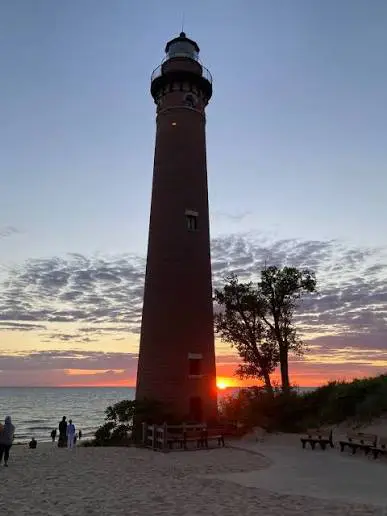
The sand, the water and the open sky were already there, and standing nearby was one of Michigan’s unmistakable sentinels along the Great Lakes — Little Sable Point Lighthouse.
That was where this particular Cooper Shortcut began.

A Wedding Beside a Lighthouse
There is something wonderfully simple about chairs arranged in the sand and a wedding arch facing Lake Michigan.
Of course, anyone who has spent time along the Great Lakes knows that “simple” doesn’t necessarily mean predictable. Lake Michigan can provide sunshine, wind, waves and a noticeable temperature change in remarkably short order.
But perhaps that is part of what makes a beach wedding memorable.
You aren’t simply looking at the scenery. You are standing in it.
As Taylor and Evan exchanged their vows, Little Sable Point Lighthouse stood nearby, just as it has stood along this shoreline since 1874.
And once the wedding was over, I found myself doing what I often do when we travel.
Looking around.
Wondering.
What happened here before we arrived?
Little Sable Point Lighthouse
Little Sable Point Lighthouse is part of Silver Lake State Park, a place Vicky and I certainly aren’t strangers to. We have been to Silver Lake and ridden the dunes more times than I can count.
Yet returning for a family wedding made the familiar surroundings feel different.
From the parking area, a wide paved walkway makes the lighthouse and Lake Michigan shoreline relatively easy to reach. Restrooms are available near the lighthouse, which is worth knowing if you’re making this a stop during a longer day of exploring.
Then the red-brick tower begins to fill your view.

It is more than 100 feet tall, constructed on a foundation designed to cope with the very thing surrounding it — sand. Construction began in 1873 and the lighthouse was completed in 1874 after concerns about navigation and shipwrecks along this portion of the Lake Michigan shoreline finally resulted in a permanent light being established.
The tower still contains its original Third Order Fresnel lens.
That alone makes it worth slowing down for.
I have always enjoyed climbing lighthouse towers, so naturally I look at Little Sable Point and immediately think about the stairs.
When the lighthouse is open for seasonal tours, visitors can pay a small fee and climb the spiral staircase to the top. Once you get there, Lake Michigan provides the reward.
There are easier ways to see Lake Michigan.
But where is the fun in that?
The current Michigan DNR information indicates that tours generally run from mid-May into October through the Sable Points Lighthouse Keepers Association. Because schedules can change, particularly later in the season, I would check before making a special trip solely for the tower climb.
Even if the tower is closed, however, the lighthouse and beach are still worth the stop.
And Little Sable has another feature I especially appreciate.
It looks like a lighthouse.
Not because of white paint or black stripes, but because of the natural red brick.
Interestingly, it wasn’t always allowed to stay that way.
Around 1900 the tower was painted white after mariners complained that the natural brick was difficult to distinguish from offshore. It remained white for decades before the paint was eventually removed and the tower returned to the warm brick appearance we see today.
Its sister lighthouse, Big Sable Point Lighthouse farther north near Ludington, offers an interesting contrast. Similar in height and purpose, Big Sable wears its familiar black-and-white daymark while Little Sable stands in natural brick.
Two Great Lakes lights.
Two very different personalities.
Silver Lake Beyond the Dunes
Most people who hear “Silver Lake” probably think about the dunes first.
We certainly do.
Silver Lake State Park includes nearly three miles of Lake Michigan shoreline and the well-known ORV area where generations of families have come to experience the dunes. But that is exactly why Little Sable Point makes such a nice addition to a Silver Lake trip.
You can spend part of your day surrounded by engines, sand and activity, and a little later find yourself walking toward a lighthouse with Lake Michigan stretching to the horizon.
For RV travelers, there are several camping choices around the Silver Lake area. Sun Retreats Silver Lake, Dunes Harbor Family Camp, and Woodland Shores RV Resort are among the nearby options.
If you are traveling with a larger RV like ours, this is one of those areas where I would rather know where I am going before pulling away from the campground. A 45-foot fifth-wheel has taught us that “we’ll figure it out when we get there” is not always a great sightseeing strategy.
Sometimes the best travel accessory is simply a little planning.
But our discovery on this trip wasn’t finished.
Not even close.
A Monument Most People Drive Past
Just a short distance away, in the Hart area, is a place that doesn’t dominate the skyline.
There is no 100-foot tower.
No Lake Michigan beach.
No spiral staircase to climb.
In fact, you could easily travel through this part of Michigan, visit Silver Lake several times, and never know it was there.
We did.

It is the Cob-moo-sa Monument.
And that small monument opened the door to a much larger story.
Who Was Cobmoosa?
Cobmoosa — whose name is also recorded with several variations in historical accounts — was an important Odawa leader associated with the Native community along the Flat and Grand rivers in what is now western Michigan.
He was known as a respected speaker and leader.
Long before Lowell, Ionia, Hart and the surrounding communities looked as they do today, Odawa people were living, traveling, trading and raising families throughout this part of Michigan.
Then settlers began arriving in increasing numbers.
The resulting story isn’t one that fits neatly into a sentence on a roadside monument.
Nor should it.
Treaties between the United States government and Native peoples during the nineteenth century dramatically altered ownership and control of ancestral lands. Earlier negotiations had included the possibility of removal westward, but the 1855 Treaty of Detroit instead provided land in Michigan for Odawa and Chippewa communities, including lands in Oceana and Mason counties.
Cobmoosa was among the Native leaders connected to those negotiations.
For his people, however, this wasn’t simply a matter of changing an address.
Their homes were along the Grand and Flat rivers.
Their families had lived there for generations.
The treaty meant leaving those ancestral places and relocating northward within Michigan.
Historical accounts describe Cobmoosa as reluctant to leave. Members of the Flat River Odawa moved north before he finally followed them.
That detail stayed with me.
We sometimes read the word relocation and move on to the next paragraph.
It sounds administrative.
Almost harmless.
But imagine being an older man looking across land where your parents lived, where your children grew up, where generations of your people had walked, knowing that nearly everyone you knew was leaving.
Suddenly, “relocation” feels like a woefully inadequate word.
Cobmoosa eventually spent his later years in Oceana County.
And decades after his death, people decided his story should not disappear.
The Cob-moo-sa Monument
The stone monument honoring Cobmoosa was dedicated in 1927.
Its inscription remembers him as an Ottawa Indian Chief and great speaker and includes words attributed to him concerning his father’s support of the American cause during the Revolutionary period.
But a monument can only tell so much.
A few carved lines might give us a name and a date.
They cannot explain what it felt like to watch settlers arrive.
They cannot tell us what was said around family fires.
They cannot describe what it meant to leave ancestral land.
They cannot completely explain the difficult choices Native leaders faced while negotiating with a rapidly expanding United States.
For that, we have to become curious.
We have to stop the vehicle.
Get out.
Read the marker.
And sometimes go home wanting to know more than we did when we arrived.
That may be the real value of places like this.
We Had Been Here Before
This is the part that bothered me a little.
We have been to Silver Lake many times.
We have ridden the dunes more times than I can count.
We know people who have visited Little Sable Point Lighthouse.
Yet we have rarely encountered anyone who mentioned the Cob-moo-sa Monument.
How many times had we been close?
How many times had we driven through this part of Michigan without knowing the story waiting just beyond the route we were following?
That is one of the things traveling continues to teach us.
Seeing someplace isn’t necessarily the same thing as knowing someplace.
You can visit the dunes and have a wonderful day without knowing anything about Cobmoosa.
You can climb Little Sable Point Lighthouse without knowing why people demanded a navigational light along this shoreline.
You can drive through Hart without wondering who walked this land before roads connected these communities.
There is nothing wrong with any of that.
Travel doesn’t require a history lesson at every turn.
But every once in a while, something catches our attention and asks us to look a little deeper.
This time it was a wedding.
A lighthouse.
And a stone monument most people probably pass without ever knowing it is there.
Around the Campfire
Is Little Sable Point Lighthouse worth visiting if I don’t climb the tower?
Absolutely. The Lake Michigan beach and the lighthouse setting make the stop worthwhile on their own. The paved approach also makes getting to the base of the lighthouse considerably easier than reaching some of Michigan’s more remote lights.
Can you climb Little Sable Point Lighthouse?
Yes, seasonally. The tower is generally open for tours from mid-May into October, and there is a fee to climb. Because hours and seasonal schedules can change, check current information before making the drive specifically for a climb.
Do I need a Michigan Recreation Passport?
Little Sable Point is within Silver Lake State Park, so Michigan’s Recreation Passport requirements apply to state park vehicle entry. Out-of-state visitors should check current entry requirements before arriving.
Can we make this part of an RV camping trip?
Very easily. The Silver Lake area has several campground choices, including options capable of accommodating larger RVs. If you’re towing something substantial, I would get settled at the campground first and explore the lighthouse and Hart with your tow vehicle rather than making sightseeing stops while hooked up.
How much time should we allow?
That depends on you. Someone wanting photographs and a walk along the beach might stay an hour. Add a lighthouse climb and you’ll probably linger longer. Add Silver Lake, the dunes, Hart and the Cob-moo-sa Monument, and what looked like a quick stop can comfortably become a day of exploring.
Which, come to think of it, sounds a lot like a Cooper Shortcut.
Final Thoughts
We went to Lake Michigan last weekend for Taylor and Evan.
That deserves to be remembered.
Years from now, I suspect we’ll remember the chairs sitting in the sand, the wedding arch, Lake Michigan behind them and Little Sable Point Lighthouse watching over the shoreline.
But we’ll remember something else too.
A stone monument.
One we could have passed without noticing.
There are famous places that almost demand our attention. Lighthouses do that. Sand dunes do that. Lake Michigan certainly does that.
History isn’t always so demanding.
Sometimes history waits quietly beside the road.
It doesn’t flash a light.
It doesn’t tower above the landscape.
It doesn’t insist that we stop.
It simply waits for someone curious enough to notice.
Maybe that is one of the reasons Vicky and I still enjoy taking the road we haven’t taken, turning where we haven’t turned, and stopping when something makes us wonder, What’s that?
Because after all the miles we’ve traveled, there is still something new to learn almost everywhere we go.
Our history quietly awaits our discovery.
And sometimes all we have to do is stop.
Until our next journey together,
The Cooper Shortcut Camping Journey Trio 😊 PlusOne
YOU MAY ALSO LIKE:



Leave a Reply