Fall is getting close, which means another RV show season is right around the corner.
For us, that has always been something to look forward to.
We enjoy walking the aisles and aisles of new RVs, stepping inside floorplans we have never seen before, talking with factory representatives and catching up with a few dealers we have come to know over the years. Sometimes we see something that makes us stop and look twice. Other times we walk out appreciating something about the RV we already own.
And no, every trip to an RV show does not mean we are looking for another RV.
Sometimes it is simply fun being surrounded by people who understand why anyone would want to spend an afternoon discussing holding tank capacities, suspension systems, refrigerators, storage compartments and whether a particular floorplan has enough room around the bed.
Apparently, we are those people.
But this year we added something new.
Instead of merely walking through finished RVs and wondering how they were put together, we drove to Goshen, Indiana, and went inside the factory where they are actually built.
We took our first RV factory tour.
And somewhere between the bare chassis and the finished fifth wheel, Vicky and I both found ourselves wondering the same thing:
Why haven’t we been doing this all along?
From an RV Show to the Factory Floor
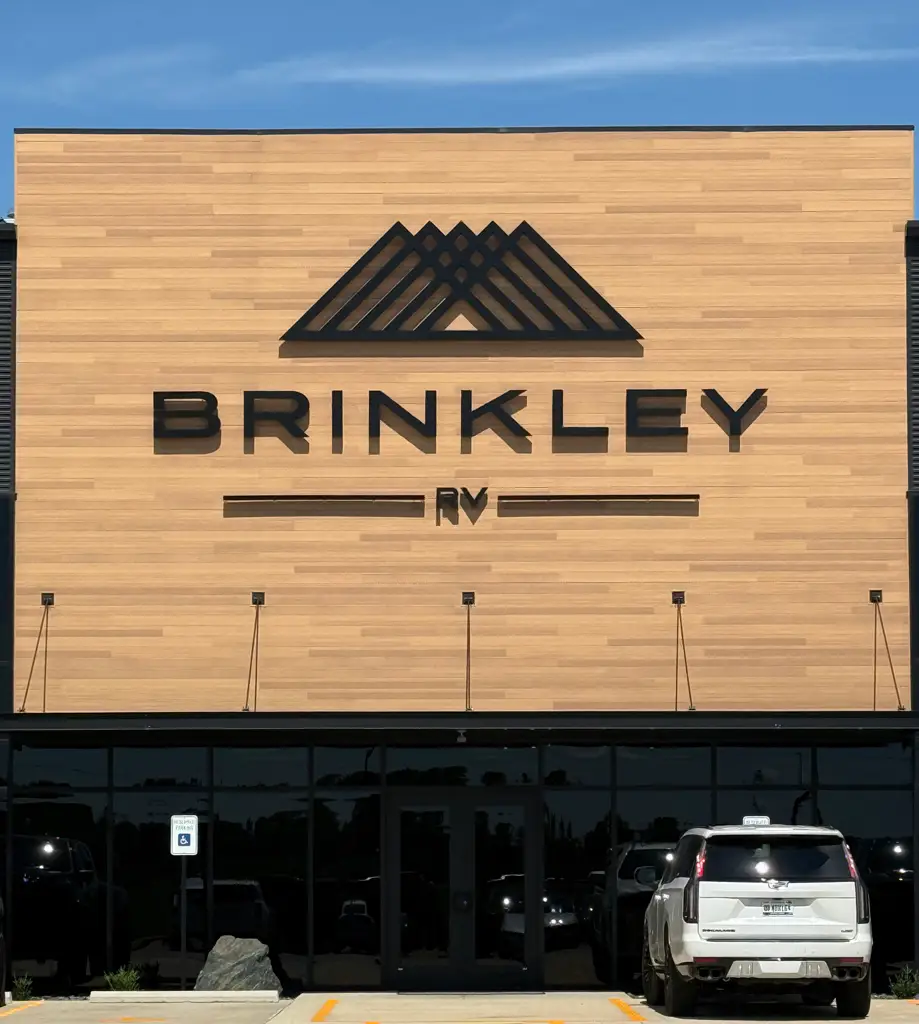
We recently visited Brinkley RV for a factory tour of its Model G luxury fifth-wheel toy hauler.
One of the things that caught our attention before we ever arrived was that Brinkley schedules tours around particular model lines. Their current tour program includes the Model I, Ix, Z AIR, Z and Model G, although actual production schedules determine what is available on a particular day. Tours generally last about two hours and are scheduled Monday through Thursday. (Brinkley RV)
You can check current availability and requirements through the Brinkley RV Factory Tours page.

That ability to choose a model to tour was right up our alley.
We weren’t interested in seeing an RV factory simply because it was an RV factory. We wanted to see the things hidden beneath the finished walls, floors and cabinets of the kind of fifth wheel we might actually consider owning.
There is a considerable difference between opening a cabinet at an RV show and watching what had to happen before that cabinet could ever be installed.
We were about to discover just how considerable that difference really is.
Before We Ever Reached the Assembly Line
We walked through the glass doors and were greeted by a receptionist who offered us water, coffee and other refreshments, pointed out the restrooms and directed us toward the conference room where our group would gather.
It was obvious almost immediately that this wasn’t merely a waiting room.
It was a training room.
The television at the front displayed information about the company, its products, goals and employees. Maybe that shouldn’t have mattered as much as it did, but it caught our attention.
When you are considering something as complicated—and expensive—as an RV, knowing the people building it are being trained matters.
Our particular group turned out to be interesting as well.
There was a full-time RVing family of five who already owned a Brinkley, two brand-new owners, and people like us who had come because we wanted to learn.
That mixture became one of the best parts of the tour.
Our guide, Eric, had eight years of experience in the RV industry and had spent the last three with Brinkley. More important than the number of years, though, was what happened when the questions started.
And believe me, our group had questions.
Eric knew his stuff.
Before heading to the Model G facility, he talked about the company’s owners, their backgrounds and what they were trying to accomplish. He also invited the Brinkley owners in our group to share their experiences.
That was when the conversation became particularly interesting.
The current and new owners had nothing but good things to say, but what repeatedly surfaced was their experience dealing directly with Brinkley’s customer service.
You can read specifications on a website.
You can compare countertops at an RV show.
It is much harder to put a value on what happens after you own the RV and something goes wrong.
For anyone shopping for a new RV, that may be one of the most useful lessons of a factory tour: don’t spend all your time asking how an RV is built. Ask what happens after it leaves the factory.
Then We Saw the Chassis
We drove our vehicle over to the Model G production facility, where the actual walking portion of our tour began.
And this is where the guys may have geeked out a little.
Okay.
Maybe more than a little.
There sat the chassis without the beautiful interior, shiny appliances, television, furniture or anything else competing for our attention.
Suddenly we were looking at welds.
Gussets.
Frame construction.
Hydraulic leveling components.
Lines.
Pumps.
Reservoirs.
Holding tanks.
Routing.
Connections.
All those things most of us hope never to see once we own the RV.
Standing there made me realize something.
When we walk through a completed RV at a show or dealership, most of what determines how that RV will serve us for the next several years has already disappeared from view.
The pretty stuff is easy to inspect.
The important stuff can be considerably harder.
If you have never looked underneath your own RV, you might be surprised by how much is packed into the space below the floor. Seeing those systems installed before the floor covered them gave us a much better understanding of not only how an RV is assembled, but why future service access matters.
Because sooner or later, somebody may have to get back to something that disappeared beneath that floor.
That is practical information you carry home to the RV you already own.
Watching an RV Become an RV
From there, the chassis moves through a long series of production stations.
We were told there are roughly 40 stations involved as a Model G makes its way through production. Rather than try to reconstruct every stop from memory—and probably get something wrong—I will simply say that watching the process unfold changes the way you look at a finished RV.
At one point you are looking at something that hardly resembles a recreational vehicle.
Then comes another system.
Another component.
Another wall.
Another group of employees doing their part.
Slowly, an RV begins to emerge.
We were permitted to take photographs and video during our visit, subject to the company’s restrictions. Brinkley’s published tour information also advises visitors that photography and video restrictions apply and to follow the guide’s instructions. (Brinkley RV)
During our tour, we were specifically asked to keep our production-floor photographs and videos for personal use rather than sharing them on social media.
We intend to respect that request.
So the photograph accompanying this story is as far inside Brinkley as I am going to take you.
If you want to see the rest, take the tour.
I think you will be glad you did.
A Factory Tour Changed the Questions We Ask
That may have been the biggest surprise of the entire day.
I expected to learn how Brinkley builds an RV.
I didn’t expect the tour to change how I would evaluate any RV.
After seeing the construction process, you begin asking different questions.
Instead of only asking whether you like the kitchen, you wonder what is underneath the floor.
Instead of admiring the basement storage, you begin thinking about how wiring and plumbing are routed around it.
You look at service access differently.
You notice suspension, brakes, tires, frame construction and tank placement.
You begin wondering whether someone can reasonably reach a component when it eventually needs repair.
That doesn’t mean the furniture, floorplan and residential comforts aren’t important. We live in these things when we travel. Comfort matters.
But an RV has to get down the highway before the recliner matters.
And after owning several different types of RVs, we know that what you cannot see on the dealer’s lot can eventually become far more important than what initially caught your eye.
RV Factory Tours Aren’t Just for Buyers
Brinkley certainly isn’t the only RV manufacturer opening its doors.
If your travels take you through northern Indiana, you are in the heart of America’s RV manufacturing country, and a Google search identified several manufacturers that currently offer some form of public factory tour.
Grand Design RV offers scheduled tours of its towable and motorized production facilities in Middlebury, Indiana. Tours must be reserved ahead of time, and current rules include closed-toe shoes, safety equipment and transportation from the corporate office to the appropriate factory. (www.granddesignrv.com)
Outside Indiana, Airstream welcomes visitors to its headquarters—better known among Airstream owners as the “Mothership”—in Jackson Center, Ohio. Its current public factory-tour information covers travel-trailer production, and the visit can also be combined with the Airstream Heritage Center. (Airstream)
Other manufacturers with published factory-tour programs include Jayco in Middlebury, Newmar in Nappanee, Thor Motor Coach at several Indiana facilities, Fleetwood in Decatur, NeXus RV in the Elkhart area and Renegade RV in Bristol.
Tour programs change, production schedules change, and some plants have age, footwear, transportation or reservation requirements. I would never plan a trip around one without checking directly with the manufacturer first.
Additionally, there may be other RV manufacturers offering factory tours that didn’t turn up in my search. If there is a particular RV manufacturer you are interested in, check with them directly. You may discover a factory tour we haven’t found yet.
And there is another reason to do that.
A factory tour isn’t merely something to do while you are shopping.
If you already own an RV, seeing one being assembled can help you better understand the systems hiding behind your own walls and underneath your own floor. You may leave with a better idea of where plumbing travels, why access panels exist where they do, what the frame is carrying and why seemingly simple repairs sometimes aren’t simple at all.
That alone can make the experience worthwhile.
What About Forest River and Keystone?
This was one of my first questions.
We have owned a Keystone travel trailer and currently own a Forest River fifth wheel, so naturally I went looking for public factory-tour information for both.
I couldn’t find a current, broadly advertised public factory-tour program on either manufacturer’s official website comparable to the programs above.
But I would not read anything ominous into that.
There can be many reasons a manufacturer doesn’t routinely bring the general public onto an active production floor—insurance, safety, production demands, plant configuration or simply company policy among them. It certainly isn’t evidence, by itself, of how well or poorly an RV is built.
Still, because we have owned products from both companies, I admit I would gladly take either tour if the opportunity became available.
Curiosity is a difficult thing to turn off once you have stood beside a bare RV chassis.
About That Brinkley Model G…
Now we come to the part where this Food For Thought story might get us into trouble.
The Model G isn’t simply being marketed as a traditional toy hauler with nicer furniture. Brinkley describes the rear garage as a multipurpose residential bonus room and patio, which is an interesting distinction for campers who might never haul a motorcycle, side-by-side or golf cart. The current Model G line also emphasizes residential interiors, exterior storage and features developed through real-world RV use. (Brinkley RV)
In other words:
Toys are no longer required.
That got our attention.
The Model G 4120 particularly caught our eye. The current 2027 specifications show a 46-foot, 3-inch fifth wheel with a 17-foot garage/flex space, 18,700-pound unloaded vehicle weight and 23,000-pound GVWR in its standard configuration. (Brinkley RV)
Those numbers also illustrate why falling in love with a floorplan can never be the end of the conversation.
A fifth wheel of that size requires serious consideration of tow-vehicle ratings, payload, hitch weight, combined weight, tire and axle capacities and the way the RV will actually be loaded for travel.
The factory tour doesn’t make those calculations disappear.
If anything, it reminds you why they matter.
Brinkley has also introduced its Sunset Bluff interior option for the Model G and Gx lines as part of its current production updates. (Brinkley RV)
So…
Is a Brinkley Model G 4120 somewhere in our future?
You’ll have to wait and see. 😜
Around the Campfire
Is an RV factory tour worthwhile if I’m not shopping for a new RV?
Absolutely. That may have been our biggest takeaway. Seeing how an RV is assembled helps you understand the RV you already own. You start thinking differently about maintenance, plumbing, electrical routing, suspension, frame construction and service access.
Should I take a factory tour before buying an RV?
If the manufacturer offers one and you can reasonably work it into your travels, I would. An RV show helps you compare finished products. A factory tour helps you understand what is underneath those finished products. The two experiences complement each other remarkably well.
Can I just show up?
I wouldn’t. Reserve your tour and verify the details directly with the manufacturer. Brinkley’s current requirements, for example, include closed-toe shoes, safety glasses, no pets and possible identification requirements. Tours are also tied to production schedules. (Brinkley RV)
What should I pay attention to during the tour?
Don’t worry about remembering every manufacturing step. Watch how components are installed and, especially, whether they remain accessible afterward. Look at the frame, plumbing, wiring, tanks, suspension and attachment points. Ask why something is done a particular way.
And listen to the other RV owners on your tour.
Some of our best information came from people who were already living with the product.
Would we take another factory tour?
Without hesitation.
In fact, we now wonder why it took us this long to take the first one.
Final Thoughts
RV shows will still be part of our fall.
We will walk through the new 2027 models, open cabinets, sit in recliners, stand in showers, look inside storage compartments and probably have a few conversations that begin with, “Did you see that one over there?”
But something has changed.
Now we know what an RV looks like before it becomes the RV sitting under all those bright show lights.
There is something reassuring about seeing the bones.
Maybe that is the real value of a factory tour. It isn’t about convincing yourself that one manufacturer has discovered the perfect way to build an RV. I am not sure such a thing exists.
It is about becoming a better-informed RVer.
The more we travel, the more we have learned that RV ownership isn’t simply about where an RV can take us. It is also about understanding the machine we are asking to carry our home down thousands of miles of highway.
A factory tour gave us another piece of that understanding.
And yes, it may also have introduced us to a certain Model G 4120.
We’ll leave that part of the story unfinished for now.
After all, RV show season is almost here.
Until our next journey together,
The Cooper Shortcut Camping Journey Trio 😊 PlusOne
YOU MAY ALSO LIKE:



Leave a Reply