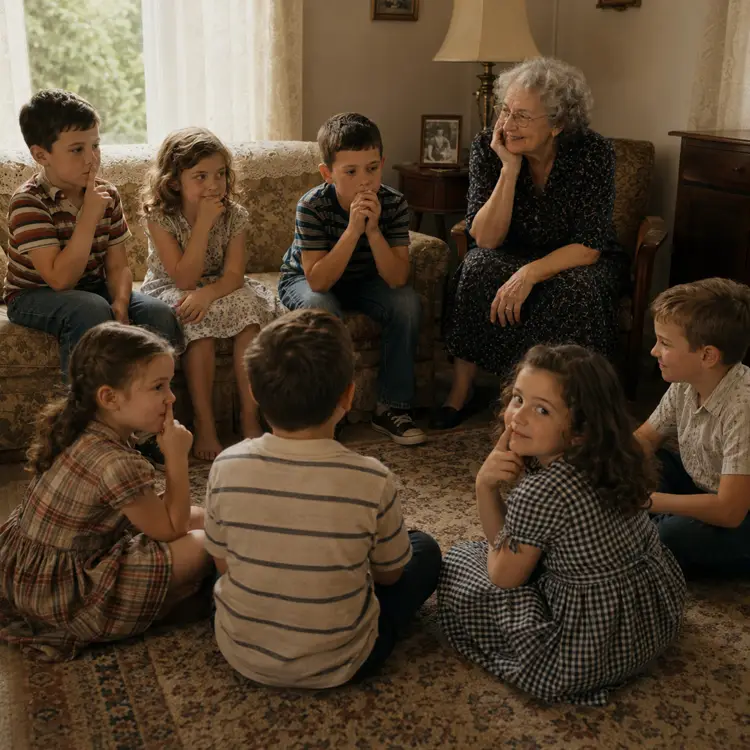
Did you ever play the game to see who could be quiet the longest?
If you grew up in a house with several children, there is a pretty good chance you did. And if you raised children of your own, there is an equally good chance you eventually discovered why parents and grandparents invented it.
We called it the quiet game.
The rules were wonderfully simple.
Everybody stopped talking.
The first person who spoke lost.
As children, we thought it was a game.
Looking back, I am not so sure Grandma Cooper did.
Grandma Knew When It Was Time
Grandma Cooper was a master at knowing exactly when the quiet game needed to be played.
Now, we could ignore the fact that we had probably been extremely rowdy for the previous half hour. We could also overlook the possibility that a couple of my sisters had reached the point where whatever disagreement they were having was no longer going to be settled through reasonable negotiation.
There were eight of us kids, after all.
Quiet was not something that occurred naturally.
Grandma, however, could apparently sense when the noise had crossed an invisible line. She didn’t need a sound meter. She didn’t need a lengthy explanation about everybody settling down.
She simply called for the quiet game.
And suddenly, silence became a competition.
That was the genius of it.
Telling a bunch of children to be quiet might have worked for thirty seconds.
Challenging us to prove we could be quieter than everyone else?
Now Grandma had our attention.
I suspect she also had a few peaceful minutes to herself.
It has taken me a lot of years to appreciate just how valuable those minutes may have been.

When Quiet Became Hard to Find
The world I remember from childhood certainly wasn’t silent.
There were televisions, radios, telephones, lawnmowers, cars going down the street and plenty of children making enough noise to fill whatever gaps remained.
But there were also places where the noise stopped.
You could sit on a porch without a phone in your hand.
You could take a walk without something talking into your ear.
You could drive somewhere without receiving a message, an alert or a notification along the way.
Sometimes you simply sat.
Somewhere along the way, silence became something we almost have to deliberately seek.
Our televisions can talk to us while our phones buzz beside us. Watches tap our wrists. Vehicles display messages. News follows us everywhere. Social media never closes, and there is always another video, another headline or another opinion waiting for our attention.
Even standing in line isn’t quiet anymore.
Watch people sometime.
The moment nothing is happening, out comes the phone.
I have done it too.
Maybe we have become so accustomed to filling every empty moment that silence now feels as though something is missing.
Grandma Cooper might have argued that something has been found.
Maybe Our Minds Need the Quiet
There is something interesting about what happens when the noise finally stops.
Researchers have spent years studying the relationship between quiet, stress and the way our brains work. The details can become complicated, but the practical lesson really isn’t.
Our minds need a chance to rest.
Periods of quiet can help the body move away from a constant state of stimulation. Without something continually demanding our attention, the brain gets an opportunity to wander through memories, consider problems and make connections that may not appear while we are busy concentrating on everything around us.
That may explain why an answer sometimes comes while sitting quietly with a cup of coffee.
Or while driving an empty road.
Or staring into a campfire.
You weren’t necessarily trying to solve anything.
Then, seemingly from nowhere, there it is.
Perhaps it didn’t come from nowhere at all.
Perhaps your mind finally had enough quiet to hear itself think.
Silence Doesn’t Always Need to Be Filled
There is another lesson in silence that Grandma understood better than we did.
Not everything requires an immediate response.
That can be difficult to remember.
Someone says something that bothers us, and we feel obligated to answer. Someone disagrees with us, and suddenly we need to explain why we’re right. A conversation becomes uncomfortable, so we rush to fill the empty space.
Sometimes the wiser response is simply to remain quiet for a moment.
Silence gives us time to think before words become something we wish we could take back.
Considering there were eight children in Grandma Cooper’s world, I imagine she had plenty of opportunities to observe that lesson firsthand.
Especially when my sisters were involved.
I’ll leave that right there.
There Is Quiet in Faith, Too
As I’ve gotten older, I have also come to understand silence differently through faith.
Prayer is often thought of as talking to God.
There is certainly a place for that.
But there is also something powerful about sitting quietly before Him without feeling the need to fill every second with words.
“Be still, and know that I am God.” — Psalm 46:10
Be still.
Two simple words that seem increasingly difficult in a world determined to keep us moving, watching, listening and responding.
Grandma Cooper’s quiet game may have begun because eight children were making too much noise.
But stillness eventually becomes something more than keeping your mouth shut.
It becomes listening.
Thinking.
Remembering.
Praying.
Sometimes it becomes nothing more complicated than allowing yourself to sit quietly for a while.
And maybe that is enough.

I Wonder What Grandma Would Think Today
I can only imagine what Grandma Cooper would have to say about the world we carry around in our pockets.
She would probably be amazed by it.
A little device that can show you someone on the other side of the country, give you directions almost anywhere, answer questions, play music, take photographs and tell you what is happening around the world would have seemed extraordinary.
Then she would probably watch us for a while.
She would see how difficult it has become for us to put those little devices down.
She might notice how often families can sit together while everybody is somewhere else.
And eventually, I have a feeling Grandma would decide she had seen enough.
“All right. Let’s play the quiet game.”
No phones.
No television.
No notifications.
No arguing.
Just quiet.
The funny thing is, as children we probably would have wondered how long we had to keep playing.
Today, I might ask Grandma if we could play a little longer.
Final Thoughts
For most of my childhood, I thought Grandma Cooper’s quiet game was simply one of her tricks for bringing peace back into a noisy house.
Perhaps it was.
Grandma raised children and spent enough time around grandchildren to know that sometimes a little peace and quiet was necessary for everyone’s survival.
But age has a way of showing us lessons that childhood couldn’t see.
Silence isn’t empty.
It gives our minds room to wander, our tempers time to cool, our memories space to return and our prayers a place to settle.
We spend much of our lives surrounded by people and devices competing for our attention. Perhaps we don’t always need to answer.
Every once in a while, we could turn everything off.
Sit somewhere comfortable.
Listen to absolutely nothing.
And play Grandma Cooper’s quiet game again.
Only this time, nobody has to lose.
Another Cooper Shortcut worth remembering.
Happy travels,
The Cooper Shortcut Camping Journey Trio 😊 PlusOne!
YOU MAY ALSO LIKE:




Leave a Reply