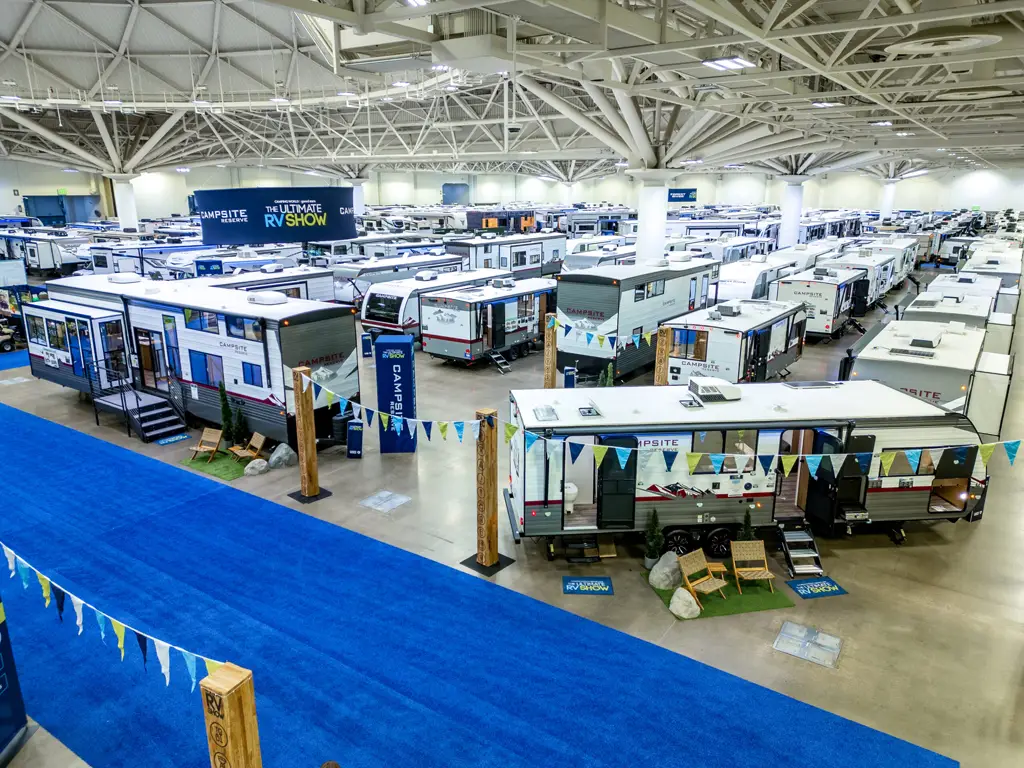
Camper shows are happening, and somewhere out there, a husband and wife are walking through a beautiful fifth-wheel trailer, looking at the fireplace, admiring the kitchen, opening every cabinet, and trying to decide whether they could see themselves traveling in something like it.
One of them is already imagining the places they could visit.
The other is wondering where they would park the thing.
I will leave it to you to decide which one is which.
Vicky and I have been there. We have walked through more campers than I could begin to count, admiring floor plans, discussing what we liked and what we would change, and occasionally finding something that made us question whether our current RV was everything we thought it was.
Camper shows have a way of doing that.
And this year, you might find yourself in a particularly interesting position if you are considering purchasing a new RV.
Is 2026 the Year to Buy an RV?
The RV industry has experienced a noticeable slowdown in 2026, and that may present an opportunity for someone who has been thinking about purchasing a camper.
According to the RV Industry Association, manufacturers shipped 183,592 RVs to dealerships during the first seven months of 2026, compared with 213,338 during the same period in 2025. That represents a decline of approximately 13.9%.
Fifth-wheel shipments experienced an even larger decline, falling approximately 19.5% through July.
Those numbers represent manufacturer shipments to dealerships rather than actual consumer purchases, but they do tell us something about the current market. Manufacturers are sending fewer RVs to dealers, and the industry is adjusting to more cautious consumer spending. (RVIA)
Does that mean every dealership is ready to negotiate an unbelievable deal?
Not necessarily.
However, a dealer with a previous model year sitting on the lot may be more willing to negotiate than one with a newly arrived camper that several people have already expressed interest in purchasing.
It never hurts to ask.
And if you are walking through a camper show this fall, perhaps you should spend a little less time admiring the decorative pillows and a little more time asking questions about the RV itself.
Especially if that RV happens to be a fifth wheel.
Because after owning ours for a couple of years, Vicky and I have learned a few things that might be worth sharing.
Not the things the salesman will tell you.
The things you discover after you bring it home.
A Little Background Before We Get Started
We didn’t begin our camping journey with a forty-five-foot fifth wheel.
Far from it.
Like many camping families, we started with a tent. Eventually, we graduated to a pop-up camper, followed by a hybrid travel trailer, a thirty-six-foot travel trailer, and then a thirty-three-foot Class C motorhome.
Today, we travel with our 2024 Forest River Rogue Armored 373BS13 fifth-wheel toy hauler, pulled by our 2024 Chevrolet Silverado 3500 HD Duramax diesel.
Our fifth wheel measures approximately forty-five feet.
Yes, forty-five feet.
I realize that might seem excessive to someone who enjoys camping in a twenty-foot travel trailer, and I understand completely.
But at seventy years of age, Vicky and I have discovered that our camping needs are different from what they were when we were raising children and spending weekends sleeping in a tent.
We enjoy our space. We enjoy our comforts. And we appreciate having a place for everything, particularly when we are traveling for extended periods.
Would we purchase another fifth wheel?
Absolutely.
But before you head to the dealership and sign the paperwork, there are a few things I would encourage you to consider.

Camper shows are wonderful opportunities to compare RVs, but finding the right floor plan is only part of choosing the right camper.
The Forty-Five-Foot Question: How Big Is Too Big?
One of the first things you will discover about owning a large fifth wheel is that not every campground is interested in accommodating you.
And I don’t blame them.
Many of our National Park Service campgrounds were established long before recreational vehicles grew into what we see traveling our highways today.
Their roads can be narrow, their campsites short, and their beautiful trees occasionally located precisely where you would prefer to place your camper.
A smaller RV certainly provides more camping options.
You may have seen statistics suggesting that a trailer under twenty-five feet can access approximately 93% of national park campgrounds. That figure comes from an RVshare analysis, rather than an official National Park Service nationwide accommodation guarantee. The underlying point is worth remembering: shorter RVs generally have more campsite choices. (RVshare)
There is no universal thirty-foot length limit for all national forest campgrounds, either. Restrictions vary by campground and sometimes by individual campsite.
For example, one campsite at Mount Rainier’s Ohanapecosh Campground permits a trailer up to twenty feet, while another permits a trailer up to twenty-seven feet. (Recreation.gov)
That difference matters.
A campground might advertise that it accommodates forty-foot RVs, but that doesn’t mean every campsite can accommodate one.
We have learned to look beyond the campground’s general description. We pay attention to the actual campsite length, road access, turning areas, trees, and whether there is sufficient room to maneuver our truck.
With our forty-five-foot fifth wheel, we don’t leave those details to chance.
And while we may not be able to camp inside every national park, we can often find a suitable campground nearby and enjoy the park during the day.
That arrangement has worked quite nicely for us.
Remember, You Still Have to Get There
A forty-five-foot camper sitting comfortably in a campsite is one thing.
Getting that camper into the campsite is another.
Our truck and fifth wheel require considerable room when making turns. The trailer tracks inside the truck’s path, which means a corner that looks perfectly reasonable from the driver’s seat may not be quite so reasonable for the camper.
Backing into a campsite requires patience, practice, and occasionally a conversation between husband and wife that is best left between husband and wife.
Vicky and I have developed a routine that works for us.
We don’t rush.
And when something doesn’t look right, we stop and take another look.
There is no prize for being the first camper parked.
That Beautiful Fifth Wheel Is Taller Than You Think
When you walk through a camper show, the ceilings can make a fifth wheel feel wonderfully spacious.
Some models have enormous living areas, residential refrigerators, ceiling fans, and beautiful cabinetry.
It’s easy to imagine sitting inside one on a rainy afternoon.
What you might not be thinking about is the height of that camper when you are traveling down an unfamiliar road.
Low bridges, railroad overpasses, tree branches, and even certain fuel station canopies can become serious concerns.
We use the Garmin RV 795 for our RV travels.
An RV-specific GPS allows us to enter information about our rig so it can help identify routes appropriate for its dimensions. RV LIFE Trip Wizard and the RV LIFE app are other options worth investigating.
However, I would caution anyone against relying exclusively on a GPS.
Know your camper’s actual height, including rooftop equipment. Verify it yourself, and keep that measurement somewhere readily available in the truck.
Pay attention to posted clearances.
And remember that a GPS doesn’t necessarily know about the tree branch that grew a little lower over the campground road since someone last updated the map.
The Truck Is Part of the Purchase
This is something I wish every prospective fifth-wheel buyer would consider before falling in love with a floor plan.
You aren’t simply purchasing a camper.
You are purchasing a camper that must be safely towed by an appropriately equipped truck.
Those are two separate decisions that need to work together.
Our Silverado 3500 HD Duramax has been an excellent match for our camping lifestyle, but I wouldn’t suggest that every fifth wheel requires the same truck.
Nor would I suggest that every fifth wheel advertised as half-ton towable is automatically a good match for every half-ton pickup.
There is considerably more to the equation.
Your truck’s Gross Vehicle Weight Rating (GVWR), Gross Combined Weight Rating (GCWR), payload capacity, rear axle rating, and towing capacity all matter.
And don’t forget the weight of the fifth-wheel hitch, passengers, tools, fuel, and everything else you carry in the truck.
The fifth wheel’s loaded pin weight counts against the truck’s available payload.
Just because a truck can pull a trailer doesn’t necessarily mean it can safely carry and control that trailer.
Before purchasing, I would encourage you to compare the truck’s actual ratings with the camper’s fully loaded weight and expected pin weight.
Better yet, weigh your combination once you have it loaded for travel.
There is a certain peace of mind that comes from knowing what your equipment can safely handle.
And peace of mind is worth considerably more than a few extra cabinets.
Fuel Stops Become Part of the Adventure
When we purchased our Silverado, it came equipped with a thirty-four-gallon fuel tank.
That might sound like plenty until you are towing a forty-five-foot fifth wheel through the mountains.
We have experienced situations where our practical towing range was approximately 250 miles, depending on terrain and conditions.
I can assure you that watching the estimated remaining fuel range drop while traveling through unfamiliar mountain country is not my preferred form of entertainment.
We once found ourselves with approximately twelve miles of estimated range remaining.
That was enough excitement for one day.
Eventually, we decided there had to be a better way.
As we shared in a previous Food For Thought article, we had the original fuel tank replaced with a sixty-gallon TITAN fuel tank, professionally installed by STE Truck in Almont, Michigan.
What a difference that upgrade has made!
We didn’t install the larger tank because we wanted to drive until we were exhausted. We installed it because we wanted the freedom to choose where and when we stopped for fuel.
There is a considerable difference between stopping because you want to and stopping because you have to.
With the additional fuel capacity, we have more flexibility when traveling through mountain country, crossing areas with fewer fuel stations, or simply deciding that the next truck stop looks more appealing than the one we just passed.
Of course, the larger tank doesn’t improve our fuel economy. The weight, height, wind resistance, terrain, and driving speed still determine how much diesel we consume.
And sixty gallons of diesel weighs considerably more than thirty-four gallons, so the additional fuel weight needs to be considered when calculating the truck’s payload.
We continue to use the Open Roads app to identify participating truck stops with diesel lanes that can accommodate our truck and fifth wheel, along with opportunities for fuel savings.
The lesson we learned?
Sometimes the most valuable RV upgrades aren’t the ones that make camping more comfortable. They’re the ones that make getting there more enjoyable.
And for us, that sixty-gallon TITAN fuel tank has certainly earned its place on the list.
What About Setting Up and Breaking Camp?
You will occasionally hear people suggest that fifth wheels require more time to set up than smaller travel trailers.
That can certainly be true.
A larger RV may have more slide-outs, additional utility connections, and considerably more equipment to put away before traveling.
However, our experience has been a little different.
Our fifth wheel has an automatic leveling system, and we have found disconnecting our B&W fifth-wheel hitch easier than dealing with the weight-distribution hitch and equalizer bars we used with our previous travel trailer.
Once we are positioned, the process is fairly straightforward.
That doesn’t mean we simply push a button and walk away.
We still check the site, position the camper, secure the wheels, disconnect properly, and verify that everything is operating as it should.
When it is time to leave, we have our routine.
We check the hitch connection, landing gear, slide-outs, utility connections, lights, tires, and everything else that needs attention before pulling away.
The important thing is developing a process that works for your particular RV.
A smaller camper isn’t automatically easier, and a larger camper isn’t necessarily more complicated.
Sometimes the equipment makes all the difference.

It is easy to understand the appeal of a fifth wheel when you step inside a living area like this. Just remember that every additional amenity becomes something you own, maintain, and eventually may need to repair.
More Comfort Means More Things to Maintain
I don’t believe there is an RV manufactured that will never require maintenance.
If someone tells you otherwise, I would be interested in meeting them.
Our fifth wheel has multiple systems that make traveling more comfortable, but each of those systems requires attention.
Slide-outs need inspection and maintenance. Seals need cleaning and conditioning. The roof requires regular inspection. Brakes, bearings, suspension components, tires, and the hitch deserve particular attention.
And then there are the things you don’t expect.
We have replaced three cracked aluminum wheels with steel wheels and now travel with two spares.
That wasn’t exactly something we anticipated when purchasing our fifth wheel.
But it became part of our experience, and we learned from it.
A larger camper may also have additional appliances, plumbing fixtures, electrical equipment, and other conveniences that eventually require repair or replacement.
I would encourage anyone purchasing a fifth wheel to maintain a separate fund for those unexpected expenses.
And if you are buying a used fifth wheel, consider having an independent RV inspection completed before purchasing.
A beautiful interior can hide a surprising amount of trouble.
Water intrusion, roof damage, frame concerns, neglected running gear, and malfunctioning equipment can turn an attractive purchase price into a very expensive camping experience.
Don’t let the fireplace distract you from looking underneath the camper.
Where Are You Going to Put It?
This might sound like an obvious question, but it deserves serious consideration.
Where will you store your fifth wheel when you aren’t traveling?
Not every homeowner has the space to park a large camper, and some neighborhoods have restrictions on RV parking.
Even if you have the room, you need to consider whether the driveway and surrounding area provide enough space to maneuver safely.
A forty-five-foot fifth wheel isn’t something you casually move from one side of the driveway to the other.
If you need to rent storage space, that becomes another ownership expense.
Covered storage may provide additional protection, but it can also increase the cost considerably.
Then there is the matter of preparing the camper for extended storage, protecting the batteries, inspecting for moisture, and winterizing when necessary.
Living in Michigan, we understand that winter eventually arrives whether we are ready for it or not.
Although, as many of you already know, Vicky and I aren’t particularly interested in putting the camper away just because the calendar says September.
There is still plenty of camping to enjoy.
A Fifth Wheel Can Change How You Travel
One of the things we have noticed is that owning a larger fifth wheel changes how we approach certain travel decisions.
We still enjoy taking Cooper Shortcuts.
We simply have to be a little more selective about which shortcuts we take while towing.
An unfamiliar road that might be interesting on our Harley-Davidson or in our Polaris Xpedition can become an entirely different adventure when pulling our fifth wheel.
We pay more attention to where we will stop, whether we can turn around, and how we will enter and exit a campground.
Sometimes we make reservations farther in advance because we need a campsite large enough to accommodate us.
That doesn’t mean we have lost our spontaneity.
It simply means our spontaneity occasionally requires a little planning.
And we have certainly enjoyed our share of unplanned overnight stops.
We have spent the night in Cracker Barrel parking lots on numerous occasions.
Of course, we check with the location first, make sure overnight RV parking is permitted, and confirm there is sufficient room for our truck and trailer.
Not every location can accommodate a large RV, and local restrictions may prohibit overnight parking.
But when everything works out, it can be a convenient stop during a long travel day.
We have also learned that there is no particular reason to travel until we are exhausted.
The campground will still be there tomorrow.
And if it isn’t, perhaps Grandma Cooper would say we were simply supposed to take a different shortcut.
Around the Campfire
Would you recommend a fifth wheel to someone who has never owned an RV?
I wouldn’t discourage someone from purchasing a fifth wheel as their first camper, but I would encourage them to spend considerable time learning about towing, weight ratings, maintenance, and campsite accessibility.
Visit camper shows. Walk through different floor plans. Talk with owners. Ask questions that don’t involve cabinet colors or television sizes.
If possible, rent an RV before making a major purchase.
The camper you think you want and the camper that actually suits your lifestyle may be two different things.
Is a fifth wheel easier to tow than a conventional travel trailer?
In our experience, yes.
Our fifth wheel provides a noticeably different towing experience than our previous travel trailers.
Because the hitch is located over the truck’s rear axle area rather than behind the bumper, the trailer behaves differently when turning and responding to crosswinds.
Our combination feels more stable and less affected by passing tractor-trailers than our previous bumper-pull arrangements.
That doesn’t eliminate the effects of wind or make a fifth wheel immune to sway, but the difference has been substantial for us.
What about towing through the mountains?
This is where we especially appreciate our Duramax diesel.
The available torque, combined with the truck’s transmission and exhaust braking, makes mountain travel considerably more comfortable than some of our earlier towing experiences.
We still pay attention to grades, road conditions, and appropriate speeds.
A powerful truck doesn’t eliminate the laws of physics.
But having equipment properly matched to the camper certainly makes the journey more enjoyable.
Would you purchase a new or used fifth wheel?
I would consider both.
A new camper may provide a manufacturer’s warranty and the opportunity to select a particular floor plan and equipment package.
A used camper may offer considerable savings, particularly when the previous owner has maintained it properly.
However, I wouldn’t assume a used camper is a bargain simply because the asking price is attractive.
Condition matters.
And I would be particularly interested in the maintenance history, evidence of water intrusion, tire age, and the condition of the roof and running gear.
Is a forty-five-foot fifth wheel too much camper for two people?
For some couples, absolutely.
For us, no.
We enjoy having the space, particularly when traveling for longer periods.
We also have equipment and hobbies that influence our choice of camper.
Someone who enjoys spending every available moment outdoors and uses the RV primarily for sleeping may be perfectly happy with something considerably smaller.
There is no wrong way to camp.

The important thing is finding what works for you.
Final Thoughts: Would We Buy Another Fifth Wheel?
Without hesitation.
If Vicky and I were standing in a camper show today, starting over with everything we have learned during our camping journey, I believe we would find ourselves walking through the fifth wheels again.
We might look at a few travel trailers.
We would probably walk through a motorhome or two.
And I can almost guarantee that we would find ourselves discussing the advantages of a particular floor plan while trying to remember what we came to the show to purchase in the first place.
But our preference would remain a fifth wheel.
At seventy years of age, I appreciate the comfort it provides, the space we enjoy, and the way our truck and camper travel together.
Our forty-five-foot fifth wheel has become our home away from home.
And while I have shared some of the potential disadvantages of owning one, I don’t consider those disadvantages reasons to avoid purchasing a fifth wheel.
I consider them reasons to make an informed decision.
A fifth wheel isn’t necessarily the right camper for everyone.
Neither is a motorhome, travel trailer, pop-up, or tent.
We have enjoyed them all at different stages of our lives.
And each one provided something the others couldn’t.
So, if you find yourself walking through a camper show this fall, admiring that beautiful fifth wheel with the spacious kitchen, comfortable living room, and fireplace, go ahead and imagine the possibilities.
Just remember to look underneath it, measure your truck’s capabilities, consider where you want to camp, and calculate what it will cost to own.
And if you find that perfect camper at a price you simply can’t refuse?
Well, perhaps 2026 will be the year you begin an entirely new camping adventure.
Just make sure your bride agrees.
The Cooper Shortcut Camping Journey Trio 😊 PlusOne!
YOU MAY ALSO LIKE:



Leave a Reply