You may have seen the saying on a T-shirt, bumper sticker, or maybe hanging on a wall somewhere:
“American by birth, Southern by the grace of God.”
I say it just a little differently.
“American by birth, Michigan born by the grace of God.”
Now, before anyone from another state gets their feathers ruffled, no offense is intended. During my years in the military, Vicky and I had the opportunity to live in other states, and we have traveled through many more since then. There are beautiful places all across this country.
But Michigan is home.
Give me our Great Lakes, four distinct seasons, the Upper Peninsula, a back road that seems to wander wherever it pleases, and a shoreline where you can walk without needing any particular destination.
Then add Grandma Cooper.
As far as I am concerned, that is about as good as it gets.
A Walk Along the Shore Was Never Just a Walk
Walking a Michigan lakeshore with Grandma Cooper could be a dangerous thing.
Not physically dangerous, mind you.
Educationally dangerous.
You might think you were simply going for a walk. Maybe you were looking for a pretty stone to put in your pocket. Before you knew what had happened, Grandma had turned the whole outing into a lesson.
She had a knack for that.
Grandma never needed a blackboard, a lesson plan, or a classroom. She could camouflage a lesson so well that sometimes you did not realize you had been taught something until years later.
Michigan’s shorelines certainly gave her plenty of teaching material.
Pick up an ordinary-looking stone, get it wet, and suddenly a pattern appears that you never noticed before. Turn another stone over and there might be a splash of color. Shine the right light on another, and a plain gray rock can practically come alive.
Maybe Grandma understood something I didn’t back then.
There is often more to see than what we notice at first glance.
Michigan Has Some Pretty Special Stones
One of the best-known is the Petoskey stone, Michigan’s official state stone. It is fossilized Hexagonaria percarinata coral, recognized by the wonderful pattern that becomes especially easy to see when the stone is wet or polished. Michigan officially adopted the Petoskey stone as its state stone in 1965. (Michigan)

Anyone who has searched a northern Michigan beach for one probably understands the routine. You pick up a stone.
Nope.
Another one.
Nope.
Then you wet one and—
There it is.
Suddenly those familiar shapes appear.
Then there are Yooperlites®, which offer a completely different surprise. In ordinary daylight, they can look like rather unremarkable rocks. Take a UV light onto a Lake Superior beach after dark, however, and the sodalite within them can fluoresce a brilliant orange. Michigan EGLE notes that a U.P. resident first discovered them there in 2017. (Michigan)

Michigan’s official state gemstone is chlorastrolite, better known as Michigan greenstone or Isle Royale greenstone. Its beautiful green patterns have earned the description “turtleback,” and the finest examples have long been associated with Isle Royale and the Keweenaw Peninsula. (Michigan)

A Michigan puddingstone looks as though someone decided one kind of rock simply wasn’t enough. It is a quartzite conglomerate containing other rounded material, most noticeably those splashes of bright red jasper. Puddingstones are among the glacial erratics Michigan rockhounds commonly seek. (Michigan)

And then there are lightning stones, traditionally called septarian nodules. Their lighter mineral-filled cracks create patterns that can look like little bolts of lightning running through the rock. (Michigan)

Petoskey stones, greenstones, puddingstones, Yooperlites, lightning stones…
Michigan certainly has no shortage of rocks worth bending over to pick up.
But none of those is the stone I remember most because of Grandma Cooper.
So What Does Any of This Have to Do With a Reading Stone?
By now you may have looked back at the title and wondered whether I forgot what story I was writing.
I didn’t.
I just buried the lead.
Long before I knew what a magnifying glass was—or what Grandma might have called a looking glass—she introduced me to something I remember as her Reading Stone.
That name alone fascinated me.
A stone that could read?
Not quite.
But to a child, it was close enough.
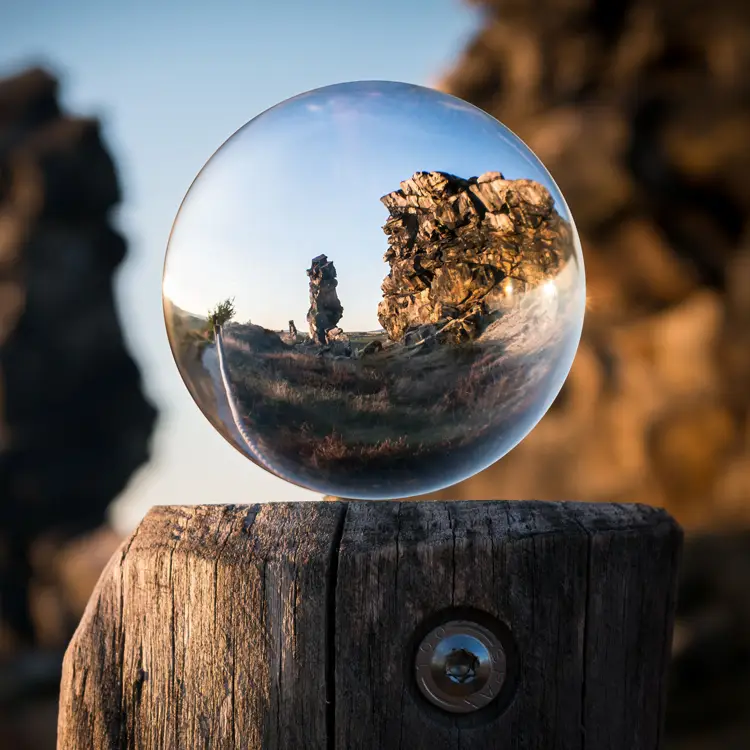
Grandma would place that clear, rounded piece directly onto a page, and something almost magical happened.

The letters underneath became larger.
Move it along the page, and the words underneath seemed to grow as it passed over them.
I can still imagine watching her do it.
No batteries. No electricity. No screen. No buttons.
Just a clear dome resting on a page.
And Grandma Cooper.
Grandma’s Reading Stone Had a Long History
What Grandma showed me wasn’t merely an interesting old household object. Reading stones belong to the early history of magnification.
They were simple lenses, generally flat on the bottom and convex on top, that could be placed directly against a manuscript to enlarge the writing beneath them. Sources trace their use in Europe to the medieval period, particularly the 11th through 13th centuries, when monks used them while working with manuscripts. Early examples were fashioned from materials including glass and rock crystal. (Yale Peabody Museum)
That flat-bottomed design mattered.
Unlike the magnifying glass we usually picture today, there was no need to hold a reading stone several inches above the page while moving it up and down trying to find the proper focus. You simply placed it on the words and moved it along.
Eventually spectacles provided a much more convenient solution, and reading stones largely disappeared from everyday life. (Wikipedia)
But somehow, generations later, one found its way into Grandma Cooper’s hands.
And then into one of her lessons.
The Lesson Was Bigger Than the Words
As a child, I was fascinated by what that stone did.
Today, I am more fascinated by what Grandma did with it.
She taught me to look closer.
Think about those Michigan stones again.
A Petoskey stone can reveal its pattern when it is wet.
A Yooperlite can appear rather ordinary until you shine a different kind of light on it.
A puddingstone rewards the person who notices the colors mixed among everything else.
A lightning stone carries its beauty in the cracks.
A greenstone may need a careful eye before its wonderful pattern is appreciated.
And a reading stone takes something already sitting right in front of you and helps you see it differently.
I don’t know that Grandma ever sat me down and explained the lesson in those words.
She didn’t need to.
That wasn’t her way.
She simply put the Reading Stone on the page.
Grandma Cooper Was Pretty Good at Magnifying Things
The older I get, the more I realize that Grandma’s real gift had nothing to do with glass.
She magnified ordinary life.
A walk became a lesson.
A garden became a lesson.
A kitchen became a lesson.
A Michigan shoreline became a lesson.
And an old Reading Stone became something I would still be thinking about all these years later.

There is something else I have learned with age.
Sometimes we look at people the same way we look at stones scattered along the beach. We make a quick judgment and keep walking.
Nothing special there.
But Grandma taught me differently.
Pick it up.
Turn it over.
Look at it from another direction.
Maybe even shine a little light on it.
You might discover something you could not see before.
Perhaps that is why I remember her Reading Stone so fondly. It magnified words, certainly, but Grandma used it to teach something much bigger.
Some of life’s most beautiful things have been in front of us all along. We just needed to look a little closer.
And Grandma Cooper was pretty good at teaching me how.
Final Thoughts
I still love walking Michigan’s shorelines. There is something about the sound of the water, the stones rolling beneath your feet, and that irresistible temptation to bend down and pick up just one more.
Maybe it will be a Petoskey stone.
Maybe a puddingstone.
Maybe something I cannot identify at all.
These days, though, I think I understand that the treasure isn’t always the stone you put in your pocket.
Sometimes the treasure is remembering who taught you to pick it up in the first place.
American by birth, Michigan born by the grace of God.
And blessed beyond measure to have had Grandma Cooper there to help me look a little closer.
The Cooper Shortcut Camping Journey Trio 😊 PlusOne!
YOU MAY ALSO LIKE:

Leave a Reply