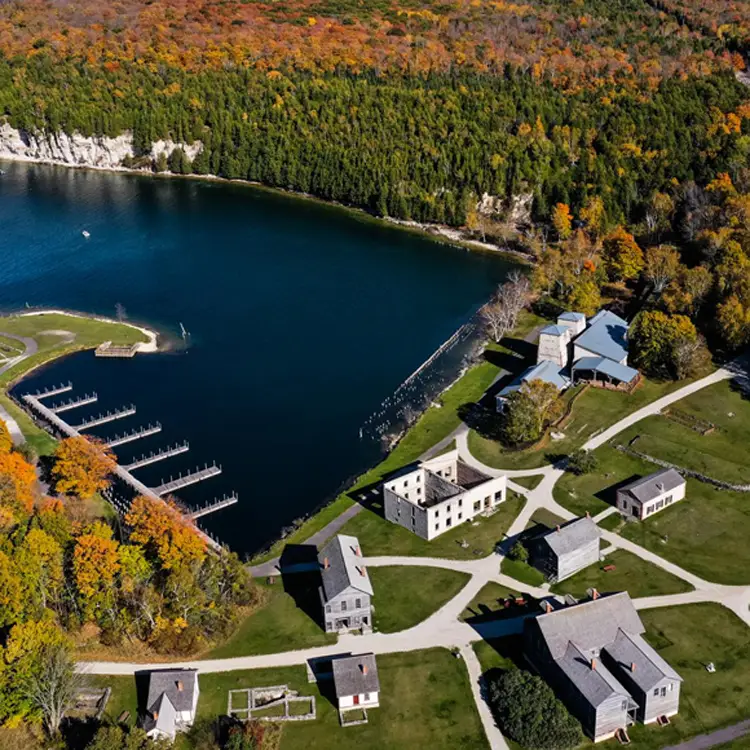
There are ghost towns where you have to use quite a bit of imagination.
You find a foundation hidden beneath the weeds, perhaps an old cemetery tucked among the trees, and a historical marker explaining that hundreds of people once lived where you are standing.

Fayette, Michigan isn’t that kind of ghost town.
The buildings are still here.
The harbor is still here.
The limestone cliffs still rise above the water.
And as you walk through what remains of this old Upper Peninsula iron-smelting town, you don’t have to work very hard to imagine the people who once called Fayette home.
That’s what makes this place different.
And perhaps that’s why Fayette Historic State Park has been on our short list of Upper Peninsula places to visit multiple times.
At the End of the Garden Peninsula
Getting to Fayette is part of the experience.
The historic townsite sits along Big Bay de Noc on the southern side of Michigan’s Garden Peninsula. You aren’t going to stumble across Fayette while hurrying from one major attraction to another.
You have to decide to go there.
I like places like that.
As you travel farther down the peninsula, the surroundings become quieter. By the time you reach Fayette Historic State Park, it feels as though you’ve left more than highway traffic behind.
Then you see Snail Shell Harbor.
That first view begins to explain why a company would build an iron-smelting operation in what seems today like such an isolated place.
The harbor wasn’t merely beautiful. It was useful.
Ships could bring people, supplies and iron ore into Fayette and carry the finished pig iron back out. The limestone cliffs provided material needed in the smelting process, while the hardwood forests surrounding the community supplied wood that could be converted into charcoal for the furnaces.
Everything the Jackson Iron Company needed seemed to be gathered around this little harbor.
In 1867, company manager Fayette Brown helped establish the community that would bear his name.
For the next 24 years, this quiet place was anything but quiet. (Michigan.gov)
Try to Imagine Fayette When the Furnaces Were Burning
This is where visiting Fayette becomes interesting.
Don’t look at the neatly cut grass and peaceful water for a moment.
Instead, imagine smoke.
Imagine heat.
Imagine steam whistles, machinery, horses and wagons. Imagine ships working the harbor and laborers moving between buildings.
At its height, Fayette was home to roughly 500 people. Between 1867 and 1891, its blast furnaces produced 229,288 tons of charcoal pig iron, much of which was eventually converted into railroad rails and steel that helped build a rapidly growing country. (Michigan.gov)
Fayette did not play a direct role in a Civil War battle. There were no armies marching through Snail Shell Harbor.
Its story began immediately afterward.
The war had ended, but America was building.
Railroads were expanding. Cities were growing. Industry needed iron.
Fayette became one small but important part of that much larger story.
That is something I’ve come to appreciate more as we’ve traveled around Michigan’s Upper Peninsula. Mining history isn’t confined to mines. The ore had to be transported, processed and turned into something useful.
Communities grew around every part of that process.
Fayette grew around fire.
There Was More Here Than a Furnace
It would be easy to tell Fayette’s story entirely through iron production.
But that would leave out the best part.

People lived here.
Walking among the surviving buildings makes that impossible to forget.
The blast furnace and machine shop may have been the reason Fayette existed, but a company town still needed homes. It needed a school, post office and company store. Fayette had a hotel, town hall, baseball team, horse racing track and even a cornet band. (Michigan.gov)
Suddenly the ghost town doesn’t seem quite so ghostly.
You begin imagining someone hurrying home after a shift.
A child heading toward school.
A family sitting down for supper.
Guests eating in the hotel dining room while the furnaces continued operating nearby.
The Michigan DNR has preserved about 20 historic structures here, and several contain exhibits that help fill in those missing pieces of everyday life. (Michigan.gov)
That’s also where children and grandchildren can change the way you experience Fayette.
Adults tend to read about furnaces, production figures and industrial history.
Kids want to know about kids.
We couldn’t help smiling at exhibits such as “Kids at Fayette” and “What Happened When Kids Got Sick?”

Those are the things that make history understandable to a child.
What did kids do all day?
Did they have chores?
Where did they go to school?
What happened when they got sick?
And suddenly a child standing in Fayette today has something in common with a child who lived here more than a century ago.
That may teach more history than memorizing a date ever could.
When the Reason for a Town Disappears
Company towns have an uncomfortable weakness.
When the company goes, what happens to the town?

Fayette’s furnaces depended heavily upon charcoal made from the surrounding hardwood forests. But industrial technology was changing, and charcoal iron was losing ground to newer and more economical methods.
In September 1891, the Jackson Iron Company ended smelting operations at Fayette. (Michigan.gov)
The furnaces went cold.
Jobs disappeared.
Families began leaving.
It is tempting to describe Fayette as though everyone simply walked away one afternoon, but history is usually messier than that. A small population remained, surviving through fishing and farming, and the property later spent years as a summer resort and tourist destination. (Michigan.gov)
Then, in 1959, the State of Michigan acquired the property.
That decision is why we can walk through Fayette today rather than simply reading another historical marker describing what used to be here. (Michigan.gov)
Walk Past the Buildings
One of the mistakes you could make at Fayette would be visiting the historic buildings and then heading straight back to the truck.
Keep walking.
History may bring you here, but the setting deserves some of your time too.
Fayette Historic State Park has about five miles of trails, including routes that lead toward overlooks above the harbor. Some of those views are from limestone cliffs rising roughly 90 feet above the water. (Michigan.gov)
From above, Fayette looks very different.
The industrial town that seemed substantial while we were walking through it suddenly becomes a small collection of buildings tucked between forest, limestone and Lake Michigan.
And Snail Shell Harbor takes center stage.
It’s hard not to stand there for a few minutes.
No furnace noise.
No whistles.
No smoke.
Just water, trees and those cliffs.
Fayette allows you to slow down and take a breath. Maybe even two.
There is no reason to rush through it.
Those Old Pilings Have a Story Too
Down along the water are rows of weathered wooden pilings.

They’re easy to photograph simply because they look good against the blue water and limestone cliffs.
But look at them a little longer.
The harbor was Fayette’s connection to the outside world.
Iron ore and supplies arrived by water, and Fayette’s finished iron left the same way. What looks today like a peaceful harbor was once part of a working industrial transportation system.
That contrast may be one of my favorite things about Fayette.
Nature has reclaimed the noise without completely erasing the evidence.
The pilings remain.
The furnaces remain.
The buildings remain.
But the smoke is gone.
You Don’t Have to Leave When the Townsite Closes
Fayette is also one of those destinations where camping can become part of the visit instead of merely providing someplace to park the RV.
The modern campground has 61 campsites, divided among three loops and shaded largely by maple and cedar trees. Sites have 20/30-amp electrical service, while the pull-through sites also offer 50-amp service. Paths from the campground lead toward Big Bay de Noc, and both the historic townsite and swimming area are within walking distance. (Michigan.gov)
For RV travelers, that changes the pace considerably.
You don’t have to arrive, tour Fayette, watch the clock and hurry toward the next campground.
You can stay awhile.
Walk the townsite.
Return to the camper for supper.
Take another walk toward the water.
Then perhaps sit outside as evening settles over a place that once revolved around furnaces burning day and night.
That’s our kind of sightseeing.
Around the Campfire
How much time should we allow for Fayette?
The Michigan History Center recommends allowing about two hours for the visitor center, historic buildings and scenic overlooks. (Michigan.gov) I would consider that a starting point rather than a deadline. If you enjoy photography, hiking or simply wandering through historic places, Fayette can easily become a good portion of your day.
Do we have to pay admission to visit the historic townsite?
Admission to the townsite itself is free, but a Michigan Recreation Passport is required for vehicle entry into the state park. (Michigan.gov)
Can we bring the kids or grandkids?
Absolutely. In fact, Fayette is one of those historical places where younger visitors have room to explore instead of being expected to quietly follow adults through display cases. Exhibits dealing with children’s lives help them see that Fayette wasn’t simply a factory. It was somebody’s hometown.
Is there more to do than tour old buildings?
Quite a bit. The park has approximately five miles of trails, scenic overlooks, a designated swimming area, fishing opportunities, boating access and paddling on Big Bay de Noc. (Michigan.gov)
Is Fayette accessible for visitors with limited mobility?
The visitor center is accessible, and some townsite paths are graded packed-crushed-rock surfaces. The park also has an accessible vault toilet and designated parking. Fayette has a track chair that can be used throughout the park, including the historic townsite; advance reservations are available by contacting the park. (Michigan.gov)
When should we visit?
The historic townsite operates seasonally. For the 2026 season, it is open from May 16 through October 11, with longer daily hours during the main summer season. Because hours can change from year to year, I would check the official schedule before making a special trip. (Michigan.gov)
Fayette Historic Townsite visitor information
Fayette Historic State Park information and camping
Final Thoughts
We’ve visited plenty of places where history is preserved behind glass.
Fayette isn’t like that.
Here, history has a shoreline.
It has walking paths.
It has old buildings with doors you can walk through and windows that once looked out upon a working industrial town.
It has a harbor where ships once carried iron away to help build railroads across a growing nation.
But what stayed with me wasn’t 229,288 tons of pig iron.
It was the thought of those 500 people.
The workers certainly mattered, but so did their wives and children. So did the shopkeepers, hotel guests, teachers and musicians. There were ballgames and school lessons, sick children and family suppers occurring within sight and sound of those furnaces.
For them, Fayette wasn’t historic.
It was home.
Today we call it a ghost town.
Walking through Fayette, however, I couldn’t help thinking that Michigan has done something better than preserve a ghost town.
It preserved enough of a community that, if we’re willing to slow down, look through the windows and use a little imagination, the people don’t seem quite so far away.
And maybe that is the best reason to make the long drive down the Garden Peninsula.
Not simply to see what remains.
But to remember who was here.
Until our next journey together,
The Cooper Shortcut Camping Journey Trio 😊 PlusOne
YOU MAY ALSO LIKE:



Leave a Reply