We did something this August that ordinarily would not even cross our minds.
We went to Florida.
August. Florida.
Those two words do not normally appear together in our travel plans. We enjoy Florida, but there is a reason RVs seem to develop a natural instinct to point north once summer arrives. This time, though, there was never any question about going.
One of our granddaughters was graduating from her Navy “A” School in Pensacola.
For grandkids?
OH YEAH!
We feel incredibly blessed watching another generation of our family choose to serve in the United States military. When I first entered the Marine Corps, retiring from the Corps wasn’t anywhere on my radar. Yet twenty-two years later, that is exactly what I did.
Now one of our sons and his wife have retired from the Marine Corps, while others among our children have served in the Air Force, Marine Corps and Army. The next generation has begun carrying that tradition forward, with grandchildren serving in the Air Force and Navy.
We are proud of every one of them.
And perhaps that made where we found ourselves a few days later feel even more meaningful.

Back to Pensacola After All These Years
Pensacola wasn’t entirely unfamiliar territory for me.
For several years, I drove a church bus filled with teenagers down here to spend a week at Pensacola Christian College. Anyone who has ever driven a busload of teenagers hundreds of miles probably understands why those trips provided enough stories to fill another article.
Good times. Great memories.
But once again, I digress.
This visit belonged to a different chapter of our lives. After the graduation celebrations, Vicky and I had some time to explore, and one place seemed especially fitting.
Fort Pickens.
The drive itself begins changing the mood before you ever reach the fort. Pensacola Beach slowly gives way to a narrower ribbon of road running across Santa Rosa Island. Development starts disappearing behind you. White sand appears beside the pavement, sea oats move in the breeze, and glimpses of blue water keep appearing between the dunes.
Then, after traveling through a landscape that feels almost too peaceful to have ever needed defending, you begin seeing concrete and brick structures rising from the sand.
That is when Fort Pickens begins telling its story.
A Fortress at the End of the Island
Fort Pickens was part of a larger system created to defend Pensacola Bay, its Navy yard and the surrounding coastline. Construction began in 1829, and the fort was completed in 1834. Together with Fort McRee, Fort Barrancas and the Spanish Water Battery, it helped guard the entrance to one of the most strategically important harbors along the Gulf Coast. (National Park Service)
Standing there today, however, dates and military strategy only tell part of the story.
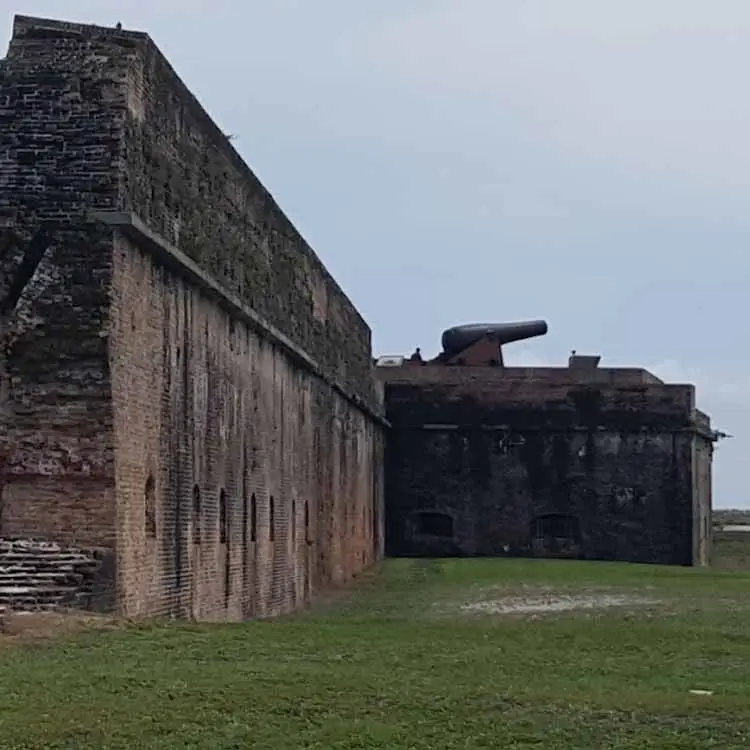
Fort Pickens is massive.
You walk through arched passageways where footsteps echo against old brick. Sunlight pours through openings and disappears again as you move farther inside. Some rooms are surprisingly large; others seem to close around you. You begin imagining soldiers moving ammunition, maintaining weapons and watching the water for ships that might never come.

And then you remember something important.
The people who built much of what you are walking through were enslaved Black men.
The National Park Service records that contractor Henry Underhill and his partner owned approximately 100 enslaved men experienced in fort construction, while additional enslaved laborers were rented from other slaveholders. Their work helped create a fort intended to protect a young nation’s freedom while they themselves were denied it. (National Park Service)
That contradiction deserves more than a passing sentence.
It is part of Fort Pickens.
So is what happened here later.
During the Civil War, freedom-seeking African Americans came to Fort Pickens and Union-held territory seeking emancipation. Decades afterward, following the Apache Wars, Chiricahua Apache prisoners were confined here. Among them was Geronimo.
History rarely fits neatly into the comfortable boxes we sometimes build for it.
Fort Pickens certainly doesn’t.
The Fort Kept Changing Because Warfare Kept Changing
Walk far enough around the property and another part of the story becomes obvious.
The original brick fort wasn’t the end of Pensacola’s coastal defenses.
Warships changed. Artillery changed. Military strategy changed.
So Fort Pickens changed with them.
During the late 1800s, enormous concrete batteries began appearing around Santa Rosa Island. Batteries Cullum-Sevier, Pensacola, Van Swearingen and Worth were constructed between 1895 and 1899. Later came Batteries Payne, Trueman and Cooper as military planners responded to smaller, faster vessels capable of penetrating minefields. (National Park Service)

Seeing those gun positions in photographs is impressive.
Standing beside one is something else.
These weren’t decorative cannons placed along a waterfront promenade. They were part of an evolving coastal defense system designed around the very real possibility of an enemy vessel appearing beyond the horizon.
And there is something about that horizon.

The photograph says something the history books cannot.
A weapon built for war sits beneath an evening sky while the sun slips toward the Gulf.
The gun is silent.
The water is peaceful.
The threat it was built to answer disappeared generations ago.
That contrast may have been one of my favorite parts of our visit.
We Had to Stop at Battery Cooper
Of course we did.
Battery Cooper.
With a blog called The Cooper Shortcut Camping Journey, there was absolutely no chance Vicky and I were walking past something named Battery Cooper without taking a closer look.
Some things simply require investigation.

Battery Cooper was among the later defenses constructed as smaller and faster enemy vessels became a concern. It was part of a new generation of fortifications that looked very different from the brick arches of Fort Pickens. (National Park Service)
Concrete replaced much of the earlier masonry. Guns were protected differently. Defensive positions became increasingly dispersed across the island.
Today, vegetation is reclaiming portions of these structures. Sand blows across areas once occupied by soldiers. The Gulf continues doing what the Gulf has always done.
And Battery Cooper remains.
I suppose we found another Cooper Shortcut.
This one just happened to have artillery.
Don’t Rush Through Fort Pickens
Fort Pickens is one of those places where checking it off a sightseeing list misses the point.
Give it some time.
Walk through the fort. Wander among the batteries. Stop at the beach. Look across Pensacola Bay and consider why military planners believed this particular stretch of sand was important enough to defend for more than a century.

The architecture alone is worth slowing down for.
Those brick arches were engineered to support tremendous weight while protecting soldiers and artillery. Walking underneath them, you occasionally catch a shaft of sunlight coming through an opening and illuminating a wall that otherwise might disappear into shadow.
There is no need to manufacture atmosphere here.
Fort Pickens already has plenty of it.
And when you’ve spent enough time inside, walk back outside.
The transition from dark brick corridors to Florida sunshine is almost startling.

Suddenly the Gulf breeze feels a little better.
Especially in August.
Did I mention it was August?
There Is More Here Than the Fort
One mistake would be driving all the way down Fort Pickens Road, touring the fort and immediately heading back toward Pensacola Beach.
Stay awhile.
Gulf Islands National Seashore offers beaches, swimming, bicycling, fishing, hiking, birdwatching, boating, snorkeling and beachcombing, along with the historic sites scattered throughout the Fort Pickens area. The Florida National Scenic Trail also passes through the area. (National Park Service)
That makes this an easy place to turn a history stop into most of a day.
Bring water, particularly during summer. Bring sunscreen. Wear shoes comfortable enough for walking around the fort, but don’t forget the flip-flops if you’re planning some beach time afterward.
And leave room in the schedule to do absolutely nothing for a while.
Find the sand.
Look at the Gulf.
You have my permission.
Around the Campfire: What Would We Want to Know?
Could we camp near Fort Pickens?
You can do better than near it.
You can camp inside Gulf Islands National Seashore at Fort Pickens Campground, within easy reach of the fort, beaches and trails. Current National Park Service information shows electric sites at $40 and non-electric sites at $26, plus the separate park entrance fee. Some loops have water and electric hookups while others do not, and individual sites have specific RV length, height and slide restrictions. Reservations are strongly recommended. (National Park Service)
For those of us traveling with larger RVs, that last sentence matters. Don’t assume that because a campground accepts RVs, your particular rig will fit. Check the dimensions of the individual site before making the reservation. The National Park Service specifically advises campers to pay attention to campsite height and length restrictions. (National Park Service)
There is also another choice that puts you closer to the restaurants and activity of Pensacola Beach.

Pensacola Beach RV Resort sits on Santa Rosa Sound with waterfront sites and Gulf beach access across the road. That’s a very different camping experience from staying inside the national seashore, but waking up beside the water and hearing waves along the shoreline isn’t exactly a hardship.
What else should we do while we’re in Pensacola?
If military history brought you to Fort Pickens, it would be difficult not to continue the story at the National Naval Aviation Museum aboard NAS Pensacola. The museum is free and currently open daily from 9 a.m. to 4 p.m., except Thanksgiving, Christmas and New Year’s Day. Because it is located on an active military installation, visitors should check the current identification and base-access requirements before leaving the campground or hotel. (NNAM)
Pensacola Beach itself can easily fill another day. Walk the shoreline, spend some time around the pier and Quietwater Beach area, or simply drive less and enjoy the reason people come to this part of Florida in the first place.
That water.
That sand.
That Gulf breeze.
And where should we eat?
After wandering around Fort Pickens in the Florida heat, seafood seems almost mandatory.
On the drive back toward the main Pensacola Beach area, Peg Leg Pete’s is a longtime casual seafood and oyster stop right on Fort Pickens Road. It makes geographical sense after a day at the fort because you’re essentially heading right past it on your return.
If the day deserves something a little more leisurely, The Grand Marlin offers waterfront dining overlooking Santa Rosa Sound and works particularly well when dinner itself is part of the evening rather than simply somewhere to eat.
But there is another important matter.
Key lime pie.
You cannot send us to Florida and expect dessert to go uninvestigated.
Local opinion on the “best” key lime pie is wonderfully argumentative—as opinions about good food should be—but both The Grand Marlin and Flounder’s receive repeated mentions from Pensacola-area diners. Flounder’s version has developed something of a reputation because it is decidedly not a timid little slice of pie. (Reddit)
Personally, I think this requires additional research.
Possibly several slices’ worth.
Purely in the interest of responsible travel journalism, of course.
One Important Thing Before You Go
Fort Pickens is located on a barrier island, and barrier islands occasionally remind us who’s really in charge.
Weather and coastal conditions can affect Fort Pickens Road, including flooding, so checking current National Park Service conditions before heading out is worth the minute it takes. Campers especially should pay attention when significant weather is approaching. (National Park Service)
Current fees, hours, closures and conditions can change, so check the National Park Service Gulf Islands National Seashore website before your visit.
Final Thoughts
We came to Pensacola for our granddaughter.
Fort Pickens was the side trip.
Yet sometimes those side trips have a way of becoming more than you expected.
Perhaps it was because we’d just watched another member of our family take another step forward in her military career. Perhaps it was because military service has been woven through so much of our family’s story. Or perhaps places like Fort Pickens simply make you think a little more carefully about the generations who stood where you’re standing.
Whatever the reason, this visit felt different.

From above, Fort Pickens almost disappears into Santa Rosa Island. You see the Gulf, Pensacola Bay, white sand, green vegetation and the remains of fortifications built by generations who could only imagine the world we live in today.
Some served here.
Some were imprisoned here.
Some sought freedom here.
And some were enslaved and forced to build the very walls that still stand.
That entire story belongs here.
Then you look beyond those walls toward Pensacola, where another generation of young men and women is learning, training and preparing to serve.
One of them happens to be our granddaughter.
We couldn’t be prouder.
And suddenly a hot August trip to Florida doesn’t seem like such a bad idea after all.
Until our next journey together,
The Cooper Shortcut Camping Journey Trio 😊 PlusOne!
YOU MAY ALSO LIKE:


Leave a Reply