Journey Down the Road to Hell… and Into One of America’s Greatest Natural Wonders
Some places leave a lasting impression on you. For me, that first unforgettable underground adventure happened at Meramec Caverns in Stanton, Missouri. I was just a kid traveling with my mom and my baby sister, Chere, on our way to Albuquerque, New Mexico, for Grandma Hamilton’s funeral. Dad had flown ahead, leaving us to make the long drive west.
Somewhere along that trip we stopped at Meramec Caverns, and I was hooked.
Years later, whenever our family spotted a roadside sign that read, “Caverns Ahead,” one of the kids would immediately yell, “Dad! Can we stop?” More often than not, we did. Those spontaneous detours became some of our favorite family memories, and over the years we’ve explored caves and caverns across several states.
So before we get started, I’d love to hear from you.
What’s your favorite cavern or cave you’ve ever visited? Leave it in the comments—I’m always looking for another adventure!
Today we’re heading to one of the grandest underground wonders in America—Carlsbad Caverns National Park in southeastern New Mexico.
It Doesn’t Look Like Much… Until You Step Inside
Driving across the Chihuahuan Desert, you might wonder why millions of visitors travel all this way.
The landscape is rugged, dry, and seemingly endless. Then you arrive at what appears to be nothing more than a large opening in the ground.
That’s when the adventure begins.
Carlsbad Caverns National Park protects more than 119 known caves, but only a small portion is open to the public. Hidden beneath the desert lies one of the largest underground limestone chambers on Earth, filled with towering formations that have taken thousands of years to create.
Walking into the cave feels less like entering a cavern and more like stepping into another world.

The “Road to Hell”
Locals and longtime visitors have jokingly nicknamed the paved entrance trail the “Road to Hell.”
The comparison is understandable.
Instead of climbing a mountain, you’re descending nearly 750 feet below the surface into complete darkness.
The natural entrance trail stretches about 1.25 miles and follows a series of switchbacks that steadily carry visitors deeper underground.
It’s an unforgettable walk.
Every few hundred feet the temperature drops.
Daylight slowly disappears.
Silence replaces the sounds of the desert.
By the time you reach the bottom, you’ve entered a place unlike anything above ground.
Don’t feel obligated to hike both directions, though. Many visitors walk down through the natural entrance and ride the elevator back to the visitor center after exploring the Big Room.

A Cowboy’s Incredible Discovery
Long before tourists arrived, Native peoples—including the Mescalero Apache and Zuni Pueblo—knew about the enormous cave entrance because of its massive bat colonies.
Modern history credits a young cowboy named Jim White with introducing Carlsbad Caverns to the world.
In the late 1800s, while working cattle, White noticed what looked like smoke rising from the desert.
It wasn’t smoke.
It was thousands upon thousands of Brazilian free-tailed bats leaving the cave for their nightly hunt.
Curiosity got the better of him.
Using homemade ladders and lanterns, Jim descended into the darkness and spent years exploring the enormous cave system, naming many of the formations visitors still enjoy today.
Without his determination, Carlsbad Caverns might have remained largely unknown for many more years.

How Were These Caverns Formed?
Unlike most caves carved by flowing groundwater, Carlsbad Caverns formed in a much different way.
Thousands of years ago, hydrogen sulfide gas rose from deep underground and mixed with oxygen-rich groundwater. That combination created sulfuric acid, which slowly dissolved the limestone reef beneath the desert.
The result?
Massive underground chambers unlike almost anywhere else on Earth.
Once the cave emptied of water, mineral-rich droplets began creating the spectacular formations visitors admire today.
Each drop deposited tiny amounts of calcite.
Given enough time…
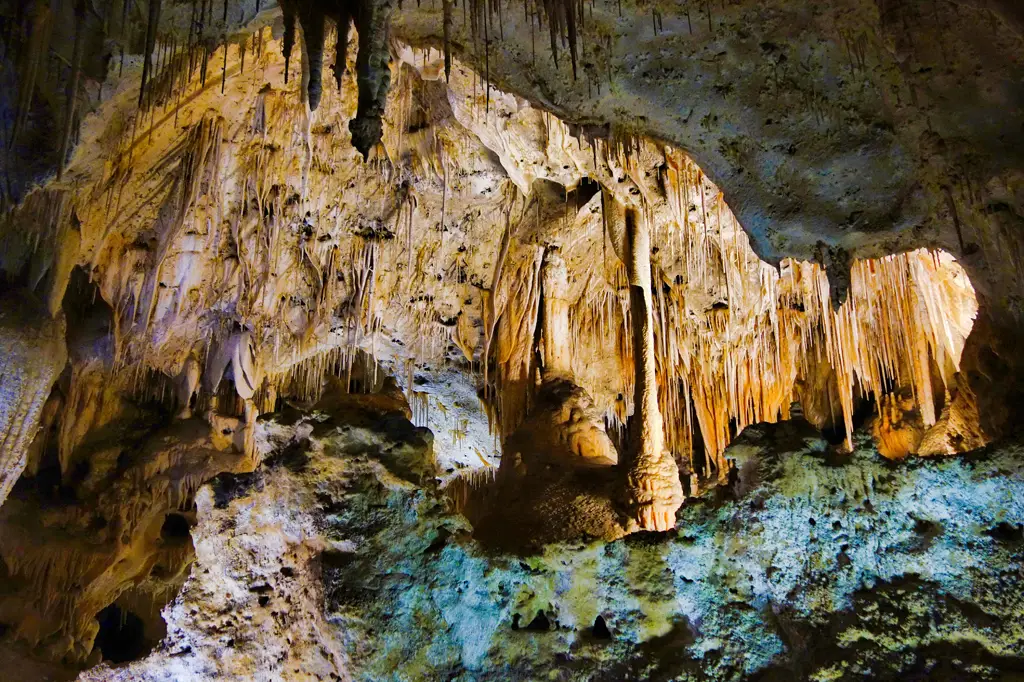
…those tiny deposits became towering stalagmites, delicate soda straws, curtains, flowstones, columns, and draperies.
Some formations are still growing today—just incredibly slowly.

The Big Room Deserves Its Name
The highlight for most visitors is the famous Big Room.
Pictures simply don’t prepare you for its scale.
The Big Room covers nearly 14 acres, making it one of the largest underground chambers in North America open to the public.
A paved, relatively level 1.25-mile walking trail loops through this incredible chamber, passing famous formations including:
- Giant Dome
- Rock of Ages
- Bottomless Pit
- Temple of the Sun
- Totem Pole
- Painted Grotto
The National Park Service has done an outstanding job lighting the formations without making the cave feel artificial.
You still experience long stretches of darkness between the illuminated features, which reminds you just how enormous this underground world really is.
Don’t Miss the Bat Flight Program
If you’re visiting between late spring and early fall, try to schedule your visit around sunset.
Thousands—sometimes hundreds of thousands—of Brazilian free-tailed bats spiral out of the cave entrance every evening to feed across the desert.
Watching this natural spectacle from the outdoor amphitheater is something you’ll remember long after your vacation ends.
One important reminder:
Photography, flashlights, and electronic devices are prohibited during the bat flight program to protect the bats.
Sometimes it’s nice to simply sit back and enjoy the moment.
More Than Just Underground Adventures
While the caverns receive most of the attention, the national park protects over 46,000 acres of Chihuahuan Desert.
If you have extra time, consider exploring:
Chihuahuan Desert Nature Trail
This easy loop introduces visitors to desert plants, wildlife, and panoramic views.
The upper section is wheelchair accessible and works well for families.
Walnut Canyon Desert Drive
This scenic gravel road provides access to overlooks, picnic areas, and trailheads that many visitors completely overlook.
Backcountry Hiking
Experienced hikers can explore rugged desert terrain where solitude is almost guaranteed.
Just remember:
Water is your best friend in southern New Mexico.
Carry far more than you think you’ll need.
Frequently Asked Questions About Carlsbad Caverns National Park
How much time should I plan?
Most visitors spend 3 to 5 hours exploring the visitor center, Natural Entrance Trail, and Big Room.
If you’re taking ranger-led tours or attending the evening bat flight, plan on most of the day.
Is Carlsbad Caverns worth visiting?
Without question.
It’s consistently ranked among America’s most impressive national parks because the experience is unlike anything you’ll find above ground.
Are reservations required?
Yes. Timed-entry reservations are generally required for cavern access in addition to the park entrance fee. Reserve your entry well before your trip, especially during summer and holiday weekends.
Is the cave difficult to walk?
The Natural Entrance Trail is steep and moderately strenuous.
The Big Room Trail is mostly paved and relatively level, making it accessible for many visitors.
If you prefer, you can take the elevator directly to the Big Room.
Are there campgrounds nearby?
There is no campground inside Carlsbad Caverns National Park.
Nearby camping options include:
- White’s City RV Park
- Carlsbad KOA Holiday
- Brantley Lake State Park, which offers RV sites, tent camping, hookups, and beautiful lake views.
Many RV travelers also stay in Carlsbad, New Mexico, about 30 minutes from the visitor center.
When is the best time to visit?
Spring and fall offer the most comfortable temperatures.
Summer is popular because of the evening bat flights, but it also brings larger crowds.
Winter provides quieter cave tours with fewer visitors.
A Few Tips Before You Go
After visiting several cave systems over the years, here are a few things we’ve learned:
- Wear sturdy walking shoes with good traction.
- Bring water for the hike to the Natural Entrance.
- Expect the cave temperature to remain around 56°F year-round.
- Photography is allowed in most areas, but leave the flash off whenever possible.
- Respect the cave formations. Oils from our hands can permanently damage delicate formations that took thousands of years to grow.
- Take your time. Some of the most fascinating details are easy to miss if you’re rushing.

Final Thoughts
Carlsbad Caverns isn’t simply another national park stop—it feels like stepping into another world.
From the moment you begin descending the Natural Entrance, the desert above disappears behind you. Every turn reveals another incredible formation that has been patiently sculpted over thousands of years.
After exploring countless campgrounds, scenic highways, and national parks over our 50-plus years of camping, this remains one of those destinations we still recommend without hesitation.
If your travels ever take you across southeastern New Mexico, don’t just drive past.
Take the journey underground.
You may discover, just as we did years ago, that some of America’s greatest adventures happen beneath your feet.
And before you leave, I’d still love to know…
What is your favorite cavern or cave you’ve ever explored? Share it in the comments—there’s a good chance we’ll add it to our travel list!
Happy travels,
The Cooper Shortcut Camping Journey Trio 😊 PlusOne!
YOU MAY ALSO LIKE:
Your Guide to Enjoying Autumn on the Road
From Michigan to Texas An Epic RV Adventure
Michigan’s Four Seasons of Adventure



Leave a Reply