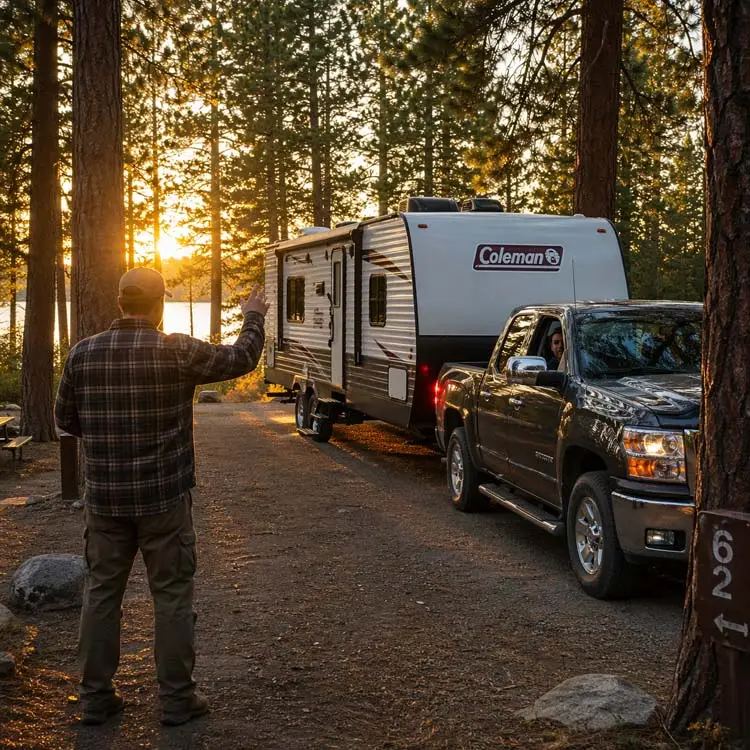
One time, I was just like you—a proud member of the “Travel Trailer Beginners Club.” I remember gripping that steering wheel a little tighter than necessary, heart thumping, hoping I wouldn’t turn my brand-new rig into an expensive lesson. If you’ve ever felt that same knot in your stomach, you’re in the right place.
Backing a travel trailer is one of the most intimidating parts of RV life. It’s where confidence meets reality. And if we’re being honest, it’s also where you’ll see just how many folks skipped the practice step—just take a walk through any campground and you’ll spot the scars on rigs that learned the hard way.
I’ve been around the block since those early days, and this guide is everything I wish someone had handed me before my first campsite backing attempt. My hope? That you skip the frustration, avoid the damage, and gain the confidence that turns stress into satisfaction.
The Moment That Says It All
We were camped at Outdoor Adventure Lake Shore, enjoying a quiet afternoon, when a pickup rolled in towing a large fifth wheel. Right behind it, a full-size SUV followed like a support vehicle… except no support ever came.
The driver—who quickly earned the nickname “Clyde” (as in collide)—pulled into a pull-through site so tight against a tree that branches dragged along the side of his rig. Painful to watch. Even worse? His partner sat in the SUV the entire time, never stepping out to help.
What struck me most wasn’t the mistake—it was the lack of awareness. There was plenty of space. A simple pull-forward adjustment would have lined everything up perfectly, cleared the tree, and made setup easy.
But here’s the truth: I’ve been that guy. Maybe not that exact moment, but close enough to know how it happens.
Backing a trailer isn’t instinct—it’s learned. And once you learn it, everything changes.
Why Backing a Travel Trailer Feels So Hard
Backing up a travel trailer flips your instincts upside down. Turn the wheel left, the trailer goes right. Go too fast, and things spiral quickly. Add in spectators, tight campsites, and expensive equipment—and suddenly, pressure builds.
But here’s the good news: this isn’t about talent. It’s about technique, patience, and repetition.
Professional drivers do this every day—not because it’s easy, but because they follow a system. And once you adopt that system, you’ll feel the difference immediately.
The Right Way to Back a Travel Trailer With Confidence
It starts before you even shift into reverse.
Pull up just short of your campsite and pause. Turn on your flashers. This isn’t just a signal to others—it’s a signal to yourself that it’s time to slow down and focus.
Roll down your windows. You want to hear and see everything around you. Adjust your mirrors so you can clearly see the sides of your trailer and your wheels. That visual awareness becomes your greatest asset.

Then comes one of the most important steps that beginners often skip—get out and look.
Walk the site. Take your time. Look for obstacles: trees, posts, hookups, uneven ground. Picture where your slide-outs will extend. Visualize your final position before you even start backing. This single habit will save you more headaches than anything else.
When you get back behind the wheel, positioning is everything. Ease your rig forward so your rear bumper aligns with the entry of your campsite. Then begin setting your angle.
Place your hands at the bottom of the steering wheel—this changes everything. Now, when you move your hand to the right, the trailer goes right. Move left, it goes left. It simplifies a process that feels backwards at first.
Start backing slowly. And I mean slowly enough that you feel almost impatient. That’s the right speed.
Make small adjustments. Tiny corrections. Big movements lead to big mistakes.
If something doesn’t feel right, stop. Pull forward. Reset. There’s no prize for getting it in one shot—but there’s a price for forcing it.
The Role of a Spotter (And When to Go Solo)
A good spotter can make backing feel effortless. But a bad spotter? That’s worse than none at all.
If someone is helping you, make sure you agree on clear signals before you start. Confusion in communication leads to costly errors.
And if your “spotter” is just watching silently from a vehicle? You’re better off relying on your mirrors and instincts.
You can absolutely back a trailer on your own. Many seasoned RVers prefer it that way. It removes noise and lets you focus fully on the task.
Building Confidence Before You Hit the Campground
Here’s the secret most experienced RVers won’t skip: practice away from the pressure.
Find an empty parking lot. Set up cones or markers. Practice backing into imaginary campsites. Do it again. Then do it again.
This is where muscle memory is built. Where mistakes are safe. Where confidence grows.
And if you have a backup camera? Great—you’re ahead of the game. But don’t rely on it alone. Your mirrors and awareness should always lead.

The Real Difference Between Beginners and Pros
It’s not skill.
It’s patience.
Beginners rush. Pros pause.
Beginners panic. Pros reset.
Beginners try to force the trailer into place. Pros take an extra pull-forward and make it look easy.
That’s the shift. And once you make it, everything feels more controlled.
Final Thoughts
Backing a travel trailer will always demand your attention—but it doesn’t have to demand your stress.
Take your time. Trust the process. Practice when no one is watching. And remember, every experienced RVer you see making it look effortless once stood exactly where you are now.
You’ve got this.
And if it takes a few extra tries to get into your campsite? That’s not failure—that’s learning done right.
Because at the end of the day, it’s far better to take your time than to hear that unmistakable sound of metal meeting tree.
YOU MAY ALSO LIKE:
Driving Tour Beacons of Light Along Lake Superior



Leave a Reply