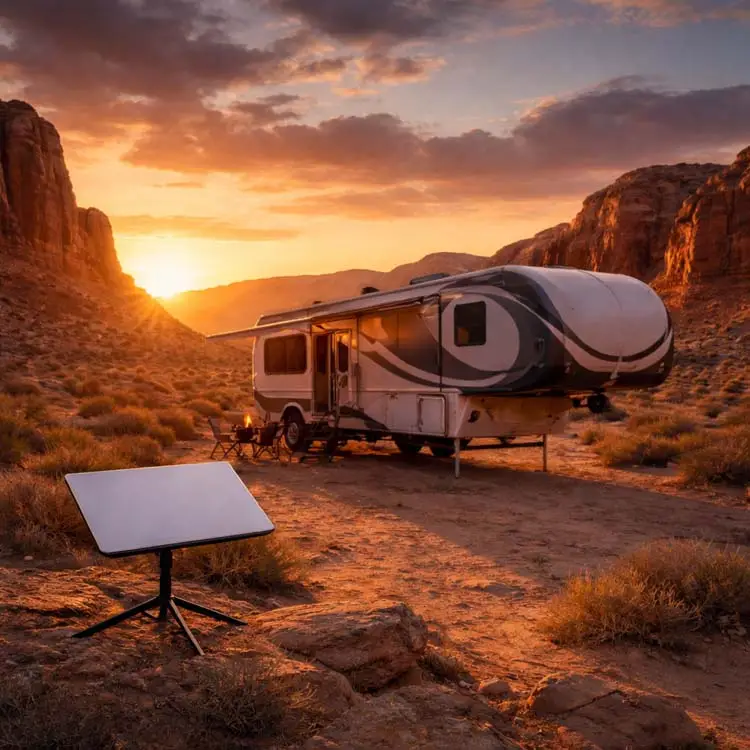
If there is one thing life on the road teaches you quickly, it is this: reliable communication can disappear faster than the next exit sign.
Here in the Midwest, it is easy to take strong cell coverage for granted. Cities, suburbs, and even many small towns tend to keep us comfortably connected. But once you begin stretching your travels into the wide-open Southwest, deep forest campgrounds, desert boondocking sites, or mountain valleys, the story changes in a hurry.
For the past couple of years, we have relied on weBoost for stronger cell phone reception and have had absolutely no complaints. It has served us well, especially while traveling through the Southwest where towns and service towers are often spread far apart. For internet, our Starlink Standard Gen 3 has been just as dependable, with quick and easy setup everywhere our travels have taken us.
Now, with Starlink’s Direct-to-Cell communication service entering the conversation, it felt like the right time to take a closer look.
For RVers, this may be one of the most exciting communication advances in years.
Why Reliable RV Cell Service Still Matters
Anyone who spends serious time on the road knows that reliable RV cell service and reliable RV internet service are two very different things.
You may have enough bars to send a text but not enough bandwidth to upload photos, stream a movie, or write and publish a blog post from the campground.
That is where many of us have learned to layer our solutions.
For voice and text, a signal booster like weBoost helps pull in weaker tower signals.
For internet, Starlink has become one of the most trusted solutions for RVers who travel beyond well-developed campgrounds.
The challenge comes when neither option has anything to work with.
Out in the boonies, no tower means no signal to boost.
That is precisely where Direct-to-Cell begins to change the conversation.

What Is Starlink Direct-to-Cell?
Starlink’s Direct-to-Cell service allows standard smartphones to connect directly to satellites overhead without requiring a satellite phone, separate hardware, or a specialized app.
That is what makes it so revolutionary.
Instead of your phone searching for a cell tower, it connects to specially equipped low-Earth orbit Starlink satellites, which effectively act as orbiting cell towers.
In simple terms, it means your existing phone may soon be able to text, call, and eventually use data in places where traditional cell service disappears.
For RVers, that translates to something powerful:
reliable communication in places that have historically been dead zones.
Why This Could Change RV Travel
One of the most searched concerns among travelers today is:
“How do I get reliable RV cell service in remote areas?”
The honest answer until now has been layered technology.
Signal boosters.
Mobile hotspots.
Wi-Fi calling.
Campground Wi-Fi.
Satellite internet.
Portable antennas.
Each solution works beautifully in the right circumstances.
None of them work everywhere.
Direct-to-Cell has the potential to bridge that gap.
Imagine being fifty miles from the nearest town in Arizona desert country, parked beside a breathtaking red rock canyon, and still being able to text family, share your location, or call for help.
For safety alone, that peace of mind is enormous.
For remote workers, travel bloggers, and families staying connected on the road, it could be transformative.
Where It Stands Right Now
At present, Starlink’s Direct-to-Cell rollout is still in the early phase.
Text messaging is the first major function expected to become widely available, followed by voice and broader data services.
That rollout has been closely tied to T-Mobile US, which is working with Starlink on the satellite-to-phone service.
The long-term goal is wider device compatibility and broader carrier support.
That is especially important for RVers who move across state lines constantly and may rely on different carriers.
This is one to watch closely.
Technology moves quickly, and what starts as simple emergency texting often becomes something much more robust in short order.
Reliable RV Internet Service vs Cell Service
This is where it helps to separate the two.
Reliable RV internet service means streaming, uploading photos, video calls, gaming, blog publishing, and working remotely.
For that, our Starlink Gen 3 continues to be one of the best tools we have used.
It has been fast, dependable, and easy to deploy from Michigan to the Southwest.
Direct-to-Cell is not meant to replace your Starlink dish.
Instead, it complements it.
Think of it this way:
- Starlink Standard / Mini / Gen 3 = internet solution
- Direct-to-Cell = communication safety net
Together, they may become the most complete connectivity setup RVers have ever had.
A Growing Trend Worth Watching
One thing that truly surprised us has been the growing number of travelers installing a Starlink Mini on their UTVs.
That is a fascinating trend, and I suspect we will take a much deeper look at that in a future post as we meet more folks embracing the idea and learn why it works so well for them.
For off-road explorers, trail riders, and backcountry adventurers, that pairing with Direct-to-Cell could become a remarkable communication and internet solution.

Final Thoughts
For years, we have trusted weBoost for reliable RV cell reception and Starlink for dependable RV internet service.
Both have earned their place in our travel routine.
Direct-to-Cell may be the next major leap forward.
For RVers who love scenic detours, remote campgrounds, and off-grid adventures, this could be the technology that finally closes the communication gap.
The road has always been about freedom.
Now it may also come with the confidence of knowing help, family, and connection are never fully out of reach.
That is exciting.
YOU MAY ALSO LIKE:
De-Winterize an RV Travel Trailer




Leave a Reply