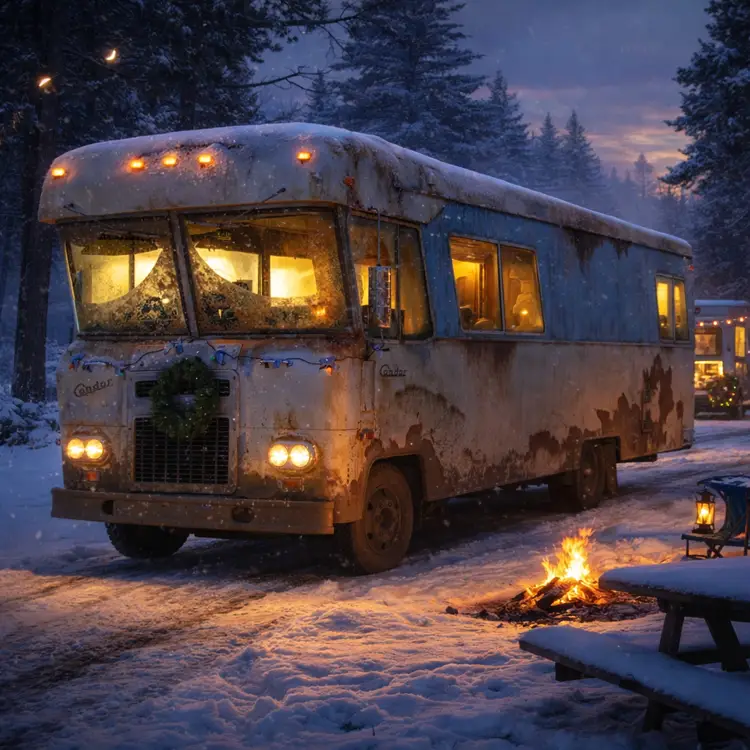
I recently scrolled past a photo on Facebook titled something like “Look Who Has Arrived.” The image showed a rusty old motorhome parked at a campsite, flanked by a paneled station wagon and an equally paneled SUV. It stopped me cold. Before I even finished looking at the details, my brain filled in the rest of the scene—Christmas lights haphazardly strung, sewer hoses doing questionable things, and Cousin Eddie standing proudly nearby.
That moment says a lot about the lasting power of Cousin Eddie and his iconic 1973 Condor II motorhome. Few movie vehicles trigger instant recognition, nostalgia, and laughter the way that rolling metal disaster from National Lampoon’s Christmas Vacation does. It’s more than a prop. It’s a character. And decades later, it still pulls into our cultural campsite unannounced.
The Legend of Cousin Eddie on Wheels
Cousin Eddie, memorably portrayed by Randy Quaid, represents the wild-card relative everyone secretly expects—and slightly fears—during the holidays. He’s loud, unapologetically confident, and completely unaware of social boundaries. The 1973 Condor II motorhome isn’t just his transportation; it’s a perfect mechanical extension of his personality.
Introduced to most audiences in Christmas Vacation (1989), the Condor II arrives without warning, without permission, and without any regard for Clark Griswold’s carefully curated holiday vision. Its arrival instantly shifts the tone of the film, injecting chaos, humor, and uncomfortable relatability.
The brilliance lies in how believable it all feels. The Condor II looks exactly like something Eddie would own—overused, undermaintained, and proudly parked where it absolutely should not be. That realism is why it sticks with viewers long after the credits roll.
Wild Facts That Make the Condor II Legendary
What many fans don’t realize is that the Condor II wasn’t an invented RV brand. Condor motorhomes were real, built in the early 1970s during a booming era of American RV enthusiasm. The boxy design, heavy steel construction, and questionable fuel efficiency were all period-accurate.
In the film, the motorhome famously dumps sewage into the storm drain, a scene that has become one of the most quoted moments in holiday movie history. While exaggerated for comedy, it tapped into a very real fear among campground owners everywhere. That scene alone permanently cemented the Condor II’s place in pop culture.
Another lesser-known fact is that the production team intentionally aged and distressed the motorhome to make it look even rougher than a typical RV of its era. The rust, stains, and mismatched elements weren’t accidental—they were carefully crafted to visually communicate Eddie’s lifestyle before he ever spoke a word.

Why the 1973 Condor II Still Resonates Today
Decades later, RVs are sleeker, smarter, and packed with technology, yet the Condor II continues to trend online every holiday season. Photos of old motorhomes at campgrounds still spark comments referencing Cousin Eddie almost instantly. That kind of brand recognition—especially for a fictionalized vehicle—is rare.
The reason it endures is emotional. The Condor II represents freedom without polish, travel without perfection, and family without filters. In an age of curated Instagram feeds and luxury rigs, there’s something comforting about a reminder that road trips don’t have to be perfect to be memorable.
For RVers, movie fans, and holiday traditionalists alike, the Condor II is a symbol of what happens when expectations collide with reality—and somehow, everyone survives with a story to tell.
Frequently Asked Questions Fans Still Ask
Many people wonder whether the Condor II was drivable. Yes, it was operational during filming, though it wasn’t exactly reliable. Others ask if the RV still exists today. One of the original movie motorhomes has been displayed at events and museums, occasionally resurfacing during anniversary celebrations.
Another common question is why the Condor II looks so massive compared to modern Class C motorhomes. RVs from the 1970s were often heavier and less aerodynamically efficient, built more like rolling houses than streamlined vehicles. Fuel economy was an afterthought in an era when gas was cheaper and expectations were lower.
Perhaps the most asked question of all is whether anyone actually camps like Cousin Eddie today. The answer is yes—minus the sewer scene, hopefully. Every campground has at least one rig that reminds you why Eddie still feels so real.

Final Thoughts
Cousin Eddie’s 1973 Condor II isn’t just a punchline or a nostalgic prop—it’s a rolling reminder that imperfections often make the best memories. It shows up uninvited, disrupts the plan, and somehow becomes the most talked-about part of the story.
That’s why, when an old rusty motorhome appears in a Facebook photo, so many of us smile and think the same thing: He’s here. And honestly, the holidays wouldn’t feel quite right without him.
YOU MAY ALSO LIKE:


Leave a Reply