The storyteller had an entire room full of sixth graders sitting perfectly still.
If you’ve ever chaperoned a school field trip, you already know that’s nearly impossible.
Yet there we sat—students, teachers, parents, and grandparents alike—listening as though every word mattered.
He wasn’t reading from a history book.
He wasn’t delivering a lecture.
He simply began telling a story.
Somewhere between his first sentence and his last, Colonial Michilimackinac disappeared.
The wooden palisades no longer looked like reconstructed walls. The interpreters were no longer actors. The sounds of the fort became real. For a little while, every one of us had traveled back to 1776.
I don’t remember every detail of the story he told.
I remember how it made me feel.
That afternoon, as our family boarded the ferry for Mackinac Island, I realized something.
History isn’t meant to stay inside books.
It’s meant to be walked.
As America celebrates its 250th Anniversary of Independence, my bride, Vicky, and I have intentionally returned to many of the places we visited years ago with our children and now again with our grandchildren. Some destinations remind us how beautiful our country is.
Others remind us how our country came to be.
Colonial Michilimackinac and Fort Mackinac do both.

Every Journey Has a Beginning
Long before there was a Mackinac Bridge…
Long before tourists filled the ferries…
Long before horse-drawn carriages became one of Mackinac Island’s most recognizable sights…
Everything began here.
Standing along the shoreline in Mackinaw City, it’s impossible not to notice the narrow ribbon of water connecting Lake Michigan and Lake Huron. Today we admire its beauty.
More than 250 years ago, whoever controlled these waters controlled nearly everything moving across the upper Great Lakes.
French traders understood it.
Native American nations understood it.
British commanders understood it.
That is why Fort Michilimackinac was built.
Not simply as a military fort.
But as the crossroads of an entire frontier.
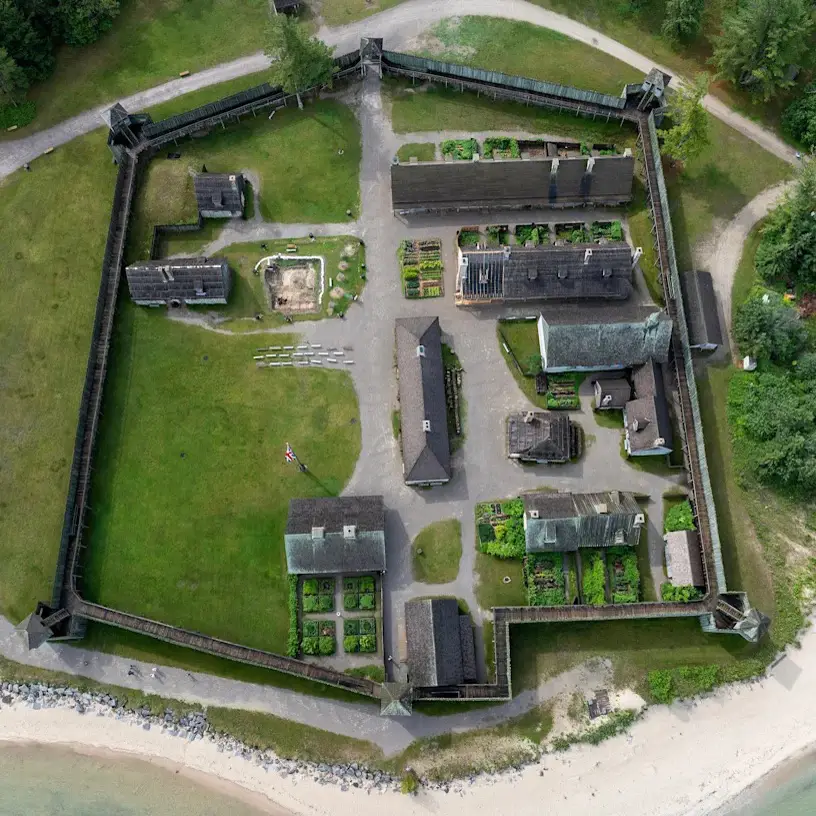
Walking through the entrance today feels remarkably authentic. Smoke drifts from cooking fires. Garden plots overflow with vegetables just as they did centuries ago. Blacksmiths hammer glowing iron. British soldiers march across the parade ground before loading muskets that echo across the Straits.
Suddenly, history no longer feels distant.
It surrounds you.
More Than Watching History… Living It
One reason I continue recommending Colonial Michilimackinac is because it never asks visitors to simply observe.
It invites them to participate.
Children aren’t told to imagine history.
They’re encouraged to ask questions.
Why were the walls built this way?
Why did soldiers wear heavy wool coats during a Michigan summer?
How did families survive the long winters?
What did children do all day?
Those conversations become some of the richest moments of the visit.
I’ve watched parents kneel beside their children while examining artifacts.
I’ve watched grandparents quietly explain what they remember from history class.
I’ve watched youngsters stare in amazement as archaeologists carefully brushed centuries of soil away from a piece of America’s past.
The excavation continues today.
More than sixty years after archaeologists first broke ground, history is still being uncovered one small discovery at a time.
How often do you get to watch history literally come out of the ground?

The Quiet Moments Stay With You
Oddly enough, my favorite memories aren’t the cannon blasts.
They’re the quiet moments in between.
Walking beneath the elevated wooden walkways.
Running my hand across rough-hewn timbers.
Looking through the narrow firing ports toward the blue waters beyond.
Then stopping.
Just for a moment.
Imagine standing watch there on a cold October evening.
No bridge.
No automobiles.
No electric lights.
Only the wind across the Straits and the responsibility of protecting one of Britain’s most valuable frontier outposts.
History becomes much easier to understand when you pause long enough to imagine yourself living it.

Then Comes One of Michigan’s Great Rides
Eventually, the British reached the same conclusion visitors often discover today.
The mainland was vulnerable.
During the Revolutionary War, they moved their military operations to the towering limestone bluff across the water.
That decision forever linked Colonial Michilimackinac and Fort Mackinac into one remarkable story.
Fortunately for us…
Getting there is half the fun.
As the ferry pulls away from the dock, Mackinaw City slowly fades behind you. The Mackinac Bridge stretches across the horizon while the island grows larger with every passing minute.
Children rush from one side of the boat to the other.
Adults suddenly begin taking far more photographs than they expected.
Everyone smiles.
Before you’ve even reached the island, you’ve already begun making memories.

Looking Down Upon History
Fort Mackinac isn’t simply another fort.
It feels entirely different.
Where Colonial Michilimackinac welcomes you with bustling activity at water level, Fort Mackinac greets you from above.
The climb up the hill rewards every step.
Cannons point toward the Straits.
White limestone walls gleam beneath the summer sun.
The oldest building in Michigan still stands proudly within the fort.
Below, horse-drawn carriages quietly move through the streets while sailboats drift across the sparkling blue water.
Standing beside the cannon overlooking the harbor, it’s easy to understand why the British selected this commanding location.
The view alone explains the decision.

History Comes Alive Again
Throughout the day, Fort Mackinac echoes with life.
Cannons roar.
Soldiers demonstrate military drills.
Doctors explain eighteenth-century medicine.
Families learn how officers and enlisted men lived together within the walls.
Unlike many museums where history sits behind glass, Fort Mackinac encourages visitors to experience it with all five senses.
You hear it.
You smell the gunpowder.
You feel the lake breeze.
You see the same incredible view soldiers once watched more than two centuries ago.
Somehow, that changes everything.
Two Forts. One Story.
Many visitors choose one fort or the other.
I would encourage you to visit both.
Colonial Michilimackinac explains why this location mattered.
Fort Mackinac explains how that story continued.
Together they tell one remarkable chapter of America’s Revolutionary War that many people never knew happened here in Michigan.
As we commemorate America’s 250th Anniversary, I can think of few better places to gain a deeper appreciation for the sacrifices, uncertainties, and determination that helped shape our nation.
Sometimes history isn’t found where everyone expects.
Sometimes it’s waiting quietly along the shores of the Straits of Mackinac.

Are There Campgrounds Nearby?
Absolutely, and they make this an easy destination to enjoy over several days rather than trying to rush through it.
One of our longtime favorites is Mackinaw Mill Creek Camping, where many campsites overlook the Straits with breathtaking views of Mackinac Island and the Mackinac Bridge. Watching the sunrise there with a cup of coffee is reason enough to stay another day.
Just across the bridge, Straits State Park in St. Ignace offers spacious campsites beneath the Mackinac Bridge and provides another excellent base for exploring both forts, the island, and the surrounding area.
Several private RV parks in Mackinaw City are also located only minutes from Colonial Michilimackinac and the ferry docks.
If your schedule allows, don’t make this an overnight stop.
Give yourself two or three days.
You’ll appreciate having time to slow down.
History deserves that.
One More Story Waiting Around the Corner
While preparing for this journey, I stumbled across a fascinating piece of Revolutionary War history I somehow had never learned.
Daniel Boone was once held prisoner in Detroit.
Immediately my curiosity took over.
Now I’m wondering…
What happened during those eleven days?
Something tells me another Cooper Shortcut may already be waiting.

Final Thoughts
Travel has a wonderful way of changing with the seasons of life.
As children, we marvel at the cannons.
As parents, we watch our children’s excitement.
As grandparents, we find ourselves watching both.
Somewhere along the way, we begin to realize that the greatest memories aren’t created by the loudest cannon blast or the tallest fort wall.
They’re created during the conversations that happen afterward.
The questions asked on the ferry ride home.
The stories shared around the campground that evening.
The grandchildren who suddenly discover history isn’t nearly as boring as they expected.
Years from now, they may not remember every date.
They may forget the names of the officers or the battles.
But perhaps they’ll remember standing beside a cannon overlooking the Straits…
Or listening to a storyteller who somehow made 1776 feel like yesterday.
And maybe, just maybe, they’ll return one day with children of their own.
If they do, the journey will have come full circle.
That, to me, is one of the greatest gifts travel can ever give us.
Happy travels,
The Cooper Shortcut Camping Journey Trio 😊 PlusOne!
YOU MAY ALSO LIKE:




Leave a Reply