“Some places tell their story through monuments. Others tell it through the people who still call them home. Sault Ste. Marie does both.”
As America celebrates its 250th Anniversary of Independence, Vicky and I have found ourselves drawn toward places where history still feels alive. We aren’t simply checking destinations off a map. We’re searching for communities where the past continues to shape everyday life, where the stories of those who came before us are still visible in stone buildings, quiet churches, busy waterways, and the people proud enough to share them.
Our journey to Sault Ste. Marie, Michigan, began before sunrise on a morning unlike any other.
The evening before, I had been sitting quietly in our backyard watching smoke from the Canadian wildfires slowly drift across the sky. It was almost mesmerizing as the haze grew thicker by the hour. News reports urged everyone to stay indoors, but I’ve always had a tendency to judge conditions for myself. Even so, the timing wasn’t lost on me. In less than twenty-four hours, we’d be driving toward the very country where the smoke had begun.
The next morning, the farther north we traveled, the thicker the haze became. What should have been familiar scenery was softened into silhouettes. Crossing the Mackinac Bridge, the towering suspension cables faded into the smoke until they nearly disappeared. Looking over the side, the Straits of Mackinac had vanished completely beneath the haze. It was one of the most unusual crossings we’d ever experienced.
After grabbing a quick lunch in St. Ignace, something unexpected happened.
The smoke simply… disappeared.
Blue skies stretched overhead, sunshine returned, and just ahead stood an old friend.
A Tradition That Never Gets Old
Every time our travels take us through St. Ignace, there is one stop we almost can’t resist.

Castle Rock.
Rising nearly 200 feet above the surrounding landscape, this natural limestone formation has welcomed travelers for generations. Long before highways carried families north, the Ojibwa people knew it as Pontiac’s Lookout, a place offering remarkable views across the surrounding countryside.
We’ve stopped here more times than I can count.
Some people visit once, climb the steps, take a photograph beside Paul Bunyan and Babe the Blue Ox, browse the wonderfully unique gift shop with its handcrafted birch bark interior, and continue on their way.
We keep coming back.
Perhaps it’s because every visit offers a slightly different view. Sometimes Mackinac Island stands crystal clear on the horizon. Other days Lake Huron sparkles beneath endless blue skies. This time, after driving through miles of wildfire smoke, the clear air made the panorama seem even more spectacular.
Standing at the summit, it felt like we had driven out of one season and into another.
It was the perfect beginning to another Upper Peninsula adventure.
A Warm Welcome to Michigan’s Oldest City
A little over an hour later, we arrived in Sault Ste. Marie, checking into the Holiday Inn Express just south of the International Bridge.
Sometimes the smallest moments become the most memorable.
The gentleman at the front desk greeted us with genuine Upper Peninsula hospitality. Before handing over our room keys, he unfolded a city map across the counter and began circling favorite restaurants, historic landmarks, scenic overlooks, and places he insisted we shouldn’t miss.
He wasn’t reading from a brochure.
He was sharing his hometown.
By the time we reached our room, we already felt less like tourists and more like welcomed guests.
That simple conversation set the tone for everything that followed.
Where Michigan’s Story Began

The next morning, our walking tour began at the Chippewa County Courthouse.
Its beautiful stone walls and impressive clock tower immediately caught our attention, but what truly impressed us wasn’t its architecture.
It was its longevity.
Completed in 1877, the courthouse continues serving the residents of Chippewa County today, making it one of Michigan’s longest continuously operating courthouses. Walking through its halls, even peeking inside the historic courtroom, offered a quiet reminder that history here hasn’t been preserved behind velvet ropes.

It is still being written every single day.
That realization stayed with us as we continued exploring Michigan’s oldest city.
Where Giants Climb Twenty-One Feet

Every visitor eventually finds themselves drawn toward the Soo Locks.
And once you arrive, it’s easy to understand why.
Standing along the observation platforms, you’re witnessing one of North America’s greatest engineering achievements in action.
Lake Superior sits approximately 21 feet higher than the lower Great Lakes. Rather than allowing that elevation change to stop commerce, engineers solved the problem by creating a system of locks that gently raise and lower enormous freighters between the two water levels.
Watching the process unfold is almost hypnotic.
A thousand-foot freighter slowly enters the lock chamber.
Massive gates close behind it.
Water quietly begins rising—or falling.
Within minutes, a vessel weighing tens of thousands of tons has changed elevation without ever leaving the water.
There is no dramatic machinery.
No roaring engines.
Gravity does nearly all the work.
We spent far longer watching than we had planned.
Like everyone else gathered along the railings, we simply couldn’t walk away.
Before arriving, we stopped inside the Soo Locks Visitor Center, where informative exhibits and a short film provided valuable background on the construction of the locks and the remarkable people who made them possible. Understanding their history only made watching the engineering marvel outside even more fascinating.

One helpful tip for anyone planning a visit: before heading to the locks, call the vessel arrival hotline. Knowing when freighters are expected can make the difference between watching multiple ships pass through or arriving during a quiet stretch.
Sometimes timing is everything.
Ships, Stories, and the Spirit of the Great Lakes
Just a short walk away sits one of Sault Ste. Marie’s most unforgettable attractions.

The Museum Ship Valley Camp.
Walking aboard wasn’t like touring a museum.
It felt as though one of the Great Lakes giants had simply tied up to the dock and invited visitors inside.
Below deck, enormous cargo holds have been transformed into more than 20,000 square feet of exhibits, telling the story of Great Lakes shipping through artifacts, photographs, models, and personal accounts.
For many visitors, the most emotional stop is the Edmund Fitzgerald Memorial.
Seeing the two recovered lifeboats from the legendary freighter is a sobering experience. Their quiet presence serves as a powerful reminder that while the Great Lakes are breathtakingly beautiful, they have also demanded tremendous respect from those who made their living upon them.
Elsewhere aboard the ship, we wandered through the captain’s quarters, crew cabins, engine spaces, and exhibits showcasing life aboard these hardworking vessels.
By the time we stepped back onto the dock, we had gained a far deeper appreciation for the men and women whose lives have been shaped by these waters.
A Walk Through Living History
One of the things we appreciated most about Sault Ste. Marie was that history wasn’t concentrated in one building.
It surrounded us.

A short walk led us to the Bishop Frederic Baraga House, once home to the missionary remembered throughout Michigan’s Upper Peninsula as the “Snowshoe Priest.” During harsh winters, he traveled hundreds of miles on snowshoes to minister to Native American communities scattered across the wilderness. Standing outside the modest brick home, it wasn’t difficult to imagine the determination those journeys required.
Nearby, Holy Name of Mary Catholic Church quietly reminds visitors that faith has been part of this community for well over three centuries. Beautiful Gothic architecture and deep historical roots make it far more than simply another church along the roadside.
Every corner of downtown seemed to reveal another story waiting to be discovered.
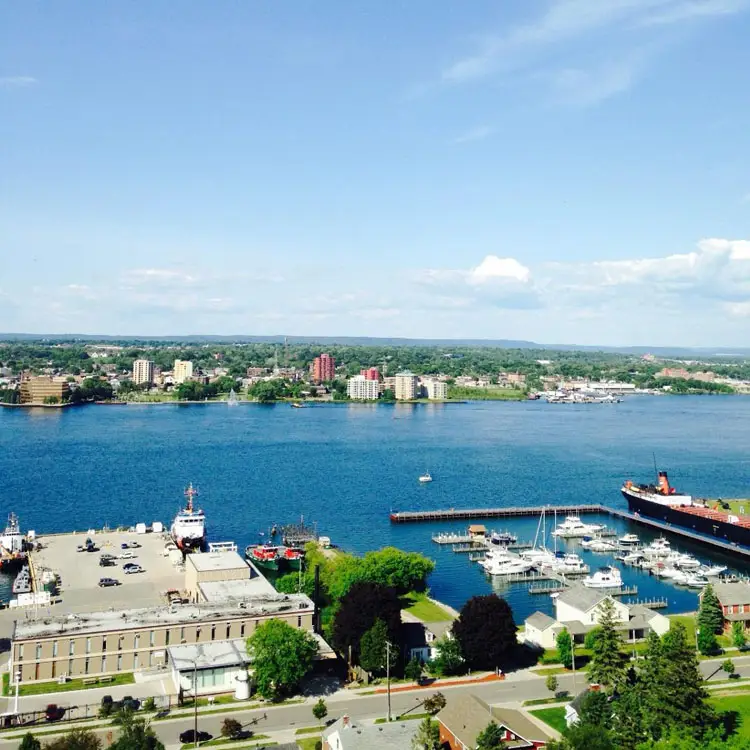
Seeing It All From Above

No visit would feel complete without riding the elevator to the top of the Tower of History.
Within seconds, we found ourselves 210 feet above the city.
The view was breathtaking.

The St. Marys River stretched into the distance.
Freighters moved steadily toward the locks.
Canada rested peacefully on the opposite shoreline.
Historic churches, neighborhoods, marinas, museums, and tree-lined streets spread beneath us in every direction.
From above, it became easy to understand why this location has been important for centuries.
Everything seemed connected.
The waterways.
The communities.
The history.
The people.
Sometimes all you need is a different perspective.

An Evening Worth Remembering
As evening settled across the river, golden sunlight stretched through the trees, casting long shadows across the waterfront. Families gathered near the park, visitors lingered along the observation areas, and another freighter slowly made its way toward the locks.
There was no rush.
No need to hurry to the next attraction.
We simply enjoyed being there.
Some destinations impress you because they’re spectacular.
Others stay with you because they make you slow down long enough to appreciate where you are.
Sault Ste. Marie somehow manages to do both.

Final Thoughts
Our travels during America’s 250th Anniversary have taken us to battlefields, historic towns, museums, and places where our nation’s story was forever changed.
Sault Ste. Marie reminded us that history isn’t found only where wars were fought or declarations were signed.
Sometimes history flows quietly through a river.
Sometimes it rises twenty-one feet inside a lock chamber.
Sometimes it stands inside a courthouse that has faithfully served its community for nearly a century and a half.
Sometimes it’s shared by a hotel employee who proudly circles his favorite places on a map because he genuinely wants visitors to love his hometown as much as he does.
We left with wonderful photographs, certainly.
But more importantly, we left with a deeper appreciation for the people whose vision, perseverance, faith, and ingenuity helped shape not only Michigan’s oldest city but also an important chapter in America’s story.
If your travels ever bring you to Michigan’s Upper Peninsula, don’t simply pass through Sault Ste. Marie.
Slow down.
Watch a freighter rise.
Listen to the stories.
And let one of America’s oldest communities remind you that the greatest journeys aren’t measured by miles traveled—they’re measured by the memories we carry home.
Happy travels,
The Cooper Shortcut Camping Journey Trio 😊 PlusOne!
YOU MAY ALSO LIKE:



Leave a Reply