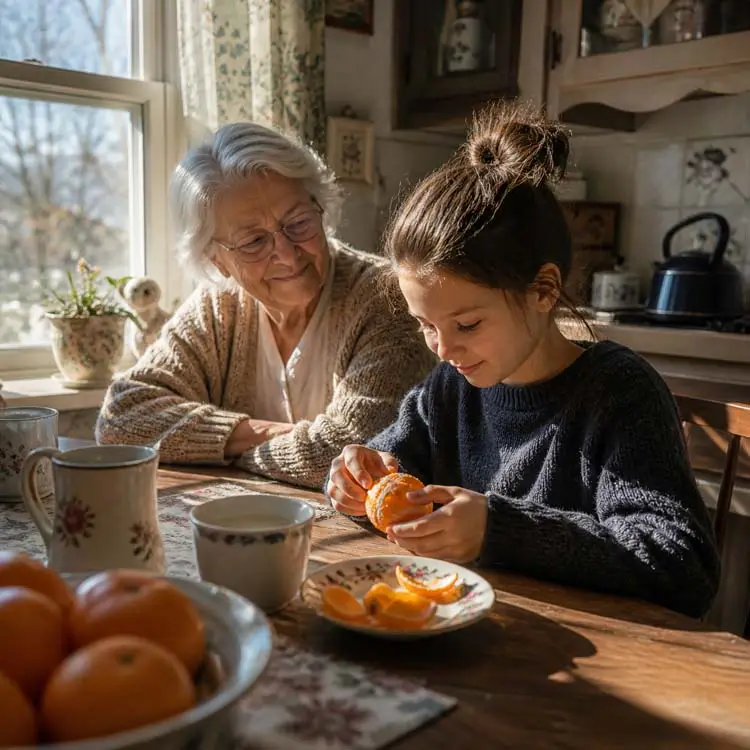
I can still see it as clear as morning light through her kitchen window.
I was sitting at the breakfast table, quietly peeling an orange, letting the scent drift into the room the way it always did—fresh, bright, and familiar. That’s when Grandma Cooper looked over at me, calm as ever, and asked a question that stopped me mid-peel.
“Did you know that oranges were not always orange?”
Now, when Grandma Cooper asked something like that, you learned to pause. There was always a story coming. Still, I couldn’t help myself.
“Come on, Grandma,” I said, studying her face for the slightest hint of a smile.
She didn’t give me one.
Instead, she simply repeated herself. “Did you know that oranges were not always orange?”
I looked down at the fruit in my hands, then back at her. “But oranges are orange… isn’t that how we know what the color orange looks like?” I asked, more unsure than I wanted to sound.
Grandma Cooper leaned back just a bit, the way she did when she was about to take you somewhere you didn’t expect.
“Oranges weren’t always as popular or as common as they are today,” she said. “And they didn’t even look the same. The ones you’re holding there… those are the result of years and years of care, patience, and a whole lot of learning.”
That’s when she began doing what she did best—peeling back history like I was peeling that orange.

She told me how long ago, farmers didn’t have neat rows of identical fruit like we see in the stores today. Back then, they worked with what nature gave them. Fruits were smaller, sometimes bitter, sometimes tough, and not always easy to harvest. So, over time, they made careful choices. They saved seeds from the best plants—the ones that tasted a little sweeter, grew a little bigger, or were easier to gather.
“Little by little,” she said, “they helped shape what we eat today.”
She explained that all the citrus fruits we enjoy—every orange, lemon, lime, and grapefruit—can be traced back to just a few ancient fruits. Citrons, pomelos, and mandarins. Names I had never heard before that morning, but somehow, by the way she said them, they felt important.
“The sweet orange you’re eating,” she continued, “comes from a mixing of those early fruits. A pomelo and a mandarin, brought together over time.”
I looked at the orange in my hand differently then.
She described the pomelo as large and pale, with a thick rind—nothing like the bright, easy-to-peel fruit I was holding. And the mandarin, she said, was once so small it was only a little bigger than an olive.
“Imagine that,” she said gently. “Something so small becoming something so familiar.”
I sat there quietly, turning the orange in my fingers, realizing that what I thought had always been this way… hadn’t.
Grandma Cooper had a way of doing that—reminding you that the world didn’t just appear as you see it. It was shaped, slowly and patiently, by time, by hands, and by choices made long before you were ever around to notice.

Before long, she smiled just a little and nodded toward my orange.
“Well,” she said, “are you going to eat it, or just admire it all morning?”
I laughed, finally taking a bite. It tasted the same as always—sweet, simple, and good.
But something had changed.
From that day on, I never looked at an orange quite the same way again. It wasn’t just a fruit anymore. It was a story… one that had been growing for generations, waiting for someone like Grandma Cooper to remind me to see it.
YOU MAY ALSO LIKE:
Camping: Strengthening the Bonds with Your Kids
Top 10 Must-Have Items for RV Camping
Leave a Reply