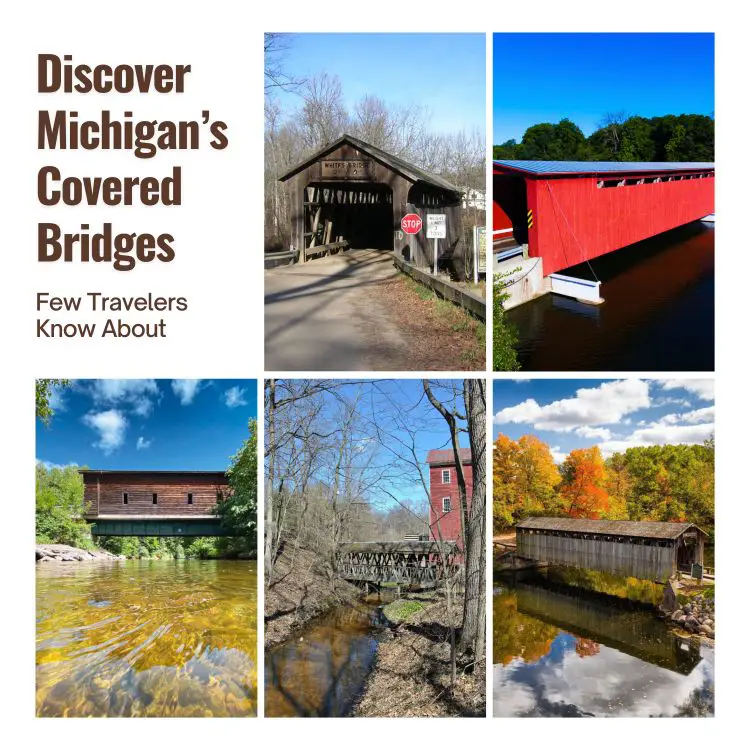
Earlier this week, I shared a Cooper Shortcut memory of discovering Michigan’s covered bridges. As Grandma Cooper would often say—always leaning in just a bit, her eyes dancing—“Things were a lot different when I was a young lady.” She insisted it wasn’t proper to kiss in public, then followed that declaration by hinting at her favorite “kissing bridge,” a tease that always ended in a deep, contagious laugh.
She never told that story. Not once.
So instead, I thought it only fitting to share the bridges themselves—the quiet witnesses to stolen moments, horse-drawn wagons, Model T crossings, and Sunday afternoon drives that took their time. Michigan’s covered bridges aren’t just structures; they’re invitations to slow down, take a detour, and maybe create a memory worth laughing about decades later.
Once common across the state, these 19th-century crossings now exist as rare survivors and carefully rebuilt tributes. Most are tucked into the southern and western reaches of the Lower Peninsula, with a few treasured spans in the southeast and northern landscapes. A covered bridge drive pairs beautifully with cider mills, wineries, orchards, or a quiet café—especially when autumn settles in and Michigan puts on its best show.
Historic Crossings That Still Whisper
The oldest covered bridge still welcoming traffic in Michigan is Whites Covered Bridge, spanning the Flat River since 1867. Its hand-hewn lumber, wooden pegs, and hand-cut nails remind you that craftsmanship once required patience, strength, and faith that things built well would last.

A short drive away stands Fallasburg Covered Bridge, built in 1871 and preserved within the Fallasburg Historic Village. One of only a few Michigan covered bridges still open to vehicles, it feels less like a museum piece and more like a pause button on time.

Then there’s the remarkable Langley Covered Bridge. Stretching 282 feet, it’s Michigan’s longest covered bridge and one of the longest in the country. Resting low and close to the St. Joseph River, it gives the impression it’s leaning in to hear the water tell its stories.

The Ada Covered Bridge carries one of the most dramatic histories. Built in 1867, rebuilt after a roof collapse, destroyed by fire, and then lovingly reconstructed by the community, it now serves pedestrians only—connecting the Village of Ada with a park, and connecting generations through shared determination.

Nearby, the Bowens Mills Covered Bridge blends beauty with industry. Recreated in 1982 beside an 1864 grist mill, it’s a picture-perfect reminder that Michigan’s early economy flowed with its rivers.

Modern Bridges, Timeless Feelings
Not all of Michigan’s covered bridges are 19th-century originals, but their charm is no less genuine. At W.K. Kellogg Forest, the Augusta Covered Bridge stands quietly among the trees, relocated there in 1973 and now part of a peaceful woodland setting.

In Mt. Pleasant, Fishers Covered Bridge waits at the end of gentle nature paths in Deerfield Nature Park, rebuilt after a fire but still carrying the feeling of discovery.

Trail users along the Kal-Haven Trail pause at the Donald F. Nichols Covered Bridge, while further north the Reed City Covered Bridge marks the gateway to one of Michigan’s longest rail-trails.


Even Sleeping Bear Dunes has its own quiet crossing. The Pierce Stocking Covered Bridge, rebuilt after porcupines developed an unfortunate taste for lumber, complements one of the most scenic drives in the state—proof that nature always has the last word.

Southeast Spans With Big Stories
Frankenmuth, Michigan’s Little Bavaria, features the charming Zehnders Holz Brucke, a pedestrian- and vehicle-friendly bridge that fits seamlessly into the town’s storybook setting.

And then there’s a bridge that traveled farther than most ever will. The Ackley Covered Bridge, built in 1832, was saved from demolition by Henry Ford himself. Moved hundreds of miles and reconstructed at Greenfield Village, it stands today as a symbol of preservation through vision.

Final Thoughts
Michigan’s covered bridges don’t demand attention—they earn it quietly. Each one offers a chance to take a different road, to linger where others rush past, and to experience the state the way Grandma Cooper’s generation did—unhurried, observant, and open to a little mystery.
Maybe you won’t find a kissing bridge. Or maybe you will. Either way, taking a Cooper Shortcut down one of these wooden spans just might give you a story worth keeping to yourself—at least for a while.
YOU MAY ALSO LIKE:
Chasing Waterfalls in Michigan’s Upper Peninsula

Leave a Reply