Grandma Cooper was a patriotic soul, though she never wore it loudly. Patriotism, in her house, wasn’t about flags on the porch or speeches at the dinner table. It lived in stories—stories that arrived quietly and stayed long after the dishes were cleared.
I grew up knowing service mattered. My Uncle Frank served in the Navy, and his sons followed that path of duty. I believe Uncle Ira may have served too in the Army as well, though time has blurred the certainty. What I do know without question is that his son Greg served in the United States Marine Corps, just as I did. Those connections mattered to Grandma Cooper, not as bragging points, but as threads in a larger American fabric she felt responsible for passing down.

You might think this is where I would launch into talk of the Stars and Stripes and everything neat and ceremonial. But that wasn’t Grandma Cooper’s style. Instead, she talked about impact. About how World War I and World War II reshaped everyday life in ways most people never think about. Her stories were gripping, part history lesson, part gentle nudge to pay attention.
As I’ve gotten older, I’ve come to understand something important. Grandma Cooper’s stories sometimes blended fiction and nonfiction—not out of carelessness, but intention. She wasn’t delivering lectures; she was teaching lessons. She wanted you to remember how deeply war touched ordinary lives. Still, the three stories she shared most often were firmly rooted in fact.

She liked those best.
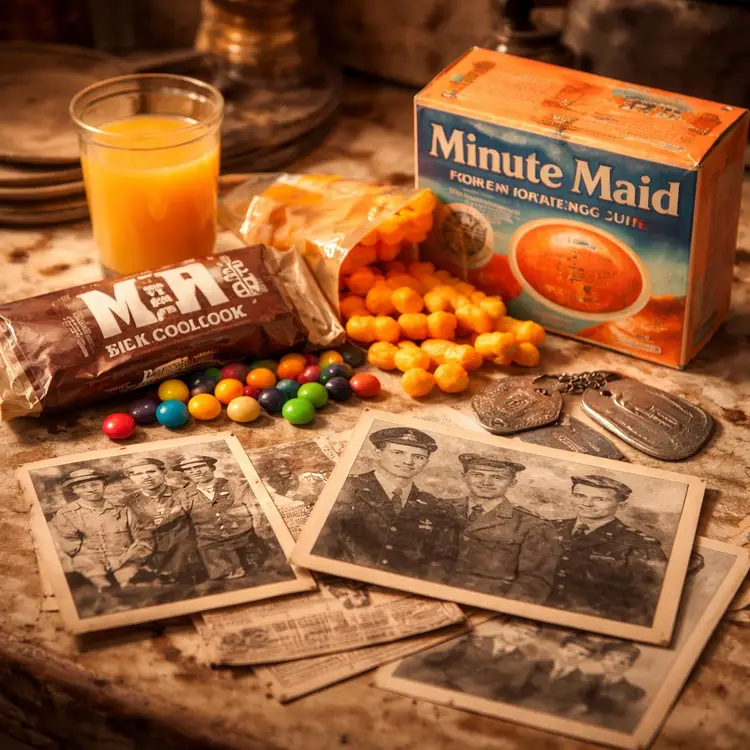
One of her favorites involved M&Ms. She would explain how, in the 1930s, Forrest Mars Sr. noticed soldiers in Europe eating chocolate pellets protected by a sugar shell during the Spanish Civil War. Chocolate that didn’t melt easily caught his attention. That idea followed him back to the United States, and by 1941, M&Ms were created. With World War II underway, the candy was produced specifically for U.S. military troops. It was practical, energy-rich, and durable in tropical climates. Only later, in 1947, did the public get access. Grandma Cooper loved that detail—that something created for soldiers eventually became a household treat.
Then there were Cheetos, a story she always told with a slight smile. Cheesy snacks and global conflict don’t seem connected at first glance, but she made sure we understood otherwise. During World War II, the U.S. Army developed powdered and processed cheese at the Natick Soldier Systems Center to meet military needs. By the war’s end, an entire industry existed to support dehydrated cheese production. That same powdered cheese found its way into one of the earliest mass-produced snacks—Cheetos. Grandma Cooper found something comforting in that transformation, how necessity quietly became familiarity.
Her third example was Minute Maid. In 1942, the U.S. Army needed a reliable way to provide vitamin C to troops and offered a contract to anyone who could create frozen orange juice that still tasted good. It took years of experimentation before a workable process emerged in 1945. By then, the war ended before shipment. The company behind the breakthrough changed its name and sold the concentrate to the public instead, branding it Minute Maid for its quick preparation. Sales were slow at first, but eventually the product took off, helped along by a catchy Bing Crosby jingle. Grandma Cooper liked how close that innovation came to being forgotten entirely.
She never told these stories to glorify war. Quite the opposite. She told them to show how deeply it reached into kitchens, lunchboxes, and grocery store shelves. War altered routines, diets, and daily comforts in ways that lasted long after the uniforms were put away.
Years later, standing in uniform myself, I finally understood why her stories stayed with me. Grandma Cooper wasn’t just sharing facts. She was reminding us that history doesn’t live only in textbooks or memorials. Sometimes, it melts in your hand, crunches between your teeth, or pours into a glass at breakfast.
And once you know that, you never quite look at ordinary things the same way again.
Grandma Cooper Wartime Stories Video
YOU MAY ALSO LIKE:



Leave a Reply