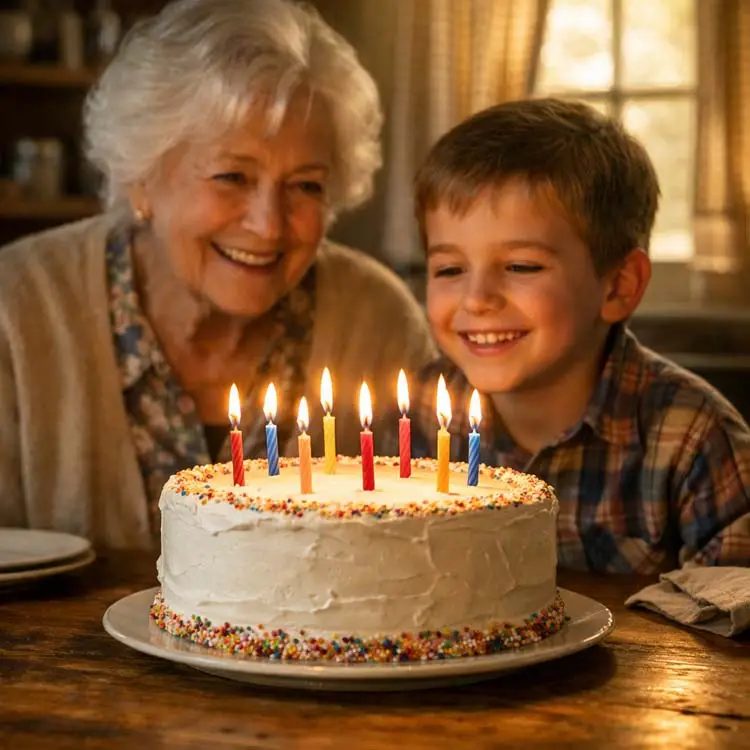
One afternoon, while sunlight rested gently across her kitchen table, Grandma Cooper looked up from her teacup and asked a question that seemed simple enough.
“Why do we eat cake on our birthday?”
I did not hesitate. “Because it tastes good,” I replied with the confidence only youth can carry.
Grandma Cooper raised an eyebrow in that thoughtful way of hers. “That’s not really an answer, you know.”
“Well,” I began, reaching for what I believed was solid reasoning, “I remember listening to one of Mom’s Bill Cosby records. He was talking about his daughter wanting chocolate cake for breakfast. He said it had eggs — and eggs are good for you. And wheat — wheat is good for you. And milk — well, milk is good for you too. So we eat cake on our birthday because it is good for us.”
Grandma Cooper smiled. Then she laughed — not at me, but with the gentle delight of someone who knows life has far more layers than a slice of chocolate cake.

Few traditions feel as universal as gathering around a frosted cake, lighting candles, and singing “Happy Birthday.” It feels timeless, as though it has always been part of who we are. Yet the story of birthday cake stretches back thousands of years, carried forward by generations who found meaning in sweetness and celebration.
In ancient times, cakes themselves were not unusual. What was rare was celebrating a personal birthday. While there is some evidence that the ancient Sumerians marked annual milestones, these occasions were not common in ancient Greece. The Romans were among the first to celebrate individual birthdays in a recognizable way, though only for men. Women’s birthdays would not become widely acknowledged until the Middle Ages.
Roman citizens honored friends and relatives with feasts, and a man reaching the age of fifty might receive a special cake made from wheat flour, nuts, honey, and yeast. Even so, birthday cakes were not yet a consistent tradition. For centuries, cakes were more closely tied to weddings, religious festivals, and offerings to the gods than to private anniversaries.
Over time, the symbolism deepened. Cakes came to represent abundance, indulgence, and festivity. Candles, flickering atop sweet layers, became markers of time — each flame a year lived, each breath that extinguished them carrying a wish into the unknown. The ritual of gathering together, voices joining in song, created a shared moment that bridged both joy and gratitude.
By the 1940s, birthday cakes often took on a familiar modern form. A simple frosted sheet cake might be decorated with a carefully piped name, transforming the dessert into something personal and meaningful. Yet beneath the icing lay centuries of tradition — echoes of moonlit cheesecakes offered to Artemis, memories of home kitchens where children waited eagerly beside cooling racks, and the quiet understanding that life itself was worth celebrating.
Grandma Cooper would later say that what mattered most was not the cake, but the gathering.
“Time passes whether we notice it or not,” she told me once. “But when we pause to share a slice together, we remind ourselves that every year lived is a blessing.”
Birthday cakes, in the end, are both sacred and ordinary. They are proof that the simplest rituals often carry the deepest history. Every candle lit, every wish whispered, every crumb brushed from the table connects us to those who came before — and to those who will one day gather in our place.
And perhaps, if Grandma Cooper were still sitting at that sunlit table, she would smile again and say,

“Cake may taste good… but it feels even better when it is shared.”
YOU MAY ALSO LIKE:



Leave a Reply