If there’s an RV for everyone, Forest River RV might just be the company making it happen. Since 1996, Forest River has grown from a single startup into one of the largest RV manufacturers in North America. Backed by Berkshire Hathaway since 2005, Forest River produces a staggering variety of travel trailers, fifth wheels, toy haulers, motorhomes, and destination trailers—along with subsidiary brands like Coachmen, Palomino, and Dynamax.
With roughly 60 brands and hundreds of floorplans under its umbrella, Forest River has built its reputation as a one-stop shop for nearly every type of RVer. But with that scale also comes important questions: What exactly does Forest River make? Where are their RVs built? And most importantly—are Forest River RVs any good?
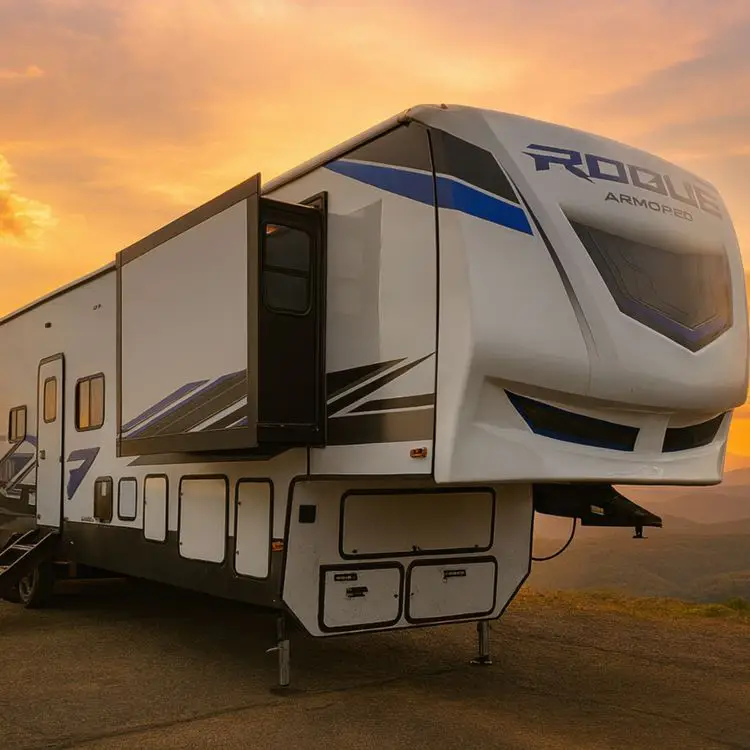
As Forest River RV owners ourselves, we can share some firsthand perspective. We’ve been traveling in our 2024 Rogue Armored 373BS134 Toy Hauler and have logged just under 18,000 miles in nine of the eighteen months we’ve owned her. And truthfully, we couldn’t be happier with our choice. That experience adds a personal layer to this review of Forest River RV—because beyond the specs and brand names, real-world use matters most.

What RVs Does Forest River Make? This May Surprise You!
Forest River is considered part of the “big three” RV companies, alongside Thor and Winnebago. While some brands focus on a narrow slice of the market, Forest River casts a wide net. Its subsidiaries and unique lines allow each to specialize in niches like lightweight travel trailers, luxury fifth wheels, or rugged toy haulers.
Travel Trailers
The travel trailer category is Forest River’s strongest, with recognizable lineups like Cherokee (Alpha Wolf, Grey Wolf), Rockwood/Flagstaff, and Salem. Each of these families offers something different—Cherokee focuses on versatility, Rockwood/Flagstaff on lightweight builds with high-end finishes, and Salem on affordability and variety. Other recognizable names include R-Pod, Vibe, Wildwood, No Boundaries (NoBo), XLR, and Wildcat.
Fifth Wheels
Forest River’s fifth wheel catalog is just as broad, from affordable models like Arctic Wolf to luxury offerings like Cedar Creek, Cardinal, and Riverstone. Mid-tier brands such as Sabre and Salem Hemisphere bridge the gap, appealing to RVers who want comfort without an extreme price tag.
Toy Haulers
For adventurers hauling ATVs, motorcycles, or gear, Forest River includes multiple toy hauler lines like XLR, Work and Play, Vengeance Rogue, Sandstorm, and Stealth. These range from practical, affordable builds to high-end rigs with extended living areas and modern amenities.
Our Rogue Armored toy hauler has proven Forest River’s dedication to this segment. With its spacious garage, smart floorplan, and rugged build, it has been the perfect companion for both long-haul trips and quick getaways. After nearly 18,000 miles, it continues to deliver the comfort and durability we were hoping for.
Motorhomes
Though smaller in number compared to towables, Forest River’s Class A and Class C motorhomes are highly competitive. Flagship names like Georgetown (Class A), Berkshire Diesel, Forester, Sunseeker, and FR3 showcase Forest River’s commitment to motorized RVs, offering both entry-level gas coaches and luxury diesel pushers.
Destination Trailers
Forest River also leads in the destination trailer market—large, residential-style RVs built for extended stays. Popular models include the Wildwood Lodge, Salem Villa, Cedar Creek Cottage, and Sierra. These rigs are perfect for RVers who want more of a stationary getaway than a rolling road trip.
Subsidiary Brands Under Forest River Inc.
Beyond its core RV lines, Forest River has strategically acquired or created several respected brands:
- Coachmen RV: Acquired in 2008, Coachmen’s history stretches back to 1964. Known for quality, affordability, and customer satisfaction, Coachmen remains one of the most trusted names in RVing.
- Palomino RV: Since 1968, Palomino has offered everything from truck campers to travel trailers and fifth wheels. Acquired by Forest River in 2002, Palomino continues to serve value-driven buyers.
- Dynamax RV: Specializes in luxury, heavy-duty Class C motorhomes. Their DX3 can tow up to 20,000 pounds—catering to RVers who want power and performance.
- Shasta RV: Founded in 1941 and acquired in 2004, Shasta blends timeless practicality with over 70 years of RV heritage.
- Prime Time Manufacturing: Established in 2009 under Forest River, Prime Time focuses on quality towables with entry-level to mid-tier offerings.
- East to West RV: A newer Forest River brand designed to simplify production with fewer floorplans, focusing on build quality and efficiency.
This portfolio means that when you shop Forest River, you’re really shopping a network of brands that can compete head-to-head with each other—keeping innovation and variety alive.
Where Are Forest River RVs Made?
Forest River operates over 100 manufacturing plants across the U.S. Many are in Elkhart, Indiana (the RV capital of the world), but others exist in Middlebury, Indiana; Silverton, Oregon; Hemet, California; and White Pigeon, Michigan. This regional spread helps keep distribution efficient while allowing certain plants to specialize—for example, Rockwood and Flagstaff continue to be built in Middlebury, where they originated.
Is Forest River a Good RV?
This is perhaps the most frequently asked question—and the answer isn’t a simple “yes” or “no.”
With 60+ brands and hundreds of floorplans, Forest River offers both budget-friendly models and high-end luxury RVs. The diversity is a strength, but it also means quality varies depending on the brand and product line.
- Pros: Huge variety of choices, backed by Berkshire Hathaway, nationwide dealer/service network, and specialized product lines that cater to nearly every type of RVer.
- Cons: Forest River has faced criticism for quality control. From 2015–2024, they led the industry in recalls, a reflection of their massive scale and sometimes rushed production processes.
The takeaway? Evaluate each model individually. Some Forest River lines, like Cedar Creek or Dynamax, are highly regarded for durability and design, while entry-level models are built to hit lower price points and may not have the same longevity.
In our case, owning a 2024 Rogue Armored toy hauler, the experience has been overwhelmingly positive. Nearly 18,000 miles later, we’ve been impressed with its performance, livability, and ability to handle the rigors of the road. That kind of real-world experience reinforces why so many RVers continue to choose Forest River despite its vast and sometimes uneven catalog.
Final Thoughts
Forest River RV has cemented itself as a giant in the RV world. With its expansive portfolio—ranging from simple travel trailers to luxury motorhomes—it continues to shape the way Americans camp, travel, and live on the road.
Is a Forest River RV right for you? The answer depends on your needs, budget, and expectations. With such a diverse catalog, there’s likely a Forest River product that fits your lifestyle—but like any RV purchase, careful research into specific models is essential.

As RVers who’ve lived the Forest River experience in a Rogue Armored toy hauler, we can say firsthand that the right choice can bring thousands of miles of memories and comfort. For us, it has been worth every mile.
YOU MAY ALSO LIKE:
Essential RV and Camping Safety Tips
The Grand Canyons Beyond Arizona

Leave a Reply