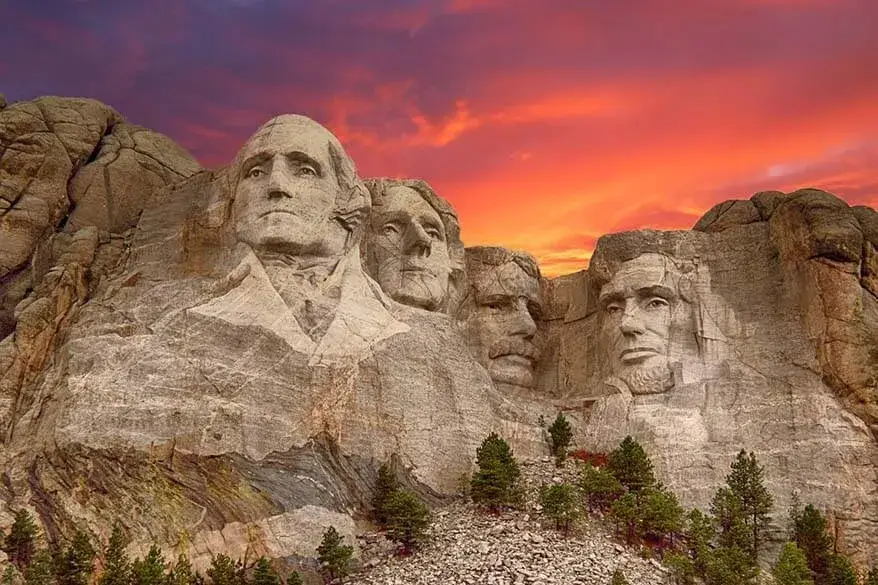

As we prepare for our journey to Sturgis this August, our conversations often turn to the magnificent sights of western South Dakota, particularly Mount Rushmore. Known for its incredible landscapes like the Badlands and the Needles of the Black Hills, nothing quite stands out like Mount Rushmore National Memorial. Celebrating its 75th anniversary in 2016, this monumental sculpture continues to capture the imaginations of millions. Here are some fascinating tidbits about this iconic landmark that you might find intriguing.
The Birth of an Idea
The concept of creating a grand sculpture in the Black Hills was conceived in 1923 by South Dakota historian Doane Robinson. His goal? To attract tourists to the state. And it worked brilliantly—Mount Rushmore now draws nearly 3 million visitors annually.
From Heroes to Presidents
Robinson originally envisioned sculpting Western heroes like Oglala Lakota leader Red Cloud, explorers Lewis and Clark, and Buffalo Bill Cody into the nearby Needles. However, Danish-American sculptor Gutzon Borglum, who was brought on board for the project, had a grander vision. Borglum, seeking an exit from his work on the Stone Mountain carving in Georgia, wanted to create something monumental that would attract global attention. Thus, Mount Rushmore was born.
Choosing the Presidents
Borglum and his son, Lincoln, decided the monument should have a national focus, opting to carve the faces of four U.S. presidents. The chosen presidents—George Washington, Thomas Jefferson, Theodore Roosevelt, and Abraham Lincoln—represent the founding, expansion, preservation, and unification of the United States.
- George Washington: The nation’s founding father.
- Thomas Jefferson: Representing expansion through the Louisiana Purchase.
- Theodore Roosevelt: Symbolizing conservation and the nation’s industrial growth.
- Abraham Lincoln: Leading the country through the Civil War and preserving the nation.
The Name and the Mountain
The mountain, known to the Lakota as the “Six Grandfathers,” had several names over the years, including Cougar Mountain, Sugarloaf Mountain, Slaughterhouse Mountain, and Keystone Cliffs. It officially became Mount Rushmore in 1930, named after New York lawyer Charles E. Rushmore, who inquired about the mountain’s name during a survey trip.
Carving the Monument
The carving of Mount Rushmore began in 1927 and concluded in 1941. Remarkably, over 400 workers, many of whom were miners, completed the project without any fatalities. Using dynamite and jackhammers, they removed over 450,000 tons of rock. Fine carving created smooth surfaces akin to concrete sidewalks.
Faces of the Presidents
Each president’s face on Mount Rushmore is 60 feet high, appearing in the order of Washington, Jefferson, Roosevelt, and Lincoln. Jefferson was initially meant to be on Washington’s right, but unsuitable rock forced a change in plans. The faces were completed as follows:
- Washington: 1934
- Jefferson: 1936
- Lincoln: 1937
- Roosevelt: 1939
The Hall of Records
Borglum envisioned a Hall of Records behind the heads, meant to house vital national documents. Although Congress halted the project in 1939, it was realized in 1998 when porcelain tablets containing key documents and biographies were placed inside the unfinished hall.
Fun Facts and Preservation
Mount Rushmore’s sculptors once had an amateur baseball team, and the image of the sculpture was meticulously mapped using a “pointing machine.” Interestingly, 90% of the mountain was carved with dynamite. The sculpture, made of granite, erodes about an inch every 10,000 years, meaning it could last millions of years.
Visiting Today
Today, visitors can explore the Lincoln Borglum Museum, the Sculptor’s Studio, and the Grand View Terrace, which offers one of the best views of the monument. The Presidential Trail provides up-close views of each face, and at night, Mount Rushmore is beautifully illuminated.
Ready for Sturgis?
With so much history and grandeur, Mount Rushmore is just one of the many incredible sights you’ll encounter on your journey to Sturgis. As we pack our bags and hit the road, let’s keep these fascinating facts in mind and look forward to an unforgettable adventure in western South Dakota!
YOU MAY ALSO LIKE:
RV Towing Through Traffic Circles and Roundabouts
Navigating the Campground with Golf Carts



Leave a Reply