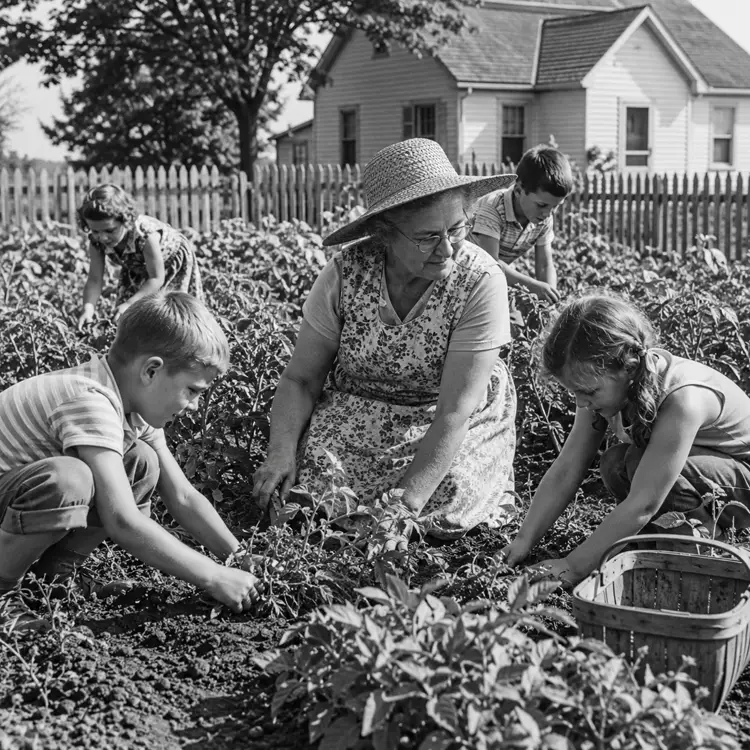
A Saturday Morning Lesson from Grandma Cooper’s Garden
History and Grandma Cooper seemed to go hand in hand.
She never looked at history as a collection of dusty books sitting on a library shelf. To her, history was simply people living their lives, making decisions, celebrating victories, suffering failures, and leaving lessons behind for the next generation.
“History matters,” she’d often say.
“If you know what happened yesterday, you might avoid making the same mistake tomorrow.”
Unfortunately, that wasn’t exactly the answer most children wanted to hear.
We wanted to fish.
Ride our bicycles.
Play baseball.
Anything but listen to another history lesson.
Grandma would just smile, knowing someday we’d understand.
She also had a way of reminding us that while fashions come and go, human nature doesn’t change nearly as much as we’d like to believe.
“The ties get wider and narrower,” she’d say.
“Skirts get longer and shorter. Hair comes and goes… though your dad seems to be losing his a little faster than most.”
Dad would just grin and shake his head.
Grandma would smile right back before adding,
“Styles have a funny way of coming back around. It’s our mistakes that ought to stay in the past.”
Those words have stayed with me far longer than I ever expected.
Sometimes I wonder what Grandma Cooper would think if she could see our country today.
She would probably notice how often we’re willing to remove monuments, rename places, erase names from buildings, or judge yesterday entirely through today’s eyes.
Would she think we’re moving forward?
Or would she quietly ask if we’re forgetting the very lessons history was trying to teach us?
Every generation has heroes.
Every generation has flaws.
History doesn’t ask us to celebrate every decision that came before us. It asks us to understand it.
After all, the freedoms we enjoy today weren’t handed to us without sacrifice.
Many were purchased through hardship, courage, and yes… bloodshed.
But before I wander too far down that road…
Grandma would probably clear her throat and bring me right back to the vegetable garden.
A Question Among the Tomatoes
One Saturday morning we were pulling weeds between rows of beans and tomatoes when Grandma suddenly asked,
“Why are Pennsylvania, Massachusetts, Virginia, and Kentucky called Commonwealths?”
We all stopped.
None of us had ever really thought about it.
“Weren’t they just states?” one of us finally answered.
Grandma smiled.
“They are.”
Then she handed someone another bucket and continued picking beans as though she’d asked the simplest question in the world.
What Does “Commonwealth” Mean?
The word commonwealth is much older than the United States itself.
It first appeared centuries ago and simply described a government that existed for the benefit of all its people rather than for the interests of one ruler.
That idea became especially important during the 1600s in England when political thinkers began discussing the rights of citizens and the responsibilities of government. For a brief period after King Charles I was executed in 1649, England itself was officially known as the Commonwealth of England before the monarchy returned in 1660.
Although America had once been part of the British Empire, our founders embraced the word for a different reason.
To them, it reflected a powerful belief.
Government should exist because the people give it authority—not because a king grants permission.
Grandma paused long enough to brush the dirt from her gloves.
“That’s a pretty good idea,” she said.

Why These Four States Chose the Name
Virginia was the first to embrace the title.
When it adopted its new constitution in 1776, the state wanted its name to reflect a government built upon the sovereignty of its citizens working together for the common good instead of loyalty to a monarch.
Pennsylvania followed that same year.
The name fit naturally with William Penn’s long-held belief that people should enjoy religious freedom, equality, and representative government.
Massachusetts adopted the designation when its constitution was written in 1780.
John Adams, one of its principal authors, believed government existed to protect the welfare of its citizens, making Commonwealth of Massachusetts an appropriate description.
Kentucky’s story was a little different.
Originally part of Virginia, Kentucky became the nation’s fifteenth state in 1792. Nearly a century later, when a new state constitution was adopted in 1891, Kentucky officially chose the title of commonwealth as well, influenced both by its Virginia heritage and by Pennsylvania’s democratic traditions.
Is There Any Difference Today?
“Does being a commonwealth make those states different?” someone finally asked.
Grandma shook her head.
“Not really.”
Today there is no legal distinction between a commonwealth and any other state.
Pennsylvania, Massachusetts, Virginia, and Kentucky function exactly like the other forty-six states.
The title simply reflects their history and the principles they wanted future generations to remember.
“In other words,” Grandma smiled, “it’s a reminder.”

Final Thoughts
Looking back now, I realize Grandma Cooper wasn’t trying to turn us into historians.
She was trying to teach us to become thoughtful citizens.
History isn’t valuable because every person who lived before us was perfect.
Far from it.
History matters because real people faced difficult choices, and those choices shaped the country we enjoy today.
If we refuse to remember where we’ve been, it becomes much harder to understand where we’re going.
Maybe that’s why Grandma believed history belonged in everyday conversations—even while picking beans in the garden.
Because history isn’t just about yesterday.
It’s one of the tools that helps prepare us for tomorrow.
And perhaps that’s the greatest lesson Grandma Cooper planted that Saturday morning.
Some seeds grow into vegetables.
Others grow into wisdom.
YOU MAY ALSO LIKE:



Leave a Reply