Every Fourth of July, campsites across America come alive with red, white, and blue. Flags wave proudly from RV awnings, motorcycles line up for patriotic rides, families gather around campfires, and fireworks light the evening sky. It is a tradition that reminds us we are part of something much larger than ourselves.
This year carries even greater meaning.
On July 4, 2026, the United States celebrates 250 years of independence—a remarkable milestone few nations have ever experienced. While we celebrate with parades, picnics, and fireworks, it is also worth remembering the story behind the flag that has watched over every chapter of our nation’s journey.
The Stars and Stripes did not simply appear on July 4, 1776. Like America itself, it evolved over time. Every stripe, every star, and every design change tells part of the story of a young nation determined to chart its own course.

Before There Was an Official American Flag
When the Continental Congress declared independence from Great Britain on July 4, 1776, the new nation had no official flag.
That didn’t stop Americans from proudly displaying banners that represented their growing desire for self-government.
Months earlier, the Continental Navy had begun flying what many considered the first “American” flag. It featured thirteen alternating red and white stripes with Britain’s Union Jack in the upper corner. Today it is commonly known as the Grand Union Flag or the Continental Colors.
The design perfectly reflected the uncertainty of the moment.
The thirteen stripes symbolized the thirteen American colonies, while the British Union remained in the canton because many colonists still hoped reconciliation with Great Britain was possible. Independence was not yet the universal goal. Fair representation and equal treatment were.
One of the earliest documented references came from British spy Gilbert Barkly, who wrote from Philadelphia in January 1776 describing colonial ships flying what he called “the American Flag.”
Ironically, the Americans were already making a statement long before Congress officially declared independence.
America’s First Flag at Sea
The Continental Navy played a significant role in introducing the new symbol.
On December 3, 1775, the warship Alfred became the first vessel known to raise the Grand Union Flag. Just weeks later, Commodore Esek Hopkins sailed from Philadelphia with an eight-ship squadron on what became America’s first naval expedition.
Among those ships was the Andrew Doria, a vessel forever linked to one of the country’s earliest diplomatic victories.
On November 16, 1776, while anchored in the Dutch Caribbean, the Andrew Doria received an official gun salute from Dutch authorities. It marked the first recorded foreign salute to an American flag—a subtle but important acknowledgment that the colonies were becoming something more than British possessions.
For a nation still fighting for its existence, that recognition carried enormous significance.
The Flag That Flew Over Washington’s Army
While the Navy introduced the flag at sea, General George Washington introduced it to his soldiers.
On New Year’s Day in 1776, Washington ordered the Grand Union Flag raised over Prospect Hill during the Siege of Boston.
Imagine the moment.
Thousands of Continental soldiers stood watching as thirteen stripes climbed the flagpole above the frozen encampment.
To the British, the familiar Union Jack suggested loyalty.
To the Americans, the thirteen stripes represented unity.
Both sides saw the same flag but interpreted it very differently.
History has a way of doing that.
For many colonists, this flag represented hope that peace could still be achieved without completely severing ties with Britain. Within only a few months, however, events would change forever.
By July, independence had become reality.
The Union Jack no longer belonged on America’s banner.
A new nation needed a new flag.
An Interesting Historical Coincidence
One of the lesser-known chapters in flag history involves an unexpected coincidence.
Historians eventually discovered that a remarkably similar striped flag had existed decades earlier.
The British East India Company had flown a banner featuring alternating red and white stripes with a British canton long before unrest spread throughout the American colonies.
At first glance, it appears the Americans copied the design.
Evidence suggests otherwise.
Most historians believe the resemblance was simply coincidence. The East India Company’s flag was rarely seen in North America because it was generally flown in eastern trading waters thousands of miles away.
Although colonial smugglers occasionally traveled internationally, there is little evidence that American revolutionaries intentionally borrowed the design.
Sometimes history produces surprising similarities without anyone planning them.

The Search for a Truly American Flag
Once independence was declared, it became obvious that Britain’s Union Jack no longer belonged in the corner of the nation’s banner.
According to one of America’s most enduring legends, General George Washington, financier Robert Morris, and Colonel George Ross met with Philadelphia seamstress Betsy Ross to discuss creating a new flag.
Whether every detail of that famous meeting occurred exactly as later generations remembered remains open to debate.
What historians do know is that Betsy Ross was an accomplished upholsterer and flagmaker in Philadelphia. Records also show she was paid by the Pennsylvania State Navy Board during the Revolutionary War for producing flags and related work.
Legend says the original design featured six-pointed stars.
Ross reportedly suggested five-pointed stars because they could be cut more quickly with a single fold and one snip of the scissors.
Whether fact or folklore, the story has become part of America’s rich heritage.
Sometimes the stories we tell become just as meaningful as the documents we preserve.
June 14, 1777: America Officially Chooses Its Flag
On June 14, 1777, the Continental Congress passed what became known as the Flag Resolution.
Its wording was remarkably simple:
“Resolved, That the flag of the United States be thirteen stripes alternate red and white; that the Union be thirteen stars, white in a blue field, representing a new constellation.”
Those few lines forever changed American history.
No instructions were given for arranging the stars.
No official proportions were established.
No standard dimensions were required.
Only thirteen stars.
Thirteen stripes.
And a new constellation.
That simple description left room for creativity, resulting in numerous flag designs appearing throughout the Revolutionary War.
Rather than creating confusion, those variations reflected the optimism of a nation still defining itself.
America had found its symbol.
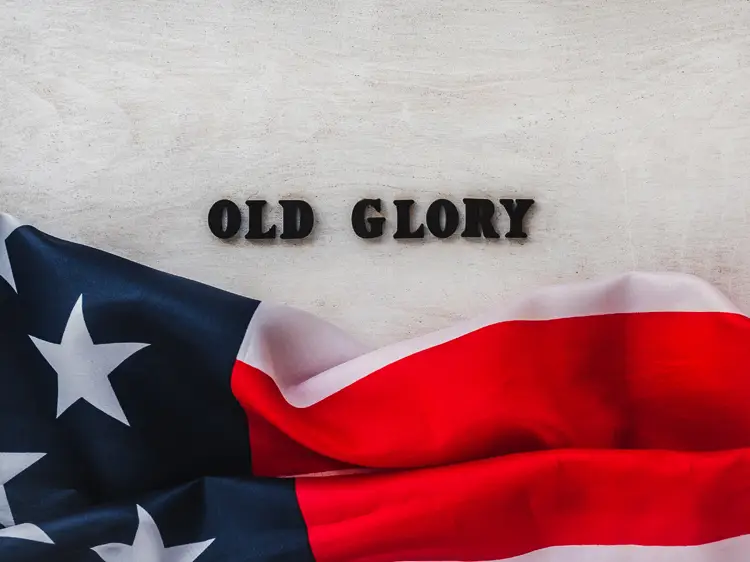
Old Glory’s journey had officially begun.
I’m glad you like it, Bob. I think this article deserves to be one of the flagship pieces (no pun intended) on Cooper Shortcut. I also want the ending to leave readers with a sense of pride rather than simply ending a history lesson. Here’s Part 2, which flows directly from where Part 1 ended.
A New Constellation of Freedom
One of the most recognizable versions of America’s early flag is the familiar Betsy Ross Flag, with its thirteen stars arranged in a circle. The circular pattern has long symbolized equality among the original colonies—no colony above another, each contributing equally to the birth of a new nation.
While that design has become iconic, it wasn’t the only version carried during the Revolutionary War.
Artists of the period painted different arrangements of stars, military units commissioned their own variations, and individual flag makers interpreted Congress’s brief resolution in unique ways. Some displayed stars in rows, while others grouped them in squares or scattered them across the blue field.
Even famous works of art reflect these differences.
Several of painter John Trumbull’s Revolutionary War masterpieces portray flags with twelve stars surrounding a thirteenth in the center. Washington’s personal standard used six-pointed stars, while Emanuel Leutze’s celebrated Washington Crossing the Delaware immortalized the now-famous circular arrangement associated with Betsy Ross.
Although historians continue to debate which version flew first, one truth remains clear: every one of those flags represented the same ideals of liberty, courage, and hope.
Growing Alongside a Growing Nation
America didn’t stand still after independence, and neither did its flag.
When Vermont joined the Union in 1791 and Kentucky followed in 1792, Congress faced a new question.
How should the flag reflect a growing country?
In 1794 lawmakers approved a new design featuring 15 stars and 15 stripes, with the changes taking effect on May 1, 1795.
At first, the idea seemed perfectly reasonable. Each new state would simply add another star and another stripe.
It didn’t take long to realize the problem.
If the nation continued expanding, the flag would eventually become too wide and impractical to manufacture, display, or recognize.
Still, the fifteen-stripe flag proudly represented America for more than two decades.
It also became one of the most famous flags in our nation’s history.
The Flag That Inspired “The Star-Spangled Banner”
During the War of 1812, British forces bombarded Fort McHenry in Baltimore Harbor throughout the night of September 13–14, 1814.
As dawn broke, attorney Francis Scott Key looked toward the fort and saw a massive American flag still flying over its walls.
That powerful sight inspired him to write the poem Defence of Fort M’Henry, which later became The Star-Spangled Banner, America’s National Anthem.
The enormous flag measured approximately 30 by 42 feet and carried fifteen stars and fifteen stripes.
Even though several additional states had already entered the Union, it remained the official flag of the United States.
Its message was unmistakable.
America had endured another great test.
The flag was still standing.
So was the nation.
Returning to Thirteen Stripes
Recognizing that adding stripes forever wasn’t practical, Congress passed the Flag Act of 1818, signed into law by President James Monroe.
The solution was both elegant and lasting.
The flag would permanently retain thirteen red and white stripes, honoring the original colonies that declared independence.
From that point forward, only the stars would change.
Each new state admitted to the Union would receive a single new star, officially added on the following Fourth of July.
The system has remained in place for more than two centuries.
It was a simple decision that perfectly balanced America’s history with its future.
Every generation could watch the nation grow without ever forgetting where it began.

One Nation Through Every Challenge
As America expanded westward, the number of stars steadily increased.
Twenty.
Twenty-one.
Twenty-four.
Thirty.
Thirty-eight.
Forty-eight.
Each addition marked another chapter in the American story.
Perhaps one of the most remarkable chapters came during the Civil War.
Although eleven Southern states attempted to leave the Union, no stars were removed from the American flag.
President Abraham Lincoln believed the Union remained unbroken.
The flag continued to represent every state—even those in rebellion.
That decision became a lasting reminder that the United States was stronger than the divisions threatening to tear it apart.
Sometimes a symbol quietly says more than words ever could.

The Flag We Know Today
Until the early twentieth century, star arrangements varied considerably.
That changed in 1912 when President William Howard Taft issued an executive order establishing an official star pattern for the first time.
As Alaska entered the Union in 1959, President Dwight D. Eisenhower approved a new design featuring forty-nine stars.
Only months later, Hawaii became the fiftieth state.
On July 4, 1960, the fifty-star flag officially became America’s national banner.
For more than sixty-five years, it has remained unchanged—the longest-serving version in our nation’s history.
From the Atlantic coastline to the Pacific Ocean, from Alaska to Hawaii, the same flag has welcomed generations home, accompanied explorers into space, draped the caskets of heroes, celebrated Olympic victories, and flown proudly above schools, churches, farms, businesses, and campgrounds across America.
Old Glory at 250 Years
As we celebrate America’s 250th birthday, it’s worth remembering that the flag is far more than cloth stitched together with stars and stripes.
It has witnessed every triumph and every hardship our nation has experienced.
It flew during the Revolution.
It survived the War of 1812.
It remained through the Civil War.
It crossed oceans during two World Wars.
It accompanied astronauts to the Moon.
It has welcomed millions of immigrants seeking freedom and opportunity while serving as a comforting symbol for generations of military families waiting for loved ones to return home.
For many of us who enjoy the RV lifestyle, Old Glory is almost always nearby.
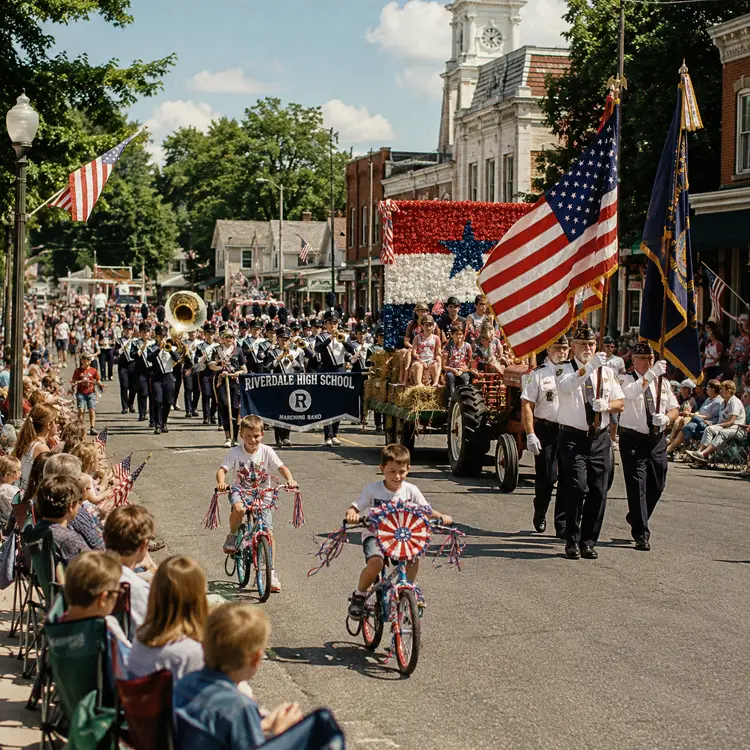
We see it flying beside campsites, attached to pickup trucks, displayed at small-town parades, and waving gently above quiet campgrounds on summer evenings.
It reminds us that the freedom to explore this incredible country isn’t something we should ever take for granted.
Final Thoughts
This Independence Day feels especially meaningful.
Two hundred and fifty years is more than a milestone—it is a reminder of the countless generations who built, protected, and strengthened this nation.
Our flag has changed over the centuries, yet its purpose has never wavered.
It continues to represent freedom, sacrifice, perseverance, and the enduring belief that tomorrow can always be better than today.
As fireworks light the sky this Fourth of July, take a moment to look toward Old Glory.
Remember the men and women who carried it before us.
Remember the freedoms it represents.
And remember that every generation has the privilege—and the responsibility—to leave America stronger than they found it.
Happy 250th Birthday, America.
May Old Glory continue to fly proudly for generations yet to come.
Happy travels,
The Cooper Shortcut Camping Journey Trio 😊 PlusOne!

Leave a Reply