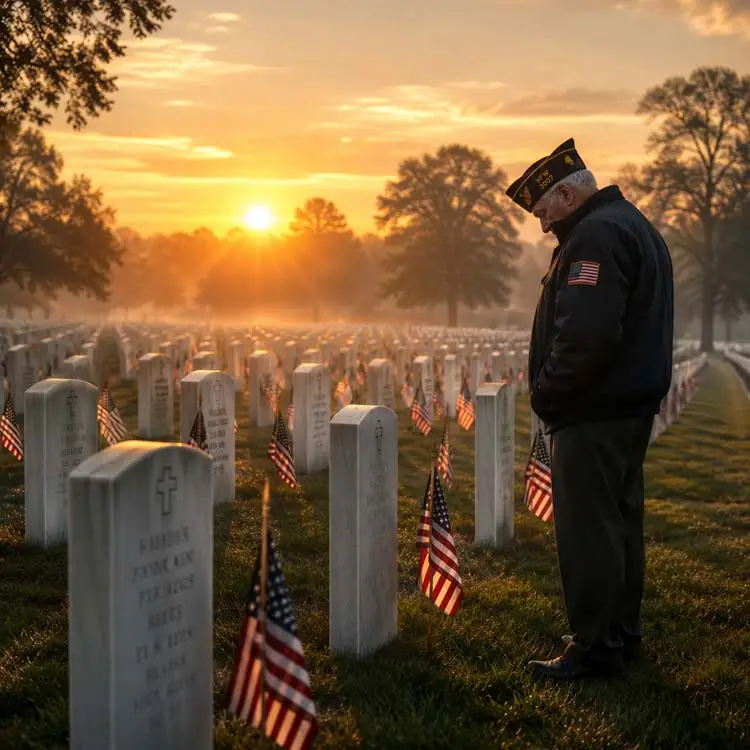
“Day is done, gone the sun,
From the hills, from the lake,
From the skies…”
Do you recognize those words?
If you do not, you are certainly not alone. Most Americans would struggle to identify them by reading the lyrics alone. Yet if the melody were played, chances are you would recognize it instantly. The tune quietly drifts across military bases every evening. It echoes through cemeteries during funeral services. It has comforted grieving families for generations.
For many, Memorial Day weekend marks the unofficial beginning of summer. Campgrounds fill with RVs. Motorcycles roll down scenic highways. Families gather around picnic tables and campfires. Yet for countless military families across America, Memorial Day means something far deeper. It is not simply another holiday. It is a sacred day of remembrance.
As a child, Memorial Day meant a trip to the cemetery with my mom, dad, and little sister Chere. Small American flags stood beside weathered headstones while veterans quietly visited old friends who never came home. At the time, I did not fully understand the meaning behind those visits. I simply knew this day was different.
The older I became, the more I realized Memorial Day is not truly about the start of summer. It is about remembering the men and women who sacrificed their tomorrows so the rest of us could enjoy today.
CLICK HERE to Hear Mel Carter sing, “Day Is Done Gone the Sun”
The Freedom Many Never Had the Chance to Enjoy
Freedom is often easiest to appreciate when we have never had to fight for it ourselves.
Every backyard barbecue, every family road trip, every peaceful evening beside a campground fire exists because generations of Americans stood willing to defend this nation, even at the cost of their own lives. Many were barely more than kids themselves. They left behind parents, spouses, children, and dreams that would never be fulfilled.
Some never made it home from places whose names are forever etched into American history. Gettysburg. Normandy. Iwo Jima. Chosin Reservoir. Khe Sanh. Fallujah.
Memorial Day is not about politics or even war itself. It is about sacrifice.
It is about the empty chair at a family dinner table.
It is about parents who received folded flags instead of welcoming their son or daughter home.
It is about husbands, wives, brothers, sisters, and friends whose futures ended far too soon.
As someone who served in the Marine Corps, and as the father and grandfather of military service members, Memorial Day carries emotions difficult to fully explain. Pride and heartbreak somehow exist together. Gratitude and sorrow walk side by side.
That is why this day matters.
Because freedom has always come with a price paid by someone else.
The Melody Behind the Words
The words at the beginning of this article belong to the traditional military bugle call known as Taps.
Of all the military bugle calls ever written, none carries more emotion than those twenty-four simple notes. Few songs can stop conversations and instantly bring silence to a crowd the way Taps can.
Its history dates back to the Civil War during the summer of 1862. Union General Daniel Butterfield was camped with the Army of the Potomac at Harrison’s Landing, Virginia, following the bloody Seven Days Battles. Butterfield disliked the formal “Lights Out” call used at the time and wanted something softer and more meaningful for his exhausted soldiers at day’s end.
Working alongside brigade bugler Oliver Wilcox Norton, he revised the melody into the version recognized today.
That evening, the new call floated across the campsites for the first time.
Soldiers immediately noticed the difference. The tune carried peace, reflection, and finality all at once. Before long, the melody spread throughout both Union and Confederate camps and eventually became an official military bugle call after the war.
What began as a signal ending the day for weary soldiers would soon become something far more meaningful.

How Taps Became America’s Final Farewell
During the Civil War, military funerals traditionally included the firing of three rifle volleys over a grave. But during the Peninsular Campaign in Virginia, Captain John C. Tidball faced a difficult situation after one of his artillerymen was killed in action.
Enemy troops remained dangerously close nearby. Firing rifles risked reigniting battle.
Instead, Tidball ordered a bugler to sound Taps during the funeral.
The haunting melody proved more powerful than gunfire ever could.
From that moment forward, Taps slowly became linked with military funerals and memorial services across the nation. By 1891, Army regulations officially recognized its use during funeral ceremonies.
Today, those same notes continue to echo through national cemeteries, military funerals, wreath-laying ceremonies, and Memorial Day observances across America.
For many families, hearing Taps marks the final goodbye to someone deeply loved.
Why Memorial Day Still Matters Today
In today’s fast-moving world, it is easy for the deeper meaning of Memorial Day to become overshadowed by sales advertisements, travel plans, and holiday gatherings. Yet across the country this weekend, thousands of volunteers will quietly place American flags beside the graves of fallen service members.
Some graves will be visited by generations of family members.
Others may only receive a silent moment of respect from strangers passing by.
But every single flag represents a life.
A story.
A sacrifice.
That is why understanding history matters. The traditions we observe today did not appear by accident. They were shaped by loss, honor, courage, and remembrance carried forward through generations.
When those twenty-four notes of Taps rise softly through the air this Memorial Day, they remind us that freedom was never free.
They remind us that behind every peaceful summer evening stands someone who once answered a call to serve.
And they remind us that remembrance itself is one of the greatest forms of respect we can give.
Final Thoughts
This Memorial Day 2026, while enjoying time with family and friends, take a quiet moment to reflect on the meaning behind those words:
“Day is done, gone the sun…”
For generations of Americans, they have symbolized honor, sacrifice, and remembrance.

Long after the campfires burn low and the holiday weekend comes to an end, the meaning behind those words continues to echo across military cemeteries, small hometown memorials, and the hearts of families who gave everything for this country.
May we never lose our understanding of what those sacrifices truly mean.
And may we never forget those who made them.
CLICK HERE TO HEAR Taps at the Tomb of the Unknown Soldier
YOU MAY ALSO LIKE:



Leave a Reply