
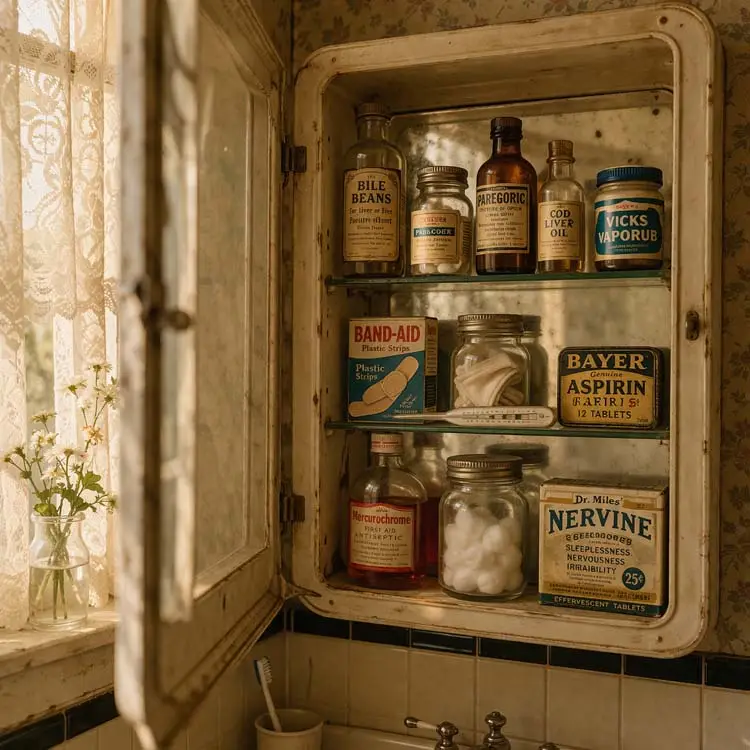
There was something about Grandma Cooper’s bathroom that always felt a little different from the rest of the house.
Perhaps it was the way the morning light slipped through the lace curtain and settled softly across the sink. Or maybe it was that old mirrored medicine cabinet above the vanity, the one with the slightly squeaky hinge that announced itself every time it was opened. To a child, it felt almost mysterious, as though behind that little mirrored door lived the answers to every scrape, sniffle, and stomachache life could hand you.
I can still hear Grandma Cooper’s voice as clear as if she were standing beside me now.
“Come here,” she would say with that calm smile of hers. “Let’s see what might help.”
Inside, you would find the familiar things we still recognize today — a thermometer tucked neatly in the corner, a box of bandages, a tin of aspirin, perhaps a jar of Vicks VapoRub with its unmistakable scent of menthol and eucalyptus. Those things have stood the test of time.
But nestled beside them were remedies that belonged to another age, a time when medicine was still learning, still discovering, and sometimes wandering down roads we now know were better left untraveled.

Grandma never spoke of these things with judgment. She spoke of them with the quiet wisdom of someone who had lived long enough to see the world change.
“You have to remember,” she once told me, “people did the best they could with what they knew.”
And that, I believe, is the heart of this story.
The Little Pills for a Troubled Stomach
In those days, digestive troubles were blamed for nearly everything.
Feeling tired? Must be your digestion.
A bit irritable? Probably the liver.
Not yourself? Well, surely the stomach had something to do with it.
One of the staples of many midcentury medicine cabinets was something called bile beans. The name alone sounds as though it belongs in another century, doesn’t it?
These little pills were marketed heavily, especially to homemakers, promising to keep a person “fit, bright, and attractive.” Their purpose was said to stimulate the liver, aid digestion, and relieve constipation.
Grandma would sometimes shake her head and smile.
“Back then,” she said, “they thought the liver was the answer to just about everything.”
Most of those so-called liver pills were, in truth, laxatives, often made with ingredients like cascara, rhubarb, and licorice. Over time, those old remedies gave way to products more familiar to us now, such as Pepto-Bismol and Ex-Lax.
The names changed, but the desire for relief stayed the same.
When Medicine Came in a Glass Bottle
Some of the remedies of Grandma’s day would raise eyebrows now.
One that stood out was paregoric, a liquid tincture containing opium. Imagine that sitting quietly on a bathroom shelf, ready for stomach troubles, coughs, or even a teething baby.
It came in small glass bottles and carried a faint licorice-like taste from anise oil.
To Grandma’s generation, it was simply something you kept on hand.
Today, of course, we understand the risks of narcotics far better. What once seemed commonplace is now tightly regulated, and for good reason.
Yet hearing her talk about it always reminded me how quickly medicine evolves.
What seems ordinary in one generation can become unthinkable in the next.
The Spoonful Nobody Wanted
There are some childhood memories that stay with you forever, and for many folks of Grandma’s era, cod liver oil was one of them.
Cod liver oil
The very mention of it was often enough to make people laugh and grimace at the same time.
“It tasted every bit as bad as you’ve heard,” Grandma would say, her eyes twinkling.
Yet it was taken because people believed in its benefits — and truthfully, modern science has shown it does contain valuable omega-3 fatty acids along with vitamins A and D.
Sometimes the old remedies were not entirely wrong.
They were simply rougher around the edges.
The Bright Red Cure
If you skinned your knee in Grandma Cooper’s day, there was a good chance the cure came in a little glass bottle of bright red liquid.
Mercurochrome and Merthiolate were household staples.
That red-orange streak across a scraped elbow was almost a badge of childhood.
It stung just enough to let you know healing had begun.
At least, that was how it felt.
Today we know those products relied on mercury compounds, and the dangers of mercury are well understood. But back then, they were trusted.
Grandma would say, “If it turned red, you knew you were going to be just fine.”
There was comfort in ritual, even when the science had yet to catch up.
Remedies We’re Glad Stayed in the Past
Some things are best remembered as history lessons.
One of the most startling was the way Lysol was once marketed as a feminine hygiene product.
To modern ears, it sounds shocking.
And it should.
The advertisements of the time spoke in carefully chosen language about marital happiness, but history now tells us the product caused harm for many women.
Grandma never liked talking about that one.
“That was a different time,” she would say softly, “and not always a wiser one.”
It is a sober reminder that just because something was commonly sold does not mean it was safe.
Calming the Nerves
By the 1950s, life was changing quickly.
The war was behind them, but the pressures of modern life had a way of settling into the shoulders and mind.
That was when medicines like Miltown and Dr. Miles’ Nervine found their way into cabinets across America.
They promised calm.
Rest.
A good night’s sleep.
A way to quiet the mind without stopping life altogether.
For a while, they became incredibly popular.
But as medicine advanced, newer and safer treatments replaced them.
Grandma’s generation lived through an era when pharmaceuticals were evolving almost overnight.
They witnessed firsthand how quickly one “miracle” medicine could be replaced by the next.
The One Jar That Remains
Some things, however, endure.
I can still picture that familiar blue jar of Vicks VapoRub sitting on Grandma Cooper’s shelf.
Its scent could fill the room in seconds.
When winter colds came calling, that jar came out.
A little on the chest, a little beneath the nose, and somehow the whole room felt warmer.
Even now, that smell carries memory with it.
Comfort.
Care.
Home.
Some remedies remain because they continue to work.
Others remain because they remind us of the hands that cared for us.

Final Thoughts from Grandma Cooper
Grandma Cooper’s medicine cabinet was more than a collection of remedies.
It was a small mirror of history.
Each bottle, tin, and jar told the story of what people once believed, what they hoped for, and how medicine has grown through time.
“People weren’t foolish,” Grandma would say. “They were learning.”
And perhaps that is the best way to remember it.
Not as a cabinet full of outdated cures, but as a shelf full of stories — reminders that every generation does the best it can with the knowledge it has.
Some remedies faded.
Some endured.
But the love behind them never changed.
YOU MAY ALSO LIKE:
Grandma Cooper A Dealer of Cards and Life Lessons



Leave a Reply