Let’s be honest for a moment. If you’ve paid even a little attention to the RV industry over the past several years, you’ve probably noticed a troubling trend—RV quality just isn’t what it used to be.
Private equity firms have swept through the industry, consolidating multiple RV brands under massive corporate umbrellas. The guiding philosophy behind many of these acquisitions has been simple: “More Money.” Unfortunately, that pursuit of profit has often come at the expense of craftsmanship, quality control, and the trust that RV owners once had in their favorite brands.
The results have been impossible to ignore. Owners report increasing issues with build quality, warranty claims, recalls, and even lawsuits. When problems surfaced, manufacturers often pointed fingers at dealers, suppliers, or anyone else who could absorb the blame. Rarely did responsibility land where it truly belonged.
As someone who spent a career working as a Quality Engineer, I can tell you firsthand that quality accountability always belongs with the manufacturer. When a supplier part failed to meet our standards, it was our responsibility to identify it and remove it from the process before it ever reached the customer. After all, if the end user experienced a failure, they wouldn’t blame the supplier—they would blame the company whose name was on the product.
That principle should apply to RV manufacturers as well.
But despite the frustrations and the headlines, the RV lifestyle is still very much alive—and very much worth pursuing.
The key is knowledge, preparation, and a thorough RV inspection before you buy.
Why the RV Lifestyle Is Still Worth It
With all the negative stories circulating about RV quality, many prospective buyers find themselves asking a perfectly reasonable question:
“Why would anyone buy an RV today?”
The answer is surprisingly simple.
Because the news rarely talks about the millions of incredible experiences RV travel creates.
Newsrooms thrive on drama. Problems attract attention, and attention brings ratings. But the quiet stories of families exploring national parks, couples chasing sunsets along coastal highways, or grandparents making lifelong memories with their grandchildren rarely make the evening broadcast.
My wife and I have been incredibly blessed through more than 50 years of RV ownership and camping adventures. Like any lifestyle, it hasn’t always been perfect. Repairs happen. Maintenance is part of the journey. But the freedom, the friendships, and the unforgettable places we’ve visited have far outweighed the occasional hiccup.
When you focus on the positive and approach RV ownership with a little preparation, it becomes one of the most rewarding ways to travel.
A Dealer That Restored Our Faith
Before diving deeper into inspections and buying advice, I want to share a quick personal note.
Over the past five decades we’ve purchased multiple RVs from several dealerships. Unfortunately, many of those experiences felt transactional—similar to buying a car where the relationship ends the moment the paperwork is signed.
That changed when we purchased our most recent unit.
At an RV show at the Suburban Collection Showplace in Novi, Michigan, we bought our current rig—a 2024 Forest River Rogue Armored 373BS13 Toy Hauler—from Price Right RV, which has locations in DeWitt and Sterling Heights.
From the moment we met the team, the experience felt different. Doug, the owner, has built a culture where customers truly feel like family. Whether you’re speaking with the sales team, the service department, or the parts staff, there’s a genuine sense that they care about your experience long after the sale.
In an industry that sometimes struggles with trust, Price Right RV stands out as an example of how dealerships should treat their customers.
Now… back to the important topic of protecting yourself as an RV buyer.
The Importance of a Thorough RV Inspection
Buying an RV is far more than purchasing a vehicle.
It’s buying a home on wheels—a complex system of plumbing, electrical components, appliances, structural materials, and mechanical equipment all packed into one traveling space.
An RV might look fantastic during a quick walk-through on a dealership lot. Fresh graphics, polished surfaces, and bright lighting can easily hide underlying issues that could become expensive surprises later.
Hidden problems such as:
- Roof leaks
- Electrical system faults
- Worn suspension components
- Plumbing leaks
- Appliance failures
These kinds of issues can quickly turn a dream purchase into a frustrating money pit.

A complete RV inspection protects you from those surprises.
It gives you the confidence to move forward—or the clarity to walk away.
Consider a Professional RV Inspection
One of the smartest decisions a buyer can make is hiring a NRVIA Certified RV Inspector.
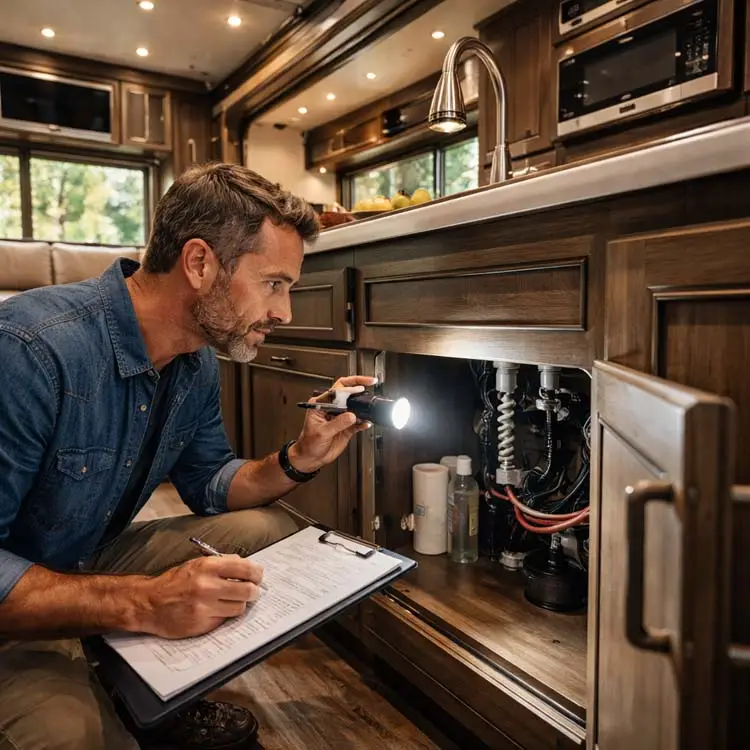
These professionals specialize in evaluating RV systems and structures before purchase. Their inspections often include advanced tools like moisture meters, thermal imaging cameras, and electrical diagnostics—equipment that can reveal issues invisible to the naked eye.
Even if you hire an inspector, I strongly recommend attending the inspection yourself. Watching the process teaches you what to look for in your own maintenance routine later.
Buying an RV isn’t just about today’s condition—it’s about understanding how to care for it long term.
Preparing for Your Own RV Inspection
A smart inspection starts with preparation.
Simple tools can dramatically improve your ability to identify issues during a walkthrough. A bright flashlight helps reveal hidden leaks or damage in dark storage bays. A tire pressure gauge tells you whether the running gear has been properly maintained. Electrical outlet testers and multimeters can uncover wiring problems before they become dangerous.
Equally important is documentation.
Before inspecting the RV itself, review critical information such as the VIN, service history, manuals, tank capacities, and weight ratings. These documents tell the story of how the RV has been cared for and whether it’s suited for your travel style.
For buyers planning extended trips, boondocking, or towing additional equipment, weight ratings like GVWR and cargo carrying capacity become essential safety considerations.
The Areas Every Buyer Should Inspect
A proper RV inspection moves methodically through the entire coach.
The exterior is your first line of defense against weather and road damage. Roof seals, sidewalls, slide-outs, awnings, and storage compartments all deserve close attention. Small cracks in roof sealant or subtle ripples in fiberglass panels can signal deeper structural concerns.

Inside the RV, the inspection shifts toward comfort and safety. Floors should feel solid beneath your feet. Walls and ceilings should show no signs of staining or bubbling that might indicate past water intrusion. Windows should open smoothly, cabinetry should feel secure, and furniture should show normal wear—not structural weakness.
From there, the focus turns to the mechanical heart of the RV.
Electrical systems must function reliably whether connected to shore power or operating from batteries and converters. Plumbing should run smoothly with no leaks beneath sinks or behind fixtures. Heating and cooling systems should operate through full cycles. Propane appliances should ignite cleanly and burn with steady blue flames.
For motorhomes, engine performance, fluid condition, and generator operation add another layer of inspection.
The goal isn’t perfection.
The goal is clarity about the RV’s true condition.
Used RV Buyers Need Extra Caution
When purchasing a used RV, inspections become even more critical.
Unlike a new unit, a used RV carries a history—sometimes a well-documented one, sometimes not. Maintenance records, service logs, and repair documentation can reveal how carefully the previous owner cared for the coach.
Structural issues deserve particular attention.
Water intrusion is one of the most expensive problems in RV ownership. Soft roof sections, delamination in fiberglass walls, and warped flooring often indicate moisture damage that can require extensive repairs.
Running gear is another important factor. Tires, suspension components, brakes, and wheel bearings represent some of the largest immediate expenses after purchase.
Cosmetic wear is normal. Structural damage is not.
Understanding that difference protects your budget and your peace of mind.
Why a Test Drive (or Tow Test) Matters
An RV that looks perfect in a parking lot can tell a completely different story on the road.
Motorhomes should accelerate smoothly, shift properly, and brake confidently without pulling to one side. Steering should feel stable, not loose or wandering.
For travel trailers and fifth wheels, a short tow test reveals whether brake controllers engage correctly and whether the trailer tracks smoothly behind the tow vehicle.
Movement reveals problems that stationary inspections cannot.
A Final Word on Confidence and Preparation
Buying a used RV should feel exciting—not stressful.
The more you understand before signing the paperwork, the more confident you’ll feel when it’s time to pull out of the driveway for that first adventure.
No RV will be perfect. Even brand-new units may require minor adjustments or repairs. But when you take the time to conduct a thoughtful inspection—whether on your own or with a certified professional—you dramatically reduce the risk of unpleasant surprises.
Knowledge transforms uncertainty into confidence.
And confidence is exactly what you want when your next road trip begins.
Final Thoughts
Despite the challenges facing the RV industry today, the RV lifestyle remains one of the most rewarding ways to explore the world.
It offers freedom, flexibility, and the chance to experience places that traditional travel simply can’t reach. From quiet lakeside campgrounds to breathtaking national parks, RV travel creates memories that last a lifetime.
The key is approaching RV ownership with open eyes.
Do your homework. Inspect carefully. Ask questions. Take your time.
When you do, the RV you choose won’t just be a vehicle.
It will be your passport to adventure.
YOU MAY ALSO LIKE:



Leave a Reply