Grandma Cooper never believed the world moved faster than people could keep up with. She said the world only seemed faster because folks were always in such a hurry to replace what was already working just fine.
“Just because something is new,” she would tell me, “doesn’t mean it knows you any better.”
Technology makes head-spinning advancements every year, and every generation believes it has found the perfect tools to make life easier. But perfection, I learned from watching Grandma Cooper, has a way of becoming obsolete when nobody’s looking. The gadgets of the 1960s were once the height of modern living, yet many of them now sit quietly in attics, drawers, and antique stores—waiting for someone who still remembers how they were used.
Grandma Cooper remembered them all.
When Telephones Stayed Put
Grandma Cooper’s telephone hung on the wall in the dining room, right where it had always been. It was heavy, solid, and reassuring—black with a rotary dial that clicked patiently back into place after each number.
There was no such thing as carrying a telephone around in your pocket. The telephone stayed put, and so did you.
Even more memorable were the party lines. Multiple homes shared the same telephone line, and you learned quickly that conversations were not always private. Grandma Cooper never minded. She treated the shared line like a front porch—something that belonged to the neighborhood as much as to her.
“You could learn a lot about people,” she once said, not unkindly. “Mostly that everyone was trying their best.”
There was a patience to rotary phones. No one dialed in anger because it took too long.
The Quiet Industry of Paper and Ink
Long before computers hummed on every desk, Grandma Cooper relied on tools that demanded intention.
Carbon paper sat neatly tucked in a drawer, ready to make duplicates of important letters. She would carefully slide it between sheets, press firmly, and produce a second copy as crisp as the first.
Her typewriter was another matter entirely.
It lived on a sturdy desk near the window, and when she used it, the entire room seemed to participate. Each keystroke carried purpose. Every letter struck the page with quiet authority.
Mistakes were not erased with a tap. They were corrected with care—or accepted as part of the record.
Grandma Cooper never rushed when she typed. She believed words deserved that respect.
Seeing the Road Over Three Yellow Phone Books
Of all her inventions, Grandma Cooper’s use of telephone books may have been her most practical.
She kept three large Yellow Pages stacked neatly on the driver’s seat of her car. Not beside her. Not behind her.
Under her.

They gave her just enough height to see comfortably over the dashboard.
She never complained about it. She never mentioned it as unusual. It was simply what needed to be done.
Those books were more than directories. They were tools. Solutions. Quiet companions on drives to the grocery store, church, or a neighbor’s house.
When I think about it now, I realize she trusted those phone books more than any adjustable seat ever made.
Evenings Filled with Light, Sound, and Memory
Entertainment in Grandma Cooper’s home required participation.
The 8-track player clicked loudly when a new track began, and nobody minded the interruption. It was part of the experience. Music didn’t hide in the background. It announced itself.
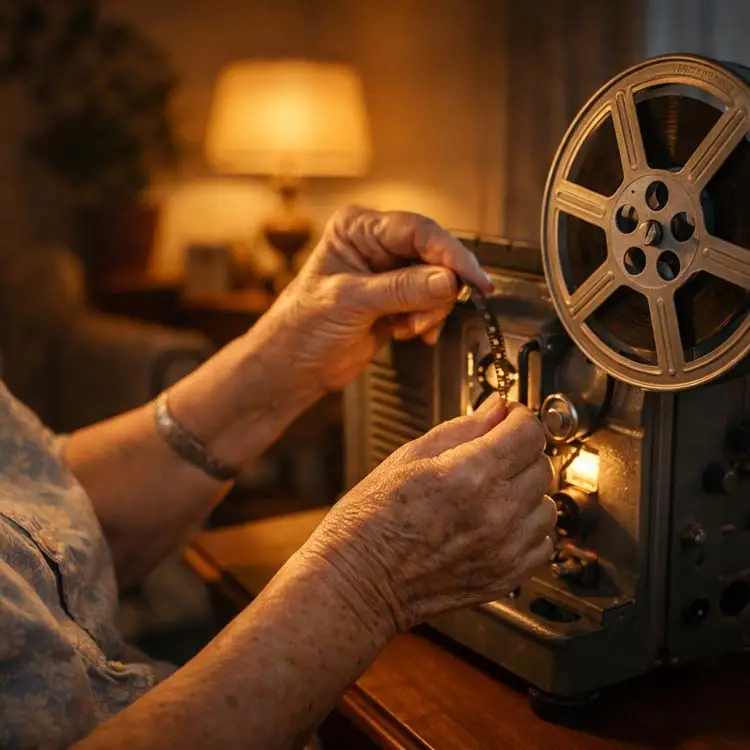
But the real magic lived inside two machines she treated with quiet respect—the slide projector and the 8mm movie projector.
She would dim the lights as if preparing the room for something sacred. The slide projector came first. With a soft mechanical advance, each image appeared on the wall—vacations, birthday cakes, familiar faces caught mid-laugh. The room grew quieter with every click, as if everyone understood they were being given permission to visit another time.

Then came the 8mm movie projector.
It made a different sound. A steady whir. Purposeful. Alive.
She would carefully thread the film through the reels, her hands steady from years of practice. When the light flickered on, the wall no longer held still images. It moved.
There we were—past birthdays, Thanksgiving dinners, Christmas mornings, and ordinary afternoons nobody realized were important until they were. Wrapping paper being torn open. Candles being blown out. People who were younger, healthier, and still entirely themselves.
No one spoke much while those films played.
We weren’t watching strangers. We were watching our own lives being returned to us.
The slide projector and the movie projector were pure entertainment, but not in the way modern screens understand entertainment. They didn’t distract you. They reminded you.

Grandma Cooper never rushed those evenings. She let the reels turn at their natural pace, trusting that memories knew exactly when to arrive.
And when the film ran out, the room stayed quiet for a moment longer, as if everyone needed time to return to the present.
She would simply smile, switch off the projector, and turn the lights back on—never saying a word about what had just been given back to us.
She didn’t need to.
She understood that memories, like the machines that carried them, worked best when treated with care.
Earning the Right to Sit Still
Grandma Cooper believed comfort should be appreciated, not assumed.
She kept folding TV dinner trays stacked neatly beside the couch. They were not used casually. They were privileges.
If you wanted to eat in front of the television, you first had to mow the lawn.
Her manual push mower waited in the garage. It had no motor. No shortcuts. Just spinning blades and the steady rhythm of effort.
Mowing her lawn was not punishment. It was preparation.

When the work was finished, and the grass lay in neat, even rows, she would unfold a TV tray and allow you to sit down in front of the television with your dinner.
The tray wasn’t just holding your plate. It was holding the reward you had earned.
She understood something modern life often forgets—that rest feels different when it follows effort.
The Things That Were Never Really Obsolete
Many of those objects are gone now. Rotary phones. Carbon paper. Slide projectors. Phone books stacked for practical reasons no engineer ever imagined.
They have been replaced by devices smaller, faster, and infinitely more capable.
But what those machines cannot replace is the patience those tools required. Or the intention. Or the quiet satisfaction of solving problems with what you already had.
Grandma Cooper never chased technology. She used what she needed, when she needed it, and never once believed newer meant better.
She believed usefulness had nothing to do with age.
And sometimes, when I see an old rotary phone sitting silently on a shelf, I don’t see something obsolete.
I see something that once connected people in ways that required them to stay awhile.
Grandma Cooper would have understood that perfectly.
YOU MAY ALSO LIKE:
Grandma Cooper – The Original Alice Cooper




Leave a Reply