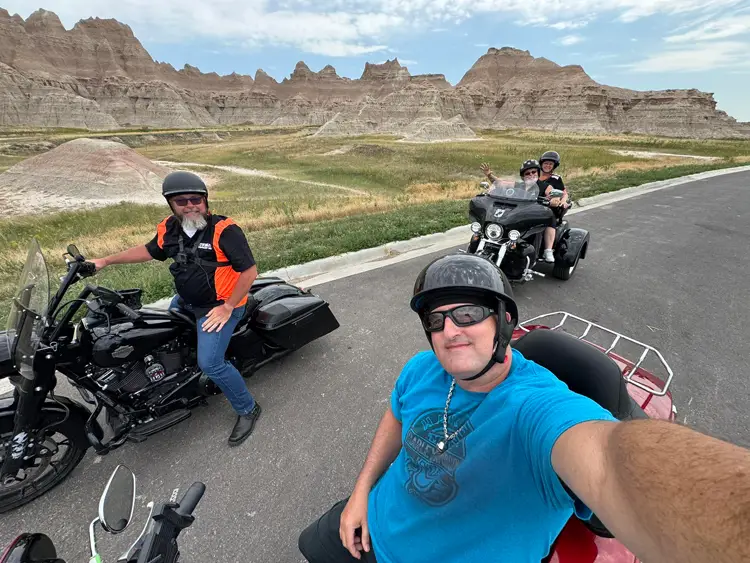
For years, I’d heard whispers about the South Dakota Badlands—jagged peaks rising like a fortress from the prairie, colors shifting with the sun, and a wild beauty unlike anywhere else in America. Yet somehow, I never made the trip. That changed during our recent journey to the Sturgis Motorcycle Rally. On our way, my wife asked me, “Why do they call it the Badlands?” I realized I didn’t know. That curiosity set me on a path to uncover the history, geology, and mystery of this extraordinary place. What I discovered made our visit unforgettable.

The Story Behind the Name “Badlands”
The term Badlands comes from the Lakota Sioux, who called the area “mako sica”—meaning “bad lands”—because of its extreme temperatures, scarce water, and rugged, impassable terrain. French-Canadian fur trappers later echoed this sentiment, calling it “les mauvaises terres à traverser” (“bad lands to travel across”). To early travelers, this was a hostile, unforgiving place. Today, it’s recognized as a rare geological masterpiece worth crossing the country to see.

A Landscape Carved by Time
Badlands National Park stretches over 244,000 acres of sharply eroded buttes, pinnacles, and spires, contrasting with the vast prairie that surrounds them. Millions of years of deposition and erosion sculpted the landscape into the layered formations we see today. Each stripe of sediment tells a story:
- Light gray layers of volcanic ash from ancient eruptions.
- Reddish-brown bands of iron-rich soils.
- Golden tones from ancient river deposits.
Wind and water continue to reshape the Badlands at an astonishing pace—eroding about one inch per year—meaning the formations are constantly changing.

Fossils & Prehistoric Life
The Badlands are one of the world’s richest fossil beds, preserving remains of ancient creatures like three-toed horses, saber-toothed cats, and rhinoceros-like mammals that roamed here 30 million years ago. Even today, paleontologists uncover new discoveries that deepen our understanding of prehistoric North America.

The Human Connection
The Badlands hold deep cultural significance for the Lakota Sioux, serving as hunting grounds and spiritual spaces for generations. The U.S. military history of the area is equally complex—nearby Pine Ridge Reservation bears witness to the struggles and resilience of Native communities. In 1939, the area was first designated as a National Monument, and in 1978, it officially became Badlands National Park, protecting both its natural wonders and cultural heritage.

Visiting the Badlands – What to Expect
When you step into the Badlands, it’s like entering another world. The views along the Badlands Loop Road are breathtaking, especially at sunrise and sunset when the formations glow with golden light. Hiking trails like Notch Trail and Door Trail allow you to walk right into the heart of the formations. Wildlife is plentiful—bighorn sheep, prairie dogs, and bison roam the park freely.
If you’re visiting during the Sturgis Motorcycle Rally, the ride through the Badlands is an unforgettable detour. The winding roads, open skies, and surreal landscapes create a sense of freedom that’s hard to match.

Why the Badlands Matter Today
In an age of instant information and digital overload, the Badlands stand as a reminder of the raw, unfiltered power of nature. They challenge us to slow down, to look closely, and to appreciate the forces that shaped our planet over millions of years.

Final Thoughts
Standing in the Badlands, I felt humbled. What was once considered an obstacle to be avoided is now one of America’s most treasured landscapes. From the Lakota heritage to its fossil-rich cliffs, the Badlands are a living museum of time. If you’ve ever thought about visiting—don’t wait. The land is changing every day, and the best time to see it is now.
YOU MAY ALSO LIKE:
Random RV Thought: Car Envy at Rest Area


Leave a Reply